


Address Newsletter
Our weekly digest on buying, selling, and design, with expert advice and insider neighborhood knowledge.
George Sarkis is trying to sell a “unicorn.”
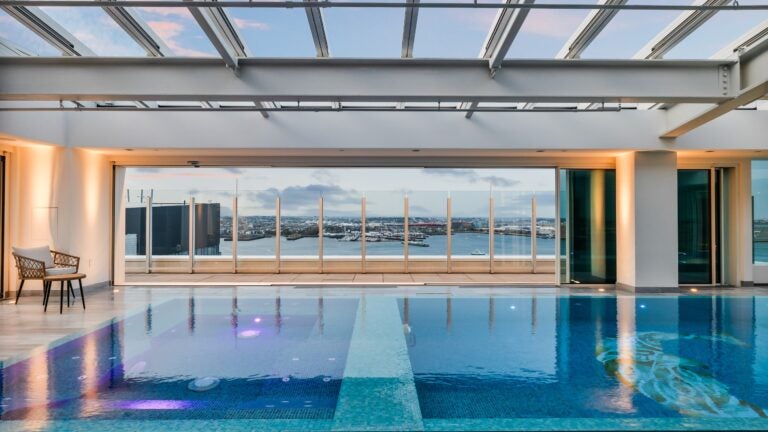
That’s what he calls the grand penthouse at the St. Regis in the Seaport. Listed at $44.5 million, the unit has a double-height great room with a curved floating staircase that has glass railings and its own indoor pool with a retractable roof.
It’s the most expensive listing in the state and has been on the market for over 300 days. But selling a niche property like a multimillion-dollar glass penthouse — or a home with an airstrip or a horse barn — requires patience and a level of research that rivals a police investigation to find the right buyer.
“You have to be like a CIA agent. It’s like a reporter’s job,” said Sarkis, CEO and cofounder of The Sarkis Team at Douglas Elliman. “We have to dig so deep.”


The average buyer is not working with that kind of budget, so Sarkis goes over lists of the most influential and wealthiest people in Boston with a fine-tooth comb. With Boston evolving more into a global market, he also targets out-of-town buyers, reaching out to agents he’s close with in Los Angeles, Aspen, Manhattan, and Palm Beach, and asks if they have any potential buyers in mind. Along with his team, Sarkis finds out who the high rollers are and specifically targets people who own boats and helicopters. They attend boat shows and Yacht Week, and build relationships with yacht brokers and jet companies over several years, referring them business, hoping they’ll one day maybe get a referral back.
Ultraluxury is certainly a niche market, but it’s not always the price tag that makes a listing a “unicorn.”
In 2023, Ellen Sebastian of William Pitt Julia B Fee Sotheby’s International Realty scored the listing for a 58-acre property in Bristol, Conn., that boasted the only FAA-approved paved airstrip in the state.


Immediately, Sebastian sprang into action. She reached out to her network of Sotheby’s brokers in Miami who specialize in aviation properties and researched all those currently listed in the state. She consulted other New England agents who had sold or currently were marketing properties with airstrips, pored over top aviation publications and classified ad platforms, and contacted a local pilot whose children went to school with her kids. She enlisted him to help spread the word and marketing materials to people who use the small plane airports in the area.
“I wanted to get a plane for my video,” said Sebastian, but the pilot wasn’t currently flying. Instead, Sebastian had her staff make a video that looked like a plane was taking off down the airstrip. A shorter version of the video went viral on the brokerage’s website, racking up 3.8 million views and scoring the property press coverage in places like the New York Post and the Hartford Courant.

The home didn’t sell the first time around; they relisted it at a lower price, and it went into contract by January of 2025. Ultimately, the buyer wanted to keep the airstrip because his brother was a pilot, but he and his fiancée wanted to use the land to have their own Christmas tree farm. Plus, there were the two 400-pound pet pigs they wanted plenty of space for. Sebastian said having patience for a longer sale like this one is part of selling a niche property.
“When you’re looking for a very specific buyer, I try to set the expectation that it could take a while,” said Sebastian.

Sheila Brady-Savard, broker and co-owner of Northbound Realty Co., has her own niche: horses. A former head trainer at a farm in Grafton, she went on to coach equestrians at Boston College for over a decade.
Last year, she had a listing in Northborough for a post-and-beam saltbox on 4 acres with a three-stall barn that included a tack room and hayloft. Immediately, Brady-Savard got to work, reaching out to her resources within the horse community. She posted the home on niche websites, like HorseProperties.net. Facebook groups also play a role — and often a free one. She shared the property in groups like Massachusetts Horse People and Horse Lovers of Massachusetts, which “all the horse people in New England follow.”
By October, the property sold for $945,000. In a unique twist, the people who bought it aren’t horse people, which Brady-Savard says is a good reminder that you can’t be so committed to your niche that you can’t look outside it.
“If you’re selling something very distinctive, it doesn’t necessarily mean that the buyer profile you’ve built in your head is actually who’s going to purchase it,” she noted.
Certainly, technology plays a significant role in a brokerage’s ability to target the right buyer. Advanced software, like the popular platform forewarn, allows agents to look up everything from property records to what kind of cars potential buyers drive. A brokerage’s email list is worth its weight in gold, and its website often needs to be laser-focused to bring in buyers through its use of Google AdWords.
But ultimately, Sarkis believes there’s nothing better than tried and true word-of-mouth.
“We do it the old school way,” he said. “We want to get on the phone and talk to people.”

Our weekly digest on buying, selling, and design, with expert advice and insider neighborhood knowledge.




Be civil. Be kind.
Read our full community guidelines.To comment, please create a screen name in your profile
To comment, please verify your email address