What to know about Donald Trump’s visit to New Hampshire on Monday
The president is expected to announce his plan for addressing the opioid crisis—in the state he once called a "drug-infested den."
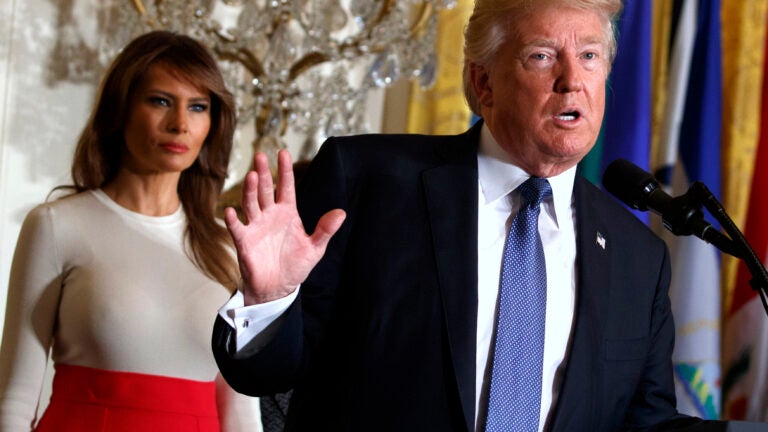
President Donald Trump is returning to New Hampshire this week, and there should be plenty to talk about.
Trump is scheduled to make two stops in the state Monday as he rolls out his long-promised — and potentially very controversial — plan to address the opioid crisis. The visit is slated to be the Republican president’s first appearance in New Hampshire, the state where he won his first primary, since the eve of the 2016 election. It’s Trump’s first visit to the Granite State since he privately called it a “drug-infested den.”
Here’s everything you need to know about Trump’s visit:
The logistics:
As the Concord Monitor reported last week, Trump plans to make two official stops Monday afternoon in Manchester, the state’s largest city.
According to the Monitor, the president is first “expected to make a policy announcement on opioids” during an event at Manchester Community College. He will then visit the Manchester Central Fire Station to get an up-close look at Safe Station, a “first-of-its-kind program” in which people battling drug or alcohol addiction can safely seek help at one of the city’s 10 fire stations without fear of arrest.
Trump praised the Safe Station program last October.
A senior White House official told CNN that First Lady Melania Trump will also make the trip, adding that the issue of opioids is “really the only policy issue the two of them have tackled together.”
What to expect:
White House advisor Kellyanne Conway told WMUR on Sunday that Trump will use the New Hampshire visit to announce his long-awaited plan to address the country’s opioid epidemic. Conway said the plan will emphasize “three main fronts: prevention and education, treatment and recovery, and law enforcement and interdiction.”
According to NBC News, the plan includes tougher punishments for drug dealers, including the potential use of the death penalty. Politico first reported last week that the White House was finalizing a plan calling for the death penalty to be used in “certain cases” when opioid dealing and trafficking (including fentanyl-related) is directly responsible for death.
Trump has recently and repeatedly floated the idea that drug dealers should pay “the ultimate penalty.”
“You kill 5,000 people with drugs because you’re smuggling them in and you are making a lot of money and people are dying. And they don’t even put you in jail,” he said at a political rally in Pennsylvania earlier this month. “That’s why we have a problem, folks. I don’t think we should play games.”
Critics say there is no evidence that executing drug dealers would effectively address the opioid crisis and that the policy could actually make it more difficult to imprison traffickers. Sen. Ed Markey called it an “extreme” proposal that would “perpetuate a harmful stigma associated with opioid use disorders and divert attention from meaningful conversations and progress on expanding access to treatment, recovery, and other public health initiatives that are critical to saving lives.”
“Patients and families suffering in this opioid crisis don’t need toughness, they need treatment,” the Massachusetts Democrat said in a statement last week.
Conway told WMUR that a single proposal shouldn’t distract from the rest of the plan, which reportedly lays out how the Trump administration thinks the $6 billion recently appropriated by Congress to address the drug crisis should be spent.
The backdrop
New Hampshire is one of the state’s hit hardest by opioid addiction.
According to the Centers for Disease Control and Prevention, the state ranked third in the nation — behind only West Virginia and, barely, Ohio — for the most overall drug overdose deaths. It also ranked first in the rate of deaths related specifically to synthetic opioids, such a fentanyl. In a University of New Hampshire poll last year, 53 percent of residents said that drugs were the biggest problem facing the state. It the first time in the poll’s history a single issue has been cited as the most important problem by a majority of respondents.
But while New Hampshire seems an appropriate place for Trump to announce his new opioid plan, the president has recently been at odds with local elected officials when it comes to the issue.
Trump was highly criticized by Republican Gov. Chris Sununu and the state’s Democratic Congressional delegation last fall after he reportedly called New Hampshire a “drug-infested den” in a phone call with the president of Mexico, as well as for the administration’s lack of action on the nationwide epidemic.
Sununu’s office told WMUR on Friday that the governor plans to meet Trump upon his arrival and hopes the president will support changing the way the government distributes money to states to combat the opioid crisis, so that particularly affected states, like New Hampshire, can receive more funding.
“Gov. Sununu hopes the president will acknowledge that states impacted the most by the opioid crisis should receive assistance proportionate to the size of the problem, enabling New Hampshire to tackle this crisis head-on,” spokesman Benjamin Vihstadt said in a statement.
Following Trump’s State of the Union in January, Sen. Jeanne Shaheen said she appreciated Trump’s continued attention on the opioid issue, but added that “words are not enough.”
“The President must finally begin fulfilling his promise to deliver treatment resources,” Shaheen said in a statement at the time. “Over the past year, President Trump has only devoted lip service to respond to the opioid epidemic.”