
How a Black-owned condom brand pitches itself as the right fit
To distinguish itself in a competitive market, B Condoms posts sex and wellness tips online, many of them explicit.
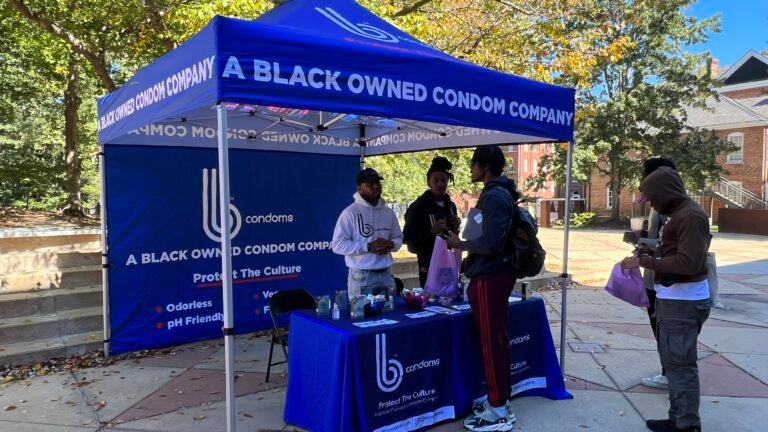
Jason Panda, who grew up in Brockton, cares deeply about branding. During a recent video interview, the logo for his company, B Condoms, was visible in no fewer than four places: on a blue wall behind him in an Atlanta warehouse, on his white T-shirt, on a condom package that just so happened to be within arm’s reach and on a cornhole board in a nearby storage room.
Just as important is where he hides the logo. His company’s Instagram page features explainer-type posts with titles like “8 Things Women Really Want in Bed” and “Let’s Normalize Laughing During Sex” — two of the more printable headlines from the account. The final slide of each post features a photo of condom boxes with the words “A Black-Owned Condom Company” in bold letters above them, underlined in red.
“You may not know about us, but when you go through those slides because they’re interesting, they’re captivating, they bring you in,” Panda said. “When you hit that last slide, you’re like, ‘Oh wow, they’re a Black-owned company.’”
In recent months, the brand has signed deals with Walmart, Target and a majority of CVS drugstores, the company said. The stores are physical spaces for what Panda, 43, calls the “David and Goliath” struggles that he’s been fighting since founding B Condoms in 2011. Its three biggest competitors — Durex, Trojan and Lifestyles — are owned by companies that are worth billions; B Condoms is independently owned.
Beyond B Condoms’ platinum packaging — an implicit riposte to Trojan’s signature color (“Gold is old,” Panda said) — its marketing is notably different from that of its competitors. According to Panda, the brand is predominantly focused on appealing to Black Americans, with Instagram posts that discuss sexuality and sexual wellness in frank terms. Among the account’s roughly 200 posts are oral sex advice, a post explaining that flirting does not equate to consent, and a video in which interviewees recall their first orgasm.
“I think that they are focusing on pleasure education,” said Goody Howard, a sex educator in Dallas. She said she first heard of B Condoms when Panda emailed her about a decade ago to promote it. “I think Trojan does a kind of good job about insinuating pleasure, but B Condoms is actually giving you actionable items: ‘This is how you do this.’”
B Condoms has focused its energies on its Instagram, where it has at least 25,000 more followers than Trojan’s and Durex’s U.S. accounts.
The emphasis on social media marketing makes sense: Instagram is not regulated as tightly as television and radio are, and it offers the possibility of more direct engagement with potential customers. And as a digitally native brand, B Condoms may have an edge on competitors that were already decades old when social media became ubiquitous. (A representative for Durex said in a statement that the brand “has been heavily active in social media marketing for more than a decade.”)
As it did for millions of others, social media took on increased importance during the pandemic for condom brands as well, according to Mia Xu, a graduate student at the NYU School of Global Public Health.
“Especially during COVID, brands realized that they had great reach and potentially a lot more buyers because everyone was at home,” Xu said. “Basically every single brand really pushed out ads on a weekly basis. Before, they were posting once a week to once a month.”
Xu was the lead author of a study that found that posts pertaining to sex were a positive predictor of likes on Instagram and YouTube, and providing sexual health education had a positive association with likes on Instagram. According to the study, “the sexual health education and resources provided by condom brands have significant reach and positive reception.” Xu noted that B Condoms was “talking basically about every single aspect of sexual health — even ones that are not related to condoms.”
The largest three condom brands all have sex-positive posts ranging from informative to playful (a recent Durex tweet: “Want to seggz?”) that date well before March, when Panda says the B Condoms account started posting raunchier Instagram slides. Its messaging is generally more reliant on sex education, though: Whereas Trojan’s and Durex’s feeds are sprinkled with collaborations with social media influencers and celebrities, the B Condoms feed features video clips from community and historically Black college and university outreach events that Panda, a Morehouse alumnus, helps organize.
With its small 10-person staff and comparatively tiny budget, B Condoms chooses to focus its resources on Black Americans, Panda said, citing the disproportionately high rates of HIV and teen pregnancies among people of color.
Panda said he spent his formative years in Brockton, Massachusetts, south of Boston, watching those issues in real time. (At his high school, there were “so many kids with kids,” Panda recalled.) Another inspiration was a conversation about the effects of HIV on Black Americans that he had with his mother, who ran a drug- and alcohol-detox facility. Panda said that after feeling unfulfilled during his time as a corporate lawyer in New York, he quit and founded B Condoms with two other Morehouse alumni. In those early days, he ran the operation from his apartment.
“I never saw condoms as a career, but after I got into it, it made perfect sense,” he said.
Without a model for a successful Black-owned condom brand, Panda said he spent a good portion of B Condoms’ existence teaching himself “every aspect of this business.” He recalled that in the earlier stages he used a storage facility in the Bronx because a warehouse was too expensive, and that he would place the condoms in bodegas free of charge because he couldn’t find any buyers. By the time he moved operations to Atlanta, in June 2020, his co-founders had left the company.
Panda said B Condoms may have to tone down its Instagram posts as the brand becomes “corporate.” During the interview, he declined to reveal who was actually responsible for the brand’s recent posts, saying that he was worried a larger company might pluck them away with the promise of a better salary.
“We’re rewriting the rules with a lot of this stuff,” Panda said.
This article originally appeared in The New York Times.



To comment, please create a screen name in your profile
To comment, please verify your email address
Conversation
This discussion has ended. Please join elsewhere on Boston.com