
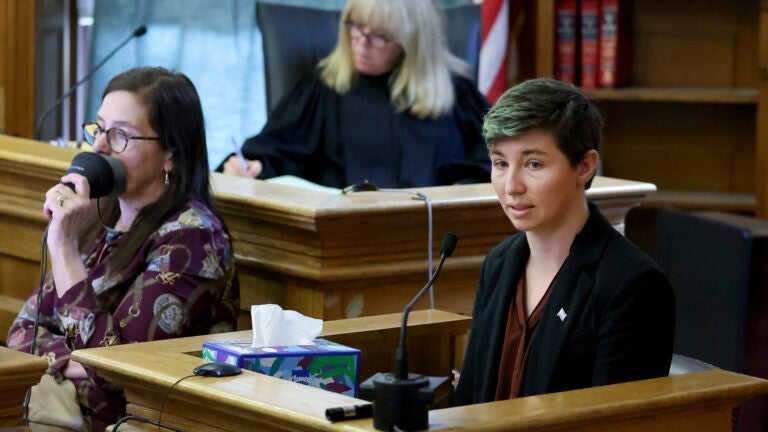
The latest on the Karen Read murder case
Sign up for our Extra newsletter to get updates from the retrial and other breaking news alerts delivered to your inbox.
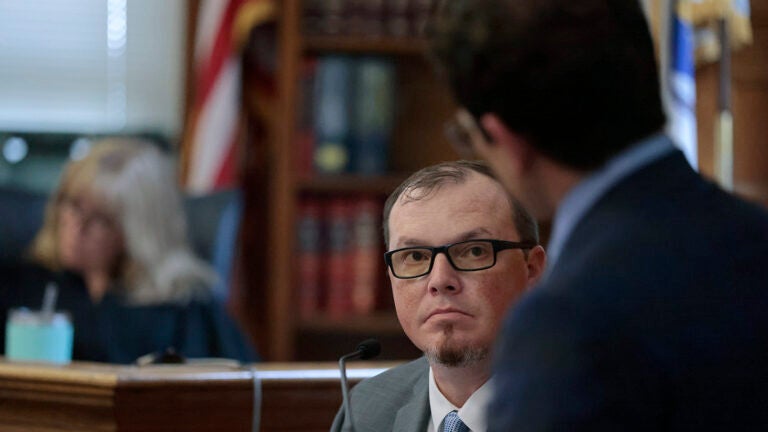
On the stand Monday:
Defense attorney Robert Alessi began his cross-examination of Aperture LLC expert Shanon Burgess by putting him in the hot seat, hammering the need for reliability, honesty, and unbiased investigation in digital forensics.
He alleged Burgess referred to John O’Keefe’s death as a “homicide” in a January report, months before completing some of his scientific testing in Karen Read’s case. Alessi further accused Burgess of operating under the assumption that Read had backed her SUV into O’Keefe, her boyfriend of two years.
“No, that would be incorrect,” Burgess testified.
In one particularly tense line of questioning, Alessi turned his attention to Burgess’s professional credentials, particularly his lack of a bachelor’s degree. He noted Burgess’s staff bio on Aperture’s website, some iterations of his curriculum vitae, and his personal LinkedIn page offer conflicting — and potentially misleading — information about whether Burgess had actually graduated with a bachelor’s degree.
“So a key aspect of your credentials, whether or not you have obtained a bachelor of science, is incorrect in more than one document that I have presented here today, correct?” Alessi prompted.
Burgess ultimately acknowledged some of the documents provided by the defense contained “errors.” Later in his cross-examination, Alessi confirmed Burgess began pursuing a bachelor’s degree 17 years ago, in 2008.
“And you have not obtained it as you sit here today?” he pressed.
“That is correct,” Burgess replied. He chalked the discrepancies in the documents up to errors or misinterpretation.
“Are you familiar with the phrase ‘academic dishonesty’?” Alessi later asked in a pointed jab.
“Yes,” Burgess answered. “I am.”
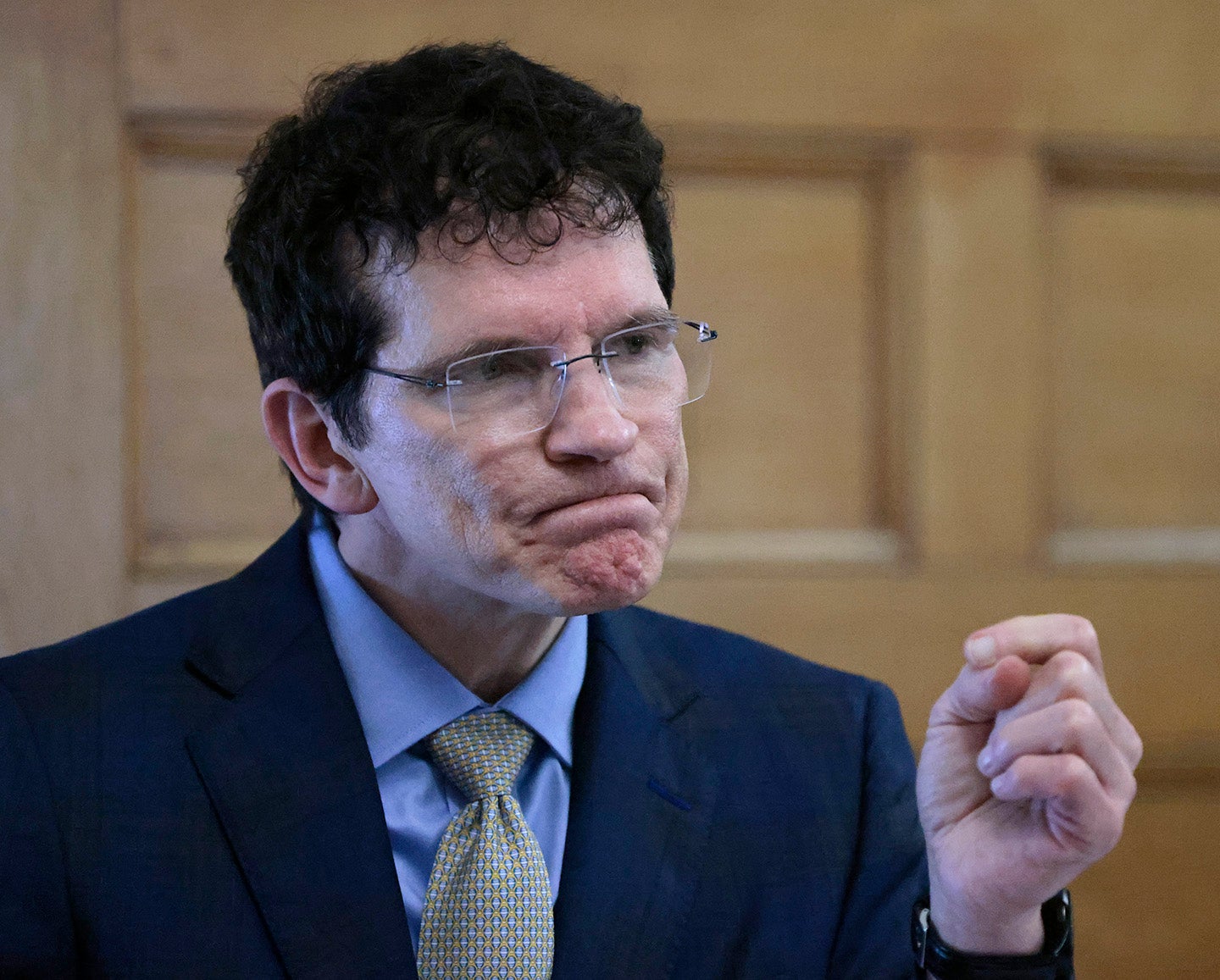
SUV ‘triggers’ come into focus
Elsewhere in his questioning, Alessi reminded jurors Burgess had mixed up bytes and bits in his initial protocol for additional testing of data from Read’s SUV.
Burgess testified that Aperture tried an “in-vehicle acquisition” in December 2024 in an attempt to pull additional data from Read’s SUV. However, he explained the firm sought to pull data directly from the microSD card in question after it was unable to reinstall and test the car’s infotainment and telematics modules.
Answering a subsequent question from Alessi, Burgess confirmed there was no scientific literature linking Read’s particular Lexus model and the methodology he used.
Alessi later turned his attention to the two Jan. 29, 2022, “Techstream” events on Read’s SUV that Burgess testified about on direct examination. Also described as “triggers,” the events in question include a three-point turn and a “backing maneuver,” Burgess explained.
“Did anybody from the commonwealth ask you in your Jan. 30, 2025, report to not discuss your work in connection with the Techstream … events?” Alessi asked.
No, Burgess replied. He did, however, confirm the two trigger events were not part of his January report.
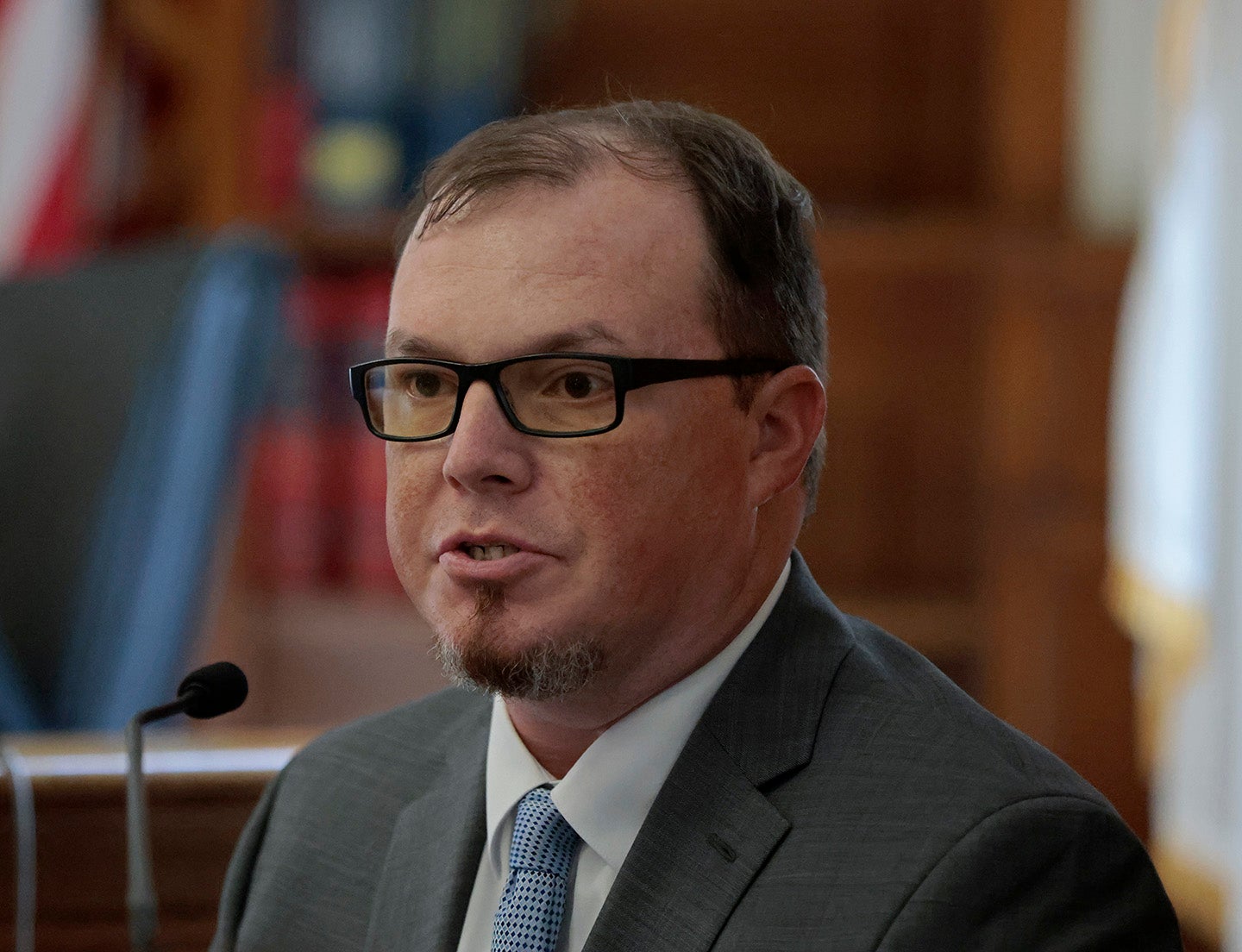
Burgess’s May 8 report under fire
Burgess delved further into the Techstream events in a supplemental report issued May 8, after Read’s retrial was already underway. Burgess disputed Alessi’s allegation that he had “enlarged” the clock variance between Read’s SUV and O’Keefe’s cellphone, which Burgess testified was between 21 to 29 seconds.
He told jurors the supplemental report included “clarifications” but did not change his original analysis. He was also adamant he prepared the report on his own, though Alessi noted Burgess opened the document by saying the additional analysis was completed “pursuant” to special prosecutor Hank Brennan’s request.
“This wasn’t done on your initiative,” Alessi charged.
Burgess said the line was an error, a copy-and-paste “holdover” from his previous report. He confirmed he didn’t review the accuracy of what he was pasting, adding, “I did not think it was significant.”
“Oh, you don’t think it’s significant, sir, that the matter is in the middle of a trial and there’s a request for a new report after testimony has occurred in that trial?” Alessi demanded. “You don’t think that’s important?”
Judge Beverly Cannone sustained an objection from prosecutors before Burgess could answer.
Later, Burgess explained he prepared the new report in response to defense expert Matthew DiSogra’s March claim about clock variance. While Burgess initially planned to address the claim in his testimony, he said he ultimately decided to issue the supplemental report.
He testified he reached out to Massachusetts State Police Det. Lt. Brian Tully for a full set of location data before issuing the May 8 report, though he said Tully did not mention during that conversation that Read’s trial had already started.
“At any time, has anybody from the commonwealth had a discussion with you” relative to the January or May reports “about keeping flexible the timelines for any events in this case?” Alessi asked.
“No, sir,” Burgess testified. He did, however, recall contacting Brennan on May 7 to discuss the contents of the new report.
Burgess said he did not watch the testimony of prosecution digital forensics experts Jessica Hyde and Ian Whiffin, nor did he receive summaries of their testimony. He also testified he was never told his analysis was consistent or inconsistent with the findings offered by Hyde and Whiffin.
Burgess said he was aware his Aperture colleague and fellow prosecution expert, Judson Welcher, created a PowerPoint about his work on Read’s case. He told jurors he reviewed some of Welcher’s slides after DiSogra included them in a separate filing.
Following some additional questioning about Burgess’s knowledge of Whiffin’s report, Cannone dismissed jurors for the day shortly before 4 p.m. Burgess will return to the stand for additional testimony Tuesday.

“Essentially all” user data from Karen Read’s SUV was missed during an initial download of the vehicle’s chips, according to digital forensics expert Shanon Burgess.
The Aperture LLC witness told jurors he specializes in vehicle and cellphone forensics and first began working with prosecutors on Read’s case in October 2024. He testified he had two theories to explain the missing data from Read’s SUV: a bad read during the chip-off process, or a chip that had been overlooked entirely.
Burgess explained he made an initial misinterpretation that “led me to believe that there was a partial download of those initial chips.” He acknowledged he mistakenly wrote an uppercase “B” for bytes in some of his early notes when he should have used a lowercase “b” for bits, a different data unit.
“Upon further review and research, I discovered that there was an SD card, or a microSD card, that was on the circuit boards at one of the modules that was never looked at,” he added.
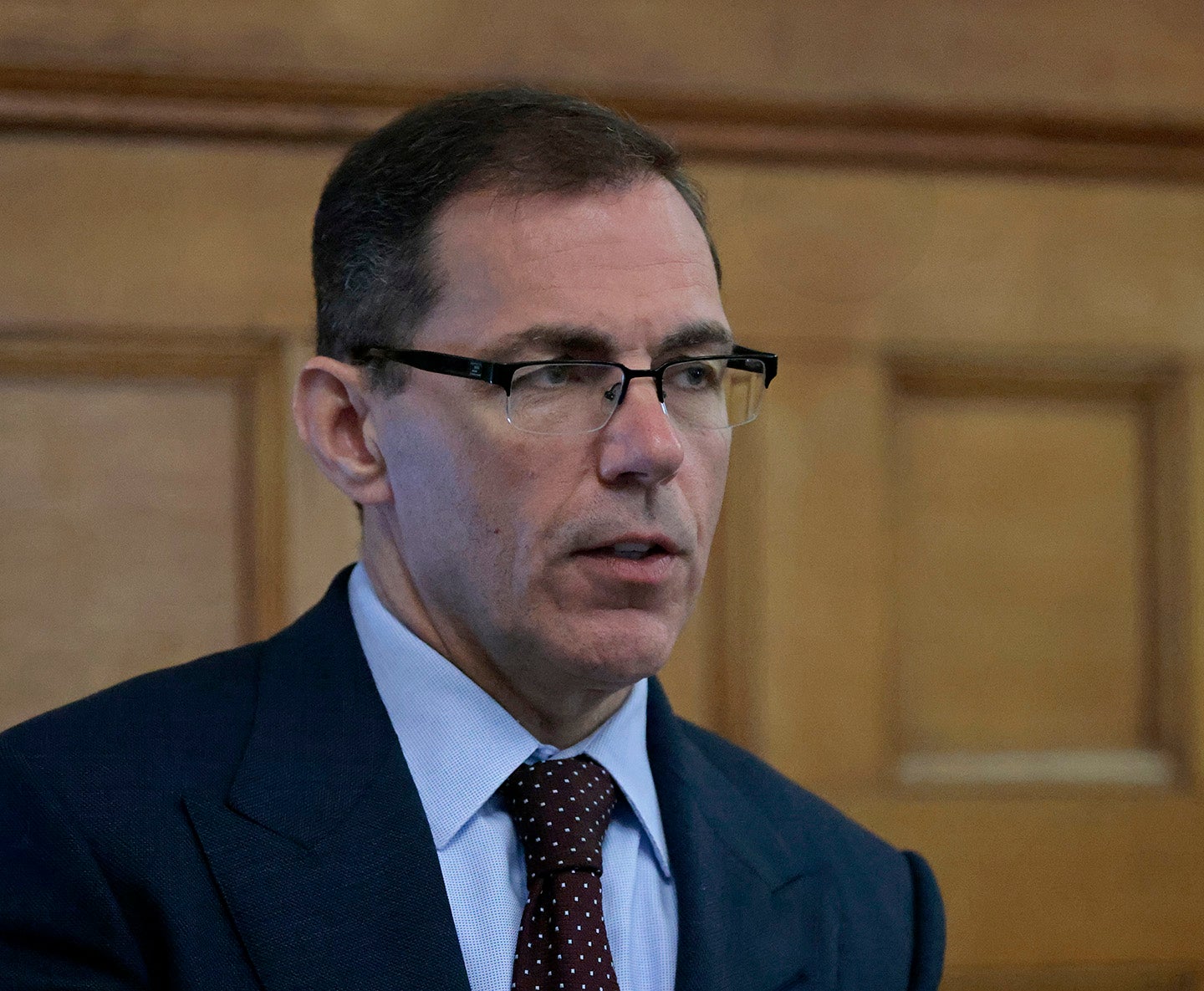
While some devices, like phones, have USB ports for easy data downloading, “That’s not the case with vehicle modules,” he explained. “So you have to remove these chips from the board, and then you’ve got programmers or readers that will read the data from these chips.”
Special prosecutor Hank Brennan displayed photos of circuit boards plucked from Read’s SUV, and Burgess pointed out damage he said occurred during the initial chip-off. He said he believed the data missing from Read’s SUV might have been housed on the microSD card he discovered, which didn’t appear to have been removed from the board.
Most of the time, SD cards in vehicle modules are locked and require a passcode to uncover the data housed within, he explained, adding that bypassing those locks is not a simple process. Burgess testified that Aperture tested his theory of the microSD card on a comparable SUV before attempting to extract the additional data from Read’s vehicle.
Earlier in his testimony, Burgess cited two “Techstream,” or “triggering,” events on Read’s SUV from Jan. 29, 2022, that drew investigators’ attention: a three-point turn and a “backing maneuver.”
He also discussed the timestamps provided by the vehicle’s various modules, noting a “running clock” that works similar to a stopwatch and counts the seconds from when the car starts.
Brennan asked how digital forensics experts could take the “running clock” time and correspond it with the time shown on a wristwatch or iPhone. Burgess explained an expert would need to know the timestamp for the vehicle’s “power on” event to be able to compare it to the “running clock.”
Following the morning recess, Burgess testified about using surveillance video to test the accuracy of the vehicle’s “power on” and “power off” timestamps. He walked jurors through various video clips of Read’s car, including footage showing the SUV backing out of O’Keefe’s driveway seconds after its ignition started at 5:07 a.m. on Jan. 29, 2022.
According to Burgess, Read’s SUV previously powered on at 12:12 a.m. on the 29th and powered off at 12:42 a.m. — the timeframe prosecutors allege she struck O’Keefe outside 34 Fairview Road in Canton.
Those timestamps come from the Lexus’s internal clock, and Burgess acknowledged timestamps will differ between various devices, otherwise known as a “clock variance.” He likened the discrepancy to the difference between the clocks on a kitchen microwave and a phone.
He said digital experts can sync two different clocks by referring to an event captured by both devices, though a clock variance of up to 60 seconds is typical. Burgess testified he initially wasn’t interested in trying to reconcile the clock on Read’s SUV with the clock on O’Keefe’s iPhone, given the generally acceptable variance.
However, he said he looked into the clock variance further after learning that an unspecified PowerPoint presentation had misinterpreted the data. Burgess ultimately used Read’s three-point turn to compare the timestamps from the SUV and O’Keefe’s phone, which was tracking location data through the Waze app at the time.
Burgess confirmed he’d seen a report on O’Keefe’s location data from another prosecution digital forensics expert, Cellebrite’s Ian Whiffin, but testified that he parsed through the data independently. Burgess said his investigation uncovered a variance of 21 to 29 seconds between the clocks on the car and the phone.
With that variance in mind, Burgess determined the “backing maneuver” Read’s SUV made ended between 12:32 a.m. and four seconds and 12:32 a.m. and 12 seconds, based on O’Keefe’s phone data.
He explained the SUV may only capture a partial snapshot of the data if a Techstream event lasts longer than 10 seconds, as the system records the five seconds before and after the trigger.
Judge Beverly Cannone called a lunch recess after Brennan wrapped his direct examination of Burgess around 12:30 p.m. Burgess will return to the stand for cross-examination after the break.
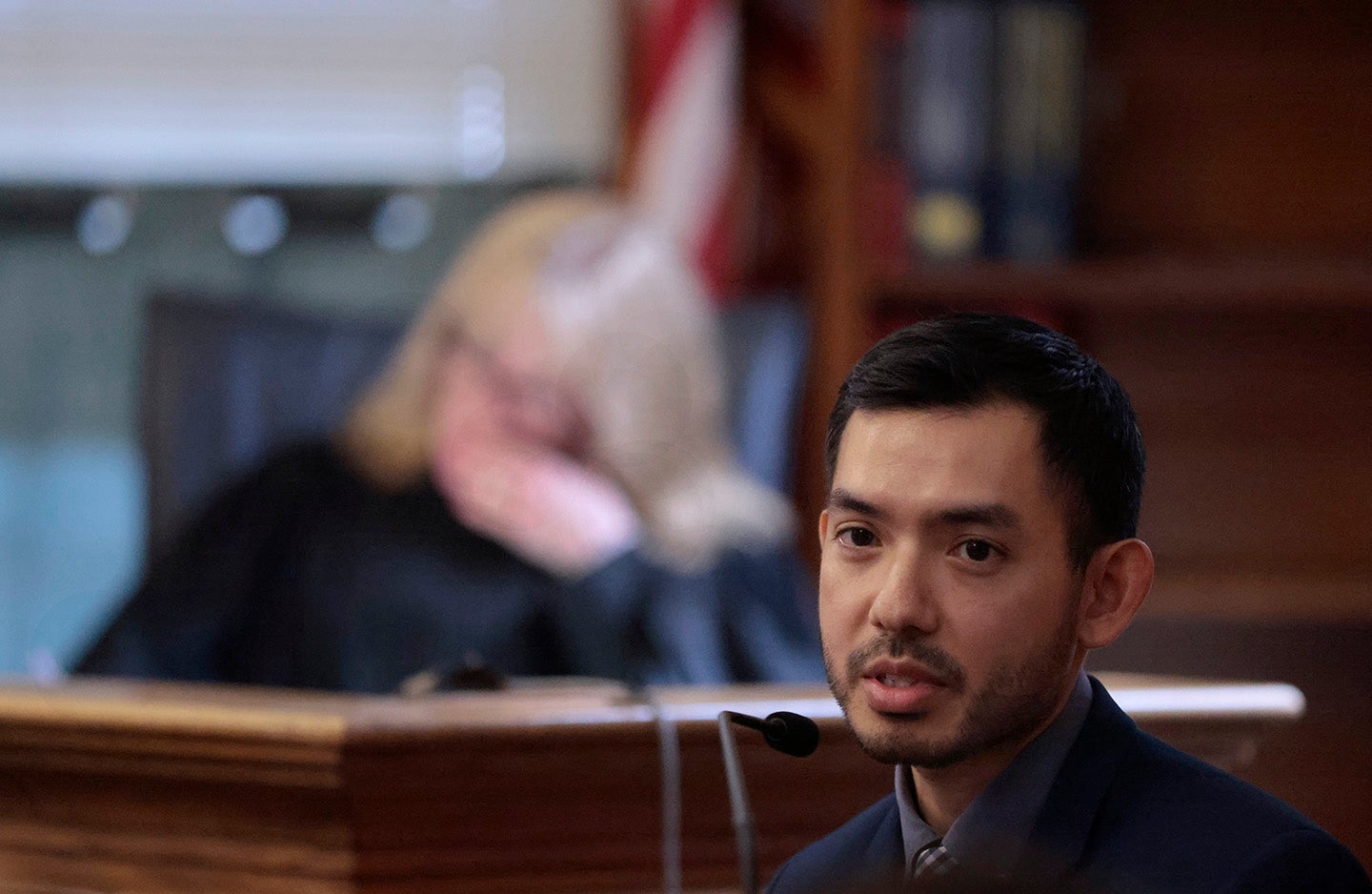
The mitochondrial DNA profile of a hair found on the back of Karen Read’s SUV was consistent with John O’Keefe, DNA analyst Karl Miyasako testified Monday.
Miyasako, who works at Bode Technology, described the process the lab used to compare O’Keefe’s DNA profile with the profile for the hair. Bode also used the forensic mitochondrial DNA database EMPOP to check the hair’s profile against African American, U.S. caucasian, and U.S. Hispanic populations, he explained.
Miyasako testified “with 95% confidence, at least 99.895% of the population can be excluded as being a source of the hair sample.”
“The majority of the population could be excluded,” he added. “However, with John O’Keefe and his maternal relatives, they could not.”
On cross-examination, defense attorney Alan Jackson noted mitochondrial DNA is inherited through the maternal line and shared among maternal relatives. He pointed out the mitochondrial DNA found on Read’s taillight could have come from others in O’Keefe’s family, including his niece and nephew, who lived with him in Canton.
“You’re not sitting here saying that that hair belonged to John O’Keefe?” Jackson asked.
Miyasako confirmed O’Keefe and his maternal relatives could not be excluded as possible sources.
“To a reasonable degree of scientific certainty, you cannot say that hair belonged to John O’Keefe specifically, can you?” Jackson pressed on a subsequent question. “Yes or no.”
“No. With mitochondrial DNA, you can’t say that it is per se an individual person,” Miyasako replied. “So it’s more so the maternal line.”
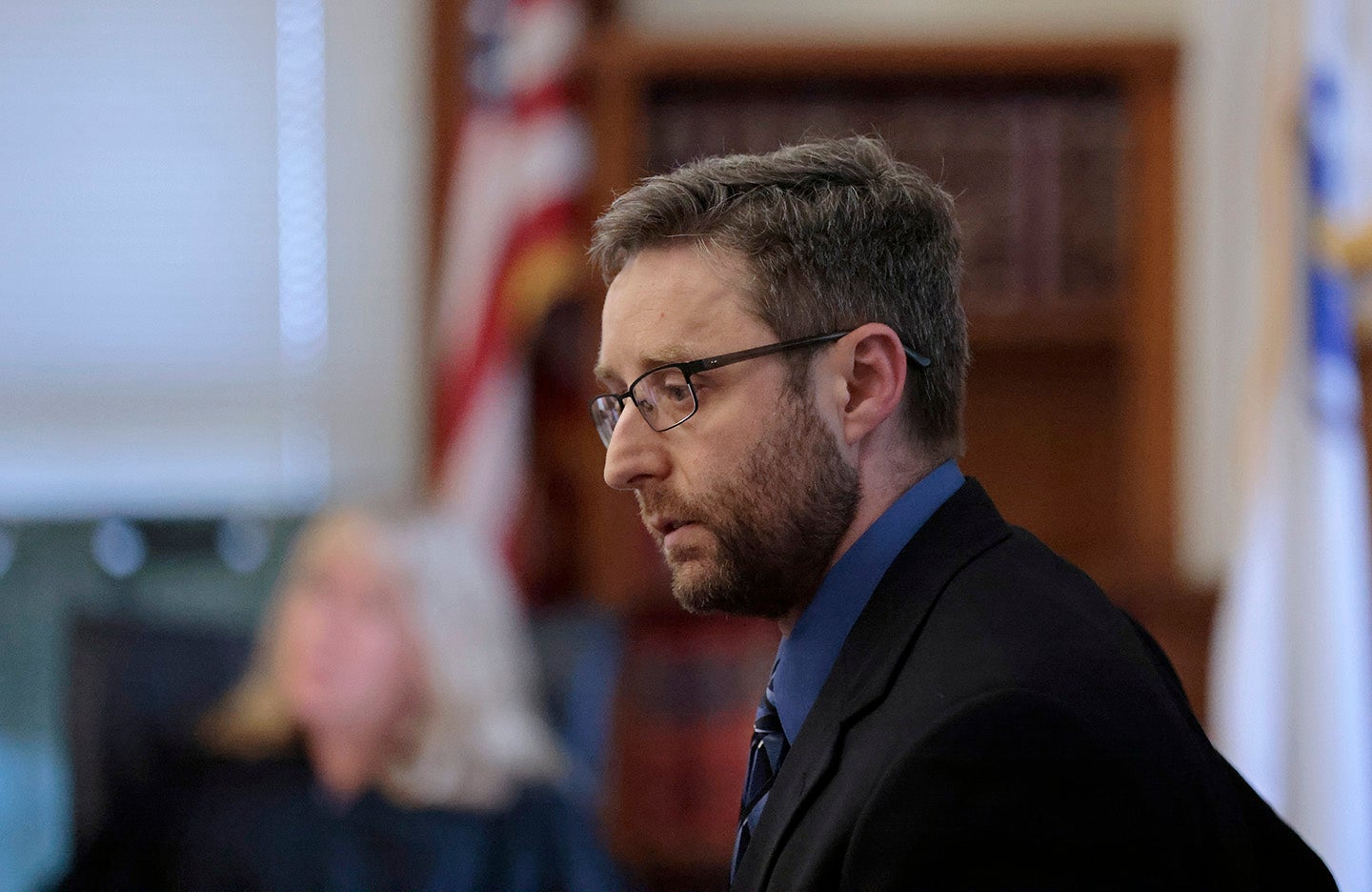
Testing showed “very strong support” for including John O’Keefe in a mixture of DNA found on Karen Read’s taillight, according to a DNA expert with Bode Technology.
Nicholas Bradford told jurors the private lab was tasked with testing several items from Read’s case, including an extract of DNA found on Read’s taillight, an apparent hair recovered from the back of the SUV, and buccal swabs from two investigators on Read’s case, Massachusetts State Police Sgt. Yuriy Bukhenik and ex-Trooper Michael Proctor. According to Bradford, the Massachusetts State Police Crime Lab also provided O’Keefe’s DNA profile for comparison.
He testified O’Keefe was exponentially more likely than not to have contributed to the DNA mixture on Read’s taillight, noting the testing also suggested Bukhenik and Proctor should be excluded as contributors. There was “very strong support” for excluding Bukhenik and “strong support” for excluding Proctor, according to Bradford.
Stepping up for cross-examination, defense attorney Alan Jackson pointed out that Bradford quantified the statistics for O’Keefe’s inclusion in nonillions — a number followed by 30 zeroes — while using tens of thousands to measure support for Proctor’s exclusion.
“Y’all literally, in your job, almost have to make up new numbers,” Jackson joked.
“What we’re talking about here are the relative likelihoods of those two different explanations of the evidence profile,” Bradford explained. That is, whether the DNA mixture from the taillight showed three strangers or Proctor and two other unknown, unidentified individuals.
Answering a question from Jackson, he confirmed he was not asked to compare samples from witnesses Brian Albert and Brian Higgins; Albert’s brother, Canton Police Detective Kevin Albert; or then-Canton Police Chief Kenneth Berkowitz. Read’s lawyers have sought to implicate all four men in their coverup claim.
As for the apparent hair recovered from Read’s SUV, Bradford testified the short tandem repeat DNA analysis results were below the level of detection.
“It’s not unexpected that the shaft of a hair would not give us STR results,” Bradford added. He told jurors Bode decided to test the hair for mitochondrial DNA, another form of DNA that exists in a different part of the cell.
Livestream via NBC10 Boston.
Karen Read‘s murder retrial enters its fifth week of testimony Monday with more witnesses expected on the stand.
Read, 45, is charged with second-degree murder, manslaughter while operating a motor vehicle under the influence, and leaving the scene of a fatal collision in the January 2022 death of her boyfriend, Boston Police Officer John O’Keefe. Prosecutors allege Read drunkenly and deliberately backed her SUV into O’Keefe while dropping him off at an afterparty following a night of bar-hopping in Canton.
But Read’s lawyers have floated an alternate theory that O’Keefe entered the party at 34 Fairview Road and was promptly beaten, attacked by the family’s dog, and tossed outside in the snow. The defense contends Read was framed in a vast law enforcement conspiracy intended to protect the family and friends of homeowner Brian Albert, a fellow Boston police officer.
Jurors last week heard from several forensic scientists, Massachusetts State Police sergeants, the medical examiner who performed O’Keefe’s autopsy, and O’Keefe’s teenage niece. O’Keefe began raising his sister’s children after they lost both parents just months apart, and his niece recalled increasingly frequent verbal arguments between Read and O’Keefe.
According to the teen, just weeks before he died, O’Keefe told Read their relationship “was good, but it had run its course.” Prosecutors have pointed to the couple’s strained relationship as a possible motive for murder.
Dr. Irini Scordi-Bello, a medical examiner with the state’s Office of the Chief Medical Examiner, told jurors she was unable to determine O’Keefe’s manner of death, though she pinpointed the cause as blunt impact injuries to the head and hypothermia.
According to Scordi-Bello, a medical examiner might leave the manner of death “undetermined” when “the circumstances in a case are not entirely known or clear to us, and the information that we have does not support one manner of death over another.” In O’Keefe’s case, she testified there were a number of possible scenarios that could account for the injuries she observed during her autopsy.
Scordi-Bello told jurors there was nothing inconsistent between a laceration on the back of O’Keefe’s head and a fall backward onto flat, frozen ground — the scenario prosecutors have suggested. However, the medical examiner also noted she did not observe any evidence of an “impact site” on O’Keefe’s lower extremities that would corroborate a vehicle collision, such as fractures, bruising, or bleeding.
Two forensic scientists with the State Police Crime Lab —Ashley Vallier and Andre Porto — testified, respectively, that O’Keefe had apparent plastic debris on his clothing and was exponentially more likely than not to have contributed to a mixture of DNA found on Read’s taillight.
Also on Friday, Judge Beverly Cannone allowed in a new report from prosecution expert Shanon Burgess of accident reconstruction and biomechanics firm Aperture LLC. Defense attorneys had sought to block Burgess’s revised report, arguing the expert shifted a crucial timestamp for a “trigger” event on Read’s SUV that occurred around the time prosecutors allege she struck O’Keefe.
“The timing of what’s alleged by the commonwealth is very important,” defense attorney Robert Alessi argued. “The seconds are very important.”
Special prosecutor Hank Brennan said another key Aperture expert, accident reconstructionist Judson Welcher, is expected to testify for the prosecution in the coming days. The ongoing trial is Read’s second. Her first murder trial resulted in a mistrial last July after the jury returned deadlocked.


Sign up for our Extra newsletter to get updates from the retrial and other breaking news alerts delivered to your inbox.


To comment, please create a screen name in your profile
To comment, please verify your email address
Conversation
This discussion has ended. Please join elsewhere on Boston.com