
The latest on the Karen Read murder case
Sign up for our Extra newsletter to get updates from the retrial and other breaking news alerts delivered to your inbox.
On the stand Thursday:
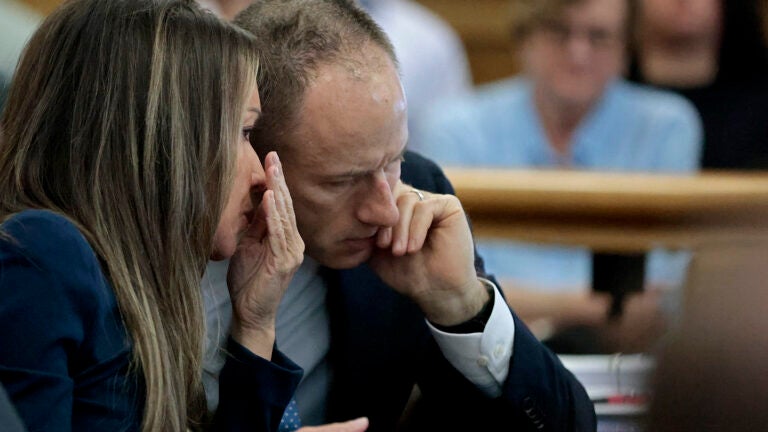
With jurors out of the room, lawyers on both sides argued over a revised May 8 report from one of the prosecution’s expert witnesses, Shanon Burgess of accident reconstruction and biomechanics company Aperture LLC.
Defense attorney Robert Alessi noted Burgess shifted a crucial timestamp in his new report for a “trigger” event that occurred around the time prosecutors allege Karen Read struck John O’Keefe with her SUV. He labeled the change a pretrial discovery violation and asked Cannone to bar the Aperture experts from testifying about the revised finding.
Noting prosecutors have repeatedly accused Read’s defense of trial by ambush, he added, “If there’s ever an example of an ambush, this is it.”
Special prosecutor Hank Brennan pushed back, chalking the issue up to differences in the clocks on Read’s SUV and O’Keefe’s cellphone. He argued prosecutors were “surprised” to receive the report and turned it over to the defense immediately, adding, “It doesn’t change any data whatsoever.”
Judge Beverly Cannone did not immediately issue a ruling. Read’s retrial will continue Friday with additional testimony.
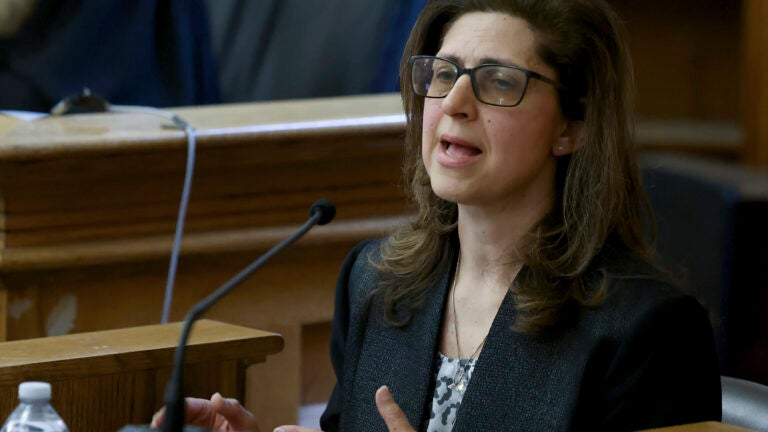
As defense attorney Robert Alessi continued his cross-examination of medical examiner Dr. Irini Scordi-Bello, he turned his attention to John O’Keefe’s internal injuries and their possible causes.
Answering a series of questions from Alessi, Scordi-Bello testified she settled on hypothermia as a secondary cause of death for O’Keefe in part due to hemorrhaging in his stomach lining and pancreas.
Asked about the initial death notification her office received from a physician at Good Samaritan Medical Center, Scordi-Bello said the report made “reference to some sort of altercation or dispute.” Her answer was cut short by an objection from prosecutors, and Judge Beverly Cannone instructed jurors to disregard the response.
Citing that initial death notification, Alessi asked if Scordi-Bello considered whether O’Keefe could have been injured and died somewhere other than the front lawn of 34 Fairview Road, where he was found unresponsive in the snow on Jan. 29, 2022.
“Initially, no,” Scordi-Bello replied.
Alessi also questioned whether something other than hypothermia could have caused the hemorrhaging Scordi-Bello observed in O’Keefe’s stomach and pancreas, such as blunt force trauma or resuscitation efforts.
He asked Scordi-Bello whether hemorrhaging would occur if someone were hooked up to a LUCAS machine for chest compressions, as O’Keefe was. Scordi-Bello testified she doesn’t believe a LUCAS machine causes hemorrhaging to the stomach lining, or mucosa, though she acknowledged it could cause hemorrhaging in the surrounding soft tissue.
She maintained her findings were consistent with hypothermia “in this context, with the gastric findings, the pancreatic findings, and the information that he was found in the snow with a body temperature of 80 degrees.”
Alessi pushed back, and the medical examiner acknowledged her report made no mention of a LUCAS machine. Alessi also pointed out Scordi-Bello’s report didn’t mention Wischnewski ulcers, superficial hemorrhagic spots that can occur in the stomach lining during hypothermia. She explained she identified those spots in her report simply as “gastric hemorrhages.”
Alessi displayed a photo of O’Keefe’s dissected stomach, with Cannone first warning jurors the image could be considered graphic. Scordi-Bello identified small, dark areas of hemorrhaging in O’Keefe’s stomach lining.
Soon after the picture was shown, Cannone called a brief recess at a juror’s request. When the jury returned, Alessi displayed another photo, a medical reference image of a stomach with significantly more hemorrhaging than was present in O’Keefe’s stomach. He asked Scordi-Bello whether there needs to be “a predominance of the stomach covered by the spots” for them to be considered Wischnewski ulcers.
“I think there’s different levels and different grades,” Scordi-Bello replied.
Alessi then asked Scordi-Bello whether, in a majority of cases she’s seen, the ulcers “predominate” or take up more than 50% of the stomach lining. She replied affirmatively and, at Alessi’s prompting, noted only 10 to 15% of O’Keefe’s stomach lining showed hemorrhaging.
Highlighting the bitter winter weather conditions the morning O’Keefe died, Alessi also confirmed the medical examiner saw no signs of frostbite during her autopsy.
“Did you evaluate at all in your autopsy whether Mr. O’Keefe had any injuries consistent with a motor vehicle accident?” he asked later in his questioning.
Scordi-Bello testified she examined O’Keefe’s lower extremities, which is protocol in suspected vehicle collisions, but did not see evidence of an “impact site.” She explained she typically looks for leg fractures, bruising, or bleeding, and added, “I did not observe those things.”
Turning his attention to O’Keefe’s facial injuries, Alessi confirmed O’Keefe’s periorbital ecchymosis, or “raccoon eyes,” couldn’t account for the laceration above his eye or the abrasion on the side of his nose. He also noted neither injury could be explained by someone falling backward and striking their head.
As Scordi-Bello reiterated that she did not determine the cause of O’Keefe’s arm wounds, Alessi asked, “Are those injuries consistent with a dog bite?” However, Cannone sustained an objection from prosecutors.
Special prosecutor Hank Brennan returned for redirect examination, noting the substantial drop between the typical 98.6-degree temperature of a human body and the 80.1 degrees O’Keefe registered the morning he died. Cannone sustained a series of objections to Brennan’s questions about whether O’Keefe’s body showed signs of “freezer burn.”
With Scordi-Bello on the stand, Brennan revisited some of the highlights from the state’s case against O’Keefe’s girlfriend, Karen Read, including the defendant’s alleged “I hit him” remarks. The medical examiner testified she learned of Read’s alleged comments at some point, though she said she was not aware of data and messages recovered from O’Keefe’s cellphone prior to filing her report.
Answering questions from Brennan, Scordi-Bello testified no one ever asked her to change O’Keefe’s death certificate or encouraged her to reconsider her findings. She also confirmed most of the fatal pedestrian crashes she’s seen involve a collision with the front end of a car. She testified that a bruise to the knee could be consistent with a sideswipe impact.
While O’Keefe’s nose abrasion could be consistent with a punch, the wound could also track with injuries from broken glass, sharp plastic shards, and first aid efforts, she confirmed.
“Anything is possible,” Scordi-Bello added, noting she does not have firsthand knowledge of how the nose abrasion occurred.
Peppering the medical examiner with a few additional questions, Alessi pointed out that before he died, O’Keefe had taken omeprazole, an antacid that can be used to alleviate heartburn and the symptoms of stomach ulcers. Alessi asked Scordi-Bello whether the ulcers in O’Keefe’s stomach could have been due to alcohol consumption, rather than hypothermia, and she confirmed it was possible.
Cannone dismissed jurors for the day shortly before 3:45 p.m., telling them Read’s retrial remains on schedule.
John O’Keefe’s official cause of death was blunt impact injuries to the head and hypothermia, according to Dr. Irini Scordi-Bello, a medical examiner with the state’s Office of the Chief Medical Examiner.
O’Keefe’s head injuries were the primary cause of his death, though his body temperature clocked in at 80.1 degrees Fahrenheit the morning of Jan. 29, 2022, she noted.
Scordi-Bello walked jurors through O’Keefe’s autopsy photos Thursday, noting an array of injuries that ranged from swollen eyelids to skull fractures and wounds spanning O’Keefe’s right arm.
Before special prosecutor Hank Brennan displayed the autopsy photos for the jury, Judge Beverly Cannone warned jurors the images may be unpleasant or graphic. Jurors seemed to study the photos intently, several of them jotting down notes. Some of O’Keefe’s family and friends hung their heads as they looked on from the gallery, and one woman appeared to be sobbing.
Medical examiner gives overview of O’Keefe’s wounds
Describing the wounds to O’Keefe’s face, Scordi-Bello noted a small laceration on his right upper eyelid, abrasions — or scrapes — on the left side of his nose, and some bleeding and swelling in both eyelids. She also testified about a small abrasion on O’Keefe’s chest that she said was commonly seen in patients who have undergone resuscitation efforts.
O’Keefe had rib fractures near his sternum, Scordi-Bello said, adding, “I believe those rib fractures were due to resuscitation.”
Similarly, she confirmed a large bruise with two pinpoints on the back of O’Keefe’s right hand would be common after medical personnel have attempted to access a vein for an IV. Scordi-Bello also described a faint scratch on the back of O’Keefe’s left hand and a small abrasion on the outside of his right knee.
The multiple abrasions on his right arm ranged in size, she testified.
Answering a series of questions about wound penetration, she said she would have measured the depth of penetration if she’d noticed any. In O’Keefe’s case, Scordi-Bello explained she measured only the wounds’ lengths, as there was no exposed fat or muscle.
Brennan asked whether Scordi-Bello had a medical opinion as to how those arm wounds occurred, and she said she did not. Prompted by Brennan, she also testified she could not say what caused the discoloration on O’Keefe’s hands, or the wound above his right eye.
She walked jurors through a photo of the laceration on the back of O’Keefe’s head, which she described as a “compound injury.” After pulling back O’Keefe’s scalp during the autopsy, she said she noted a hemorrhage associated with the cut, as well as skull fractures.
According to Scordi-Bello, the fractures appeared to originate from the area of the laceration. She also said she observed bleeding on top of O’Keefe’s brain and saved the organ for further analysis by a neuropathologist.
O’Keefe’s manner of death ‘undetermined,’ Scordi-Bello says
Following a brief morning recess, Scordi-Bello reviewed O’Keefe’s toxicology report and told jurors there were no prescription medications or illicit drugs in his system.
However, she testified that O’Keefe, who drank at two local bars before he died, had alcohol in his blood at a level of 0.21 grams per deciliter and in his vitreous humor — the fluid behind the eyes — at a level of 0.28 grams per deciliter.
Earlier in her testimony, Scordi-Bello explained that someone’s cause of death delves into why they died, while their manner of death has to do with the circumstances. A medical examiner might leave the manner of death “undetermined,” according to Scordi-Bello, when “the circumstances in a case are not entirely known or clear to us, and the information that we have does not support one manner of death over another.”
While Scordi-Bello was able to determine O’Keefe’s cause of death, she said she was unable to reach a conclusion to a reasonable degree of medical certainty as to his manner of death.
Proctor’s involvement called into question, again
As defense attorney Robert Alessi stepped up for cross-examination, he questioned Scordi-Bello about her various sources of information when determining cause and manner of death. Scordi-Bello testified she’ll conduct an autopsy and also request information from the agency investigating the death.
Fielding follow-up questions from Alessi, she confirmed she also considers information from police reports, witness statements, and scene investigation. Alessi then turned his attention to the qualifications required to perform an autopsy.
“So you wouldn’t want a neurosurgeon to perform an autopsy?” he asked at one point.
Scordi-Bello answered “no,” adding she doesn’t believe a neurosurgeon would have the proper training to perform an autopsy. Later in his cross-examination, Alessi name-dropped prosecution expert Dr. Aizik L. Wolf, a neurosurgeon expected to weigh in on O’Keefe’s injuries. Scordi-Bello testified she was not familiar with Wolf.
Alessi also put the spotlight on former Massachusetts State Police Trooper Michael Proctor, who led the investigation into O’Keefe’s death. State Police fired Proctor earlier this year, in part due to his vulgar texts about Karen Read, O’Keefe’s girlfriend and alleged killer.
Read’s lawyers have accused Proctor of taking part in a law enforcement conspiracy to frame Read, and Alessi asked Scordi-Bello whether Proctor informed her of his theory that O’Keefe had been wounded in a motor vehicle collision. She confirmed Proctor informed the medical examiner’s office.
Earlier, Brennan asked about law enforcement’s role during an autopsy, and Scordi-Bello said officers generally don’t play a role beyond that of an observer.
Did Scordi-Bello consider alternatives?
Scordi-Bello told jurors she observed hypothermic changes in O’Keefe’s body during the autopsy, or changes to the organs consistent with hypothermia.
“Did you consider whether Mr. O’Keefe could have died somewhere other than where the body was found and been moved and placed in the snow?” Alessi asked at one point. “Did you consider that?”
Cannone sustained an objection from prosecutors before the medical examiner could answer.
“What alternative scenarios did you look at, if any, for the cause or manner of death of Mr. O’Keefe?” Alessi asked, changing tack.
Scordi-Bello explained that the circumstances Alessi had asked about would fall under O’Keefe’s manner of death, which she could not determine.
“That’s not how it works,” she added. “I don’t come up with hypothetical scenarios on how those injuries occur.”
Alessi later questioned whether Scordi-Bello requested alternatives to the information she received about where O’Keefe’s injuries could have occurred. She said she didn’t.
Alessi asked if O’Keefe’s head injuries would have knocked him unconscious almost instantaneously, and Scordi-Bello acknowledged it was possible, though she couldn’t say how quickly O’Keefe would have been rendered unconscious. Answering a subsequent question from Alessi, she said she didn’t make any determination as to whether O’Keefe would have been able to engage in any cognitive functions after injuring his head.
Returning to the photo of the laceration on the back of O’Keefe’s head, Alessi noted a mark shaped like a “J,” which Scordi-Bello identified as an abrasion. Alessi also highlighted the linear laceration.
“Assume a fall backwards on a flat, frozen ground. Would such a fall, an impact, present that type of pattern, or would it present a circular pattern, perhaps with something like a starfish in the middle?” he asked.
“I can say that a fall backwards could very well produce that injury,” Scordi-Bello replied.
Alessi pushed back, asking whether Scordi-Bello would expect that type of laceration to result from a fall backward onto flat, frozen ground.
“I could, yes,” she testified, adding, “There’s nothing inconsistent with this injury and a fall … on the back of the head with a blunt surface.”
At Alessi’s prompting, she denied seeing evidence of grass either in the photo or during her autopsy. Scordi-Bello also acknowledged there are a number of different possibilities that could have caused O’Keefe’s injuries.
Cannone called a lunch recess shortly before 1 p.m. Scordi-Bello will continue her testimony under cross-examination after the break.

Ever punctilious, defense attorney Robert Alessi homed in on some of the smallest items of evidence in Karen Read’s murder trial Thursday: The debris scraped from John O’Keefe’s clothing.
He displayed photos of O’Keefe’s sweatshirt and T-shirt, confirming Massachusetts State Police forensic scientist Maureen Hartnett scraped debris from both articles of clothing. Hartnett explained she didn’t know whether the debris came from the sweatshirt, the T-shirt, or both, as the two items had been placed together in an evidence bag.
Answering a subsequent question from Alessi, she testified there might have been additional debris at the bottom of the evidence bag, though she said she shook the bag over her lab bench to collect any remaining particles. Alessi displayed a photo of the evidence bag in question and had Hartnett read from the label, which indicated ex-Trooper Michael Proctor collected the items on Jan. 29, 2022.
Alessi asked Hartnett whether she knew “the journey, if you will,” of the two articles of clothing before she received them. She said she did not. Similarly, she testified she doesn’t know the source of the debris.
Alessi asked Hartnett if she was aware the clothes had been on the floor of an ambulance, or the floor of a hospital, but she said she didn’t. Hartnett also said sifting through the debris would not be part of her analysis, adding that she did not photograph the debris and didn’t know whether anyone else had.
Asked if she knew the chain of custody for either the sweatshirt or T-shirt, Hartnett said she only knew the chain of custody beginning when State Police detectives delivered the items to the lab.
Elsewhere in his cross-examination, Alessi confirmed Hartnett didn’t find sand, salt, or other debris inside the broken taillight housing she removed from Read’s SUV. He asked Hartnett whether investigators tested pieces of taillight “alleged to have been found” at the scene outside 34 Fairview Road for biological material — that is, blood, semen, saliva, or skin cells. She said the items were not tested for biological material.
Alessi also confirmed Hartnett did not conduct any analysis to determine the cause of a circular hole in the right arm of O’Keefe’s sweatshirt.
Returning for a brief redirect examination, special prosecutor Hank Brennan confirmed the scratches and apparent hair Hartnett found were on the rear passenger side of Read’s vehicle — the same side as her broken taillight. He showed surveillance video of the SUV sitting in the Canton Police Department sallyport garage, the snow coating the vehicle appearing to melt and slough off over time.
Before she left the stand, Hartnett asked to correct some of her prior testimony from Wednesday. After consulting lawyers from both sides, however, Judge Beverly Cannone declined to let her do so.
Livestream via Court TV.
Karen Read’s murder retrial continues Thursday with additional testimony from Massachusetts State Police forensic scientist Maureen Hartnett.
Hartnett told jurors Wednesday about the damage she observed on the back of Read’s SUV, from a broken taillight to scratches, chipped paint, and a dent. Prosecutors allege Read, 45, drunkenly and deliberately rammed the vehicle into her boyfriend, Boston Police Officer John O’Keefe, while dropping him off at a house party in Canton shortly after midnight on Jan. 29, 2022.
However, Read’s lawyers allege she was a “convenient outsider” framed in a vast law enforcement conspiracy. They’ve suggested O’Keefe was actually beaten after entering the party at 34 Fairview Road, owned at the time by a fellow Boston police officer.
Retired Canton Police Lt. Paul Gallagher testified last week about finding a broken cocktail glass in the snow where O’Keefe’s body had lain, and Hartnett told jurors Wednesday she spotted apparent glass shards resting on Read’s rear bumper.
She also testified about finding an apparent hair on the back of the vehicle, noting it didn’t appear to be adhered to the vehicle in any way. Defense attorney Robert Alessi appeared skeptical as he questioned whether the apparent hair and glass fragments could have remained on the vehicle as it traveled between Canton and Dighton during a blizzard on the 29th. He further noted Hartnett’s analysis couldn’t determine when Read’s SUV was damaged.
“So it’s possible that all the damage that you’ve discussed could have existed before Jan. 29 of 2022?” Alessi prompted.
“Yes, that’s possible,” Hartnett replied.
Four others took the stand Wednesday, including O’Keefe’s teenage niece, who recalled increasingly frequent arguments between her uncle and Read leading up to late January, 2022. Years earlier, O’Keefe had taken custody of his young niece and nephew after both their parents died just months apart. Under a court order, media outlets are barred from naming the children, as they are minors.
Just 14 years old when her uncle “JJ” died, O’Keefe’s niece testified he and Read got into a loud argument during a vacation to Aruba over New Year’s Eve in 2021. Read accused O’Keefe of kissing someone else during the group trip, she alleged. During other arguments back in Massachusetts, O’Keefe’s niece recalled hearing her uncle tell Read their relationship “was good, but it had run its course.”
Flash forward to Jan. 29, 2022, and O’Keefe’s niece said she awoke to Read shaking her shortly before 5 a.m. According to the teen, Read was frantic as she explained that O’Keefe hadn’t come home.
Calling around that morning, Read questioned what could have happened to O’Keefe, his niece said. The teen alleged Read’s comments included, “Could I have done something? … Could he have gotten hit by a plow?” and “maybe I hit him.”
Later on the 29th, after Read and two other women found O’Keefe unresponsive in the snow outside 34 Fairview Road, O’Keefe’s niece said Read made a brief comment to her and O’Keefe’s father as she left the family’s home for the last time.
According to the teen, Read said she “felt like she was living in a nightmare.”


Sign up for our Extra newsletter to get updates from the retrial and other breaking news alerts delivered to your inbox.



To comment, please create a screen name in your profile
To comment, please verify your email address
Conversation
This discussion has ended. Please join elsewhere on Boston.com