
Take Sports, Add Traffic: The Life of a Boston Commuter Athlete
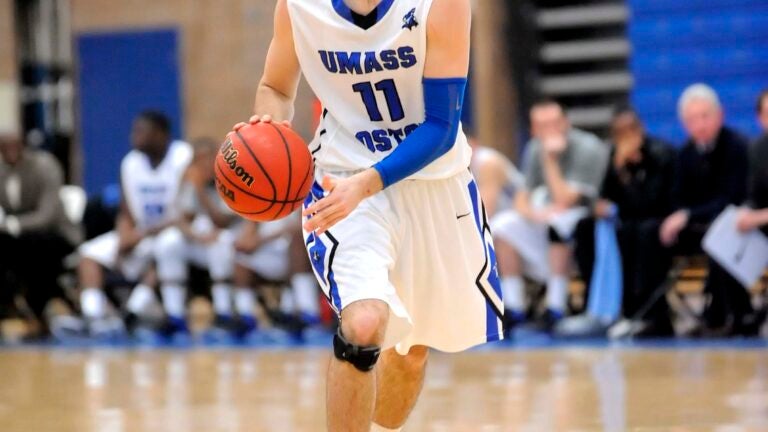
There can be serious upside to being an NCAA athlete: the trips to play in big time tournaments, the Sports Illustrated covers, the undying affection of an entire student body and alumni base. Being a big time college star is incredible.
But not everyone who plays a sport in college shares that experience. Some NCAA athletes don’t even live on campus, and if they want to continue playing their sport past high school, they have to make serious sacrifices. In Boston, quite a few athletic departments — primarily in Division III — feature talent who begin and end their days at home, and come in to play without tens of thousands of fans, cheerleaders, or professional scouts in attendance. These players play not for fame, adulation, or even free school. They simply love their games and can’t give them up.
That’s the story with Selim Omerovic, 20, a forward on UMass Boston’s basketball team. The Saugus resident starts his days with a rush hour commute on I-93 into campus. Twice a week, he wakes up at 6:30 a.m. to make his first class at eight. After classes he’ll grab a bite to eat, fit in some homework, practice, and work an overnight shift at his job at Sharp and Associates, where he provides security for hotels and events. If everything breaks right, he might grab a couple of hours of sleep before doing it all over again.
The junior management major says he thought about leaving the game after high school, but when some former teammates (including current Beacons teammate Omar Benabicha) were talking about playing college ball, he decided to give it a try.
“I was never recruited, so when I came to UMass Boston I worked all summer and I tried to walk on, and I was able to,’’ Omerovic said.
Omerovic is very glad he made that decision, as basketball is one of his passions. It has afforded him the opportunity to make friends, which can be difficult for a commuter, given the limited amount of time on campus.
“I just love basketball, everything it brings, the friendships you make,’’ Omerovic said. “It is something you’ll remember for the rest of your life. It makes the college experience so much better.’’
Of course, in order for Omerovic to maintain such a packed schedule, he needs cooperation from a number of people, including his employer, his coach, and his friends. Luckily, he says they are all understanding, whether it’s his coach letting him miss a day of practice so he can stay off the road in bad weather, or his friends letting him spend the night on their couch when he gets back from a late game. It’s a hard way of living but Omerovic was quick to point out that college doesn’t last forever.
However, at a school like UMass Boston, where there are no dorms and Rush Week usually involves signing a lease, driving in from home does have significant advantages.
“I feel like it’s way more expensive to live (in an off campus apartment),’’ Omerovic said. “If I live at home, my mom makes me meals, I don’t have to pay for food or anything. All of the money I make, I can put towards my car.’’
“Thankfully, I have a good car. The driving isn’t as bad as everyone makes it out to be, it’s just the gas.’’
The financial benefits of commuting were echoed by Rob Marks, 20, a junior outfielder for Suffolk’s baseball team who takes the Blue Line in from his Revere home every day.
“Financially, I thought (commuting) made more sense,’’ Marks said. “I’m just a 15 minute train ride outside of the city, and I wanted to stay in Boston. I knew I could’ve gone somewhere else and lived at school, but I wanted to stay in Boston and I liked what Suffolk had to offer.’’
Marks, like Omerovic, has to pull off quite a balancing act. The sociology major has to negotiate a schedule of captains practices, an internship at Middlesex Probate and Family Court, a full slate of classes, and a commute back and forth to his house, and this is just the offseason.
“(My schedule) is a challenge. But baseball’s been such a huge part of my life since I was eight,’’ Marks said. “I played AAU, I played in high school, and I just wanted to continue. I thought about giving it up but I didn’t think I could handle it, I would have missed it.’’
Marks, who wants to go to law school in a couple of years, has learned how to keep everything balanced, but he’s had to make some sacrifices to spend time with his Rams teammates. There isn’t much time to spend with friends back home and homework has to fit in to whatever breaks he can manage. It’s not a very glamorous life. But the commuting hasn’t stopped him from being a serious contributor. He hit .308 with 24 RBIs and nine steals last year.
When Marks and Omerovic see stories about athletes who are already on scholarship and live on campus asking to form unions and receive compensation, they look at it from an entirely different perspective — as someone who plays their sport strictly because they enjoy it. While it’s not unheard of for a Division III athlete to get drafted into the pros, it’s about as common as a three-pitch inning, or a quadruple-double.
“I think (my college career) has affected where I stand, and my opinion is that (NCAA athletes) shouldn’t be glorified or paid,’’ Marks said. “I’m here commuting to school and doing an internship, and we’ll get meal money sometimes, but (getting paid or glorified) is crazy, something I could never imagine.’’
Omerovic added, “Sometimes I feel like they under-appreciate things, but at the same time I love the way my sports life is here, all of the friends I’ve made here and everything is a once in a lifetime experience.’’
Charlie Titus, Omerovic’s head coach, stressed how proud he is of his student-athletes who manage to keep sports in their lives as they juggle a busy schedule.
“The respect I have for student athletes here is unbelievable because of the challenges they have,’’ Titus said. “They’re competing against athletes who have a meal ticket. They get up and get breakfast, lunch and dinner and don’t have to worry about anything. They don’t have to worry about paying rent or utility bills. Our athletes have to worry about all of that. Paying the rent, paying utility bills, paying the cable bill. How they’re getting to and from school.’’
“For our athletes to be able to handle all of those challenges and stay competitive — it makes me unbelievably proud.’’
Omerovic, who wants to eventually work as an electrician and start his own company, has some advice for anyone who has trouble keeping their lives balanced.
“You have to stay awake and you have to plan stuff correctly. Time management is big. I have to squeeze in time to do homework whenever I can and sleep is a second option, you have to get stuff done.’’
Marks has become a time management expert as well, but he made sure to stress that getting out on the field and being a part of Suffolk Baseball is a good reward for his efforts.
“I’ve found a great fit at Suffolk (…) where the friendships and memories I’ve made already, as well as the ones I’m sure to have in my remaining years, are the ones I’ll cherish for the rest of my life. That’s what makes the commuting worth it.’’



To comment, please create a screen name in your profile
To comment, please verify your email address
Conversation
This discussion has ended. Please join elsewhere on Boston.com