
Brady decision is another chapter in Roger Goodell’s history of looking out for himself
COMMENTARY
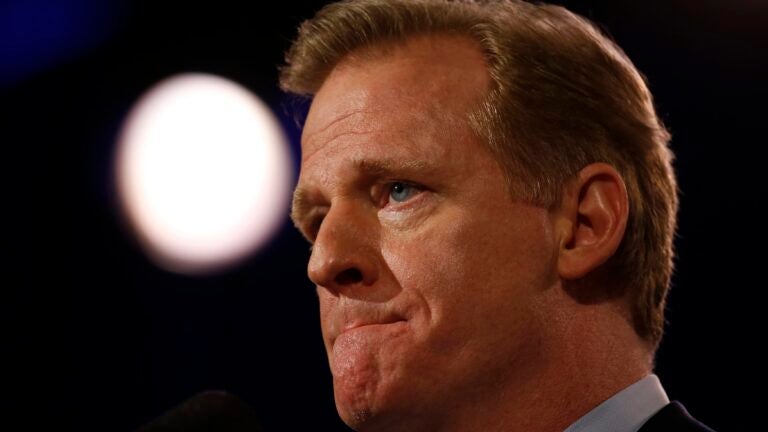
Roger Goodell has achieved something very few NFL teams could: He has taken down Tom Brady and humiliated him in the process. Which, I fear and deeply suspect, was the primary intent of his image-repairing and nefarious “independent’’ arbitration all along. Goodell upheld his own four-game suspension of the Patriots’ quarterback after league-appointed investigator Ted Wells found it “more probable than not’’ that Brady was “at least generally aware’’ of the intentional deflation of game balls in the AFC Championship Game in January.
In a statement, Goodell accused Brady of obstructing the investigation “by, among other things, affirmatively arranging for destruction of his cellphone knowing that it contained potentially relevant information that had been requested by the investigators.’’
Destroying his cellphone? Now there’s a shocking twist. The league alleged he sent 10,000 texts in the four months he owned the phone. He’d better have a good reason for destroying it. So far he does not.
Brady’s image, as absurd as this seems considering this controversy stems from a still-unproven allegation that he was in on slightly deflating footballs, is permanently tarnished. No matter what happens in federal court, the court of public opinion is going to side with Goodell over Brady for many reasons, envy among them, but also because leaks within the NFL seem to have contributed misinformation that helped form nationwide stances on Deflategate. Consider one of the stories that got all of this started: ESPN’s Chris Mortensen reported on Jan. 21 that 11 of the 12 footballs from the first half of the AFC Championship Game were two pounds per square inch below the allowable limit. This report was subsequently contradicted by an NFL.com report on Feb. 1, and the Wells Report, but it still helped hype the Deflategate media circus.
It’s almost as if the unnamed league sources cited by Mortensen wanted false information out there. Actually, I’m not sure there’s an almost about it. In upholding the suspension, Goodell justifies everything that came before, including the Wells Report’s use of supposed neutral parties such as a firm that once infamously denied a link between second-hand smoke and lung cancer.
This is the same commissioner who in 2009 testified before Congress that he could not say whether there was a link between pro football and head trauma. This is the same commissioner who once appeared on the cover of Time with the headline: “The Enforcer.’’ How he must covet that image again. Hammering Brady, the face of an extremely successful and arrogant organization, for a minor transgression restores it with 31 other NFL teams while simultaneously distracting from the league’s real issues.
It takes a special kind of leader to protract an already overblown controversy and direct the focus away from actual issues like head injuries and players retiring early. But we cannot fault him for his refusal to cede his power as arbiter in this instance. It was, after all, something the NFL Players Association agreed to in the last labor contract. For those skeptical of his motives – probably just us New Englanders at this point – there certainly appears to be one reason apparent beyond all others as to why the idea of an independent arbiter was rejected: Goodell didn’t want to have his ruling overturned and his authority impugned—again.
In 2012, Paul Tagliabue, Goodell’s predecessor as commissioner, was brought in to hear the appeals of four Saints players who were suspended by Goodell for their roles in the pay-for-injury “Bountygate’’ scandal. While acknowledging the Saints deserved a rebuke, Tagliabue vacated all four suspensions, noting that there was no precedent for the punishments and that there was little to no evidence of misconduct on the field. Goodell was said to be surprisedby the decision.
Goodell’s hypocrisy serves as a shameful bridge from Bountygate to the Ray Rice scandal. When Goodell dropped the hammer in Bountygate and suspended Saints coach Sean Payton for a season despite no direct evidence that he was aware of his players’ bounty system, his ruling made clear that ignorance is no excuse.
Yet that was precisely his excuse for why he suspended Ray Rice for just two games last July after the then-Ravens running back punched out his then-fiancee in the elevator of an Atlantic City casino. Goodell acknowledged in August that he “didn’t get it right’’ and later suspended Rice indefinitely in September after horrific video of that assault surfaced via TMZ.
He reacted to the outrage, not the initial crime, and his epiphany regarding “the domestic violence space’’ never should have required video accompaniment, but the NFL used that as Goodell’s excuse for the underwhelming initial punishment, sending out a statement that no one in the league office had ever seen the tape.
Perhaps that is true, perhaps not, but that must have been a result of a see-no-evil game plan by the league. According to an ESPN report published just days after the release of the graphic TMZ video, Rice was honest with Goodell about what happened when they met, and the league had a copy of the Atlantic City Municipal Court complaint, which noted that Rice attempted “to cause significant bodily injury.’’ As GQ noted in a feature in January:
“This is a league that works with Homeland Security, confers with the Drug Enforcement Agency, collaborates with law enforcement and has its own highly equipped and secretive private security arm. You’re telling me it couldn’t get a hold of a grainy tape from an Atlantic City casino elevator? But TMZ could?’’
If Goodell wanted to know what really happened in the elevator, he would have found out. He didn’t want to know. He wanted to rule at a safe distance. He wants to talk about integrity. He wants you to believe he possesses it. The last thing he does is strive for it.
In the Rice case, and the Bountygate case, and in various stages of Deflategate, he has not emphasized doing what is right, but what he thought would look right and show him in the greatest light. He did it again today, and the cost was much cheaper than usual. No lives were put at risk. Merely the reputation of the league’s greatest player and representative.
Timeline of Deflategate Controversy
[bdc-gallery id=”106353″]


To comment, please create a screen name in your profile
To comment, please verify your email address
Conversation
This discussion has ended. Please join elsewhere on Boston.com