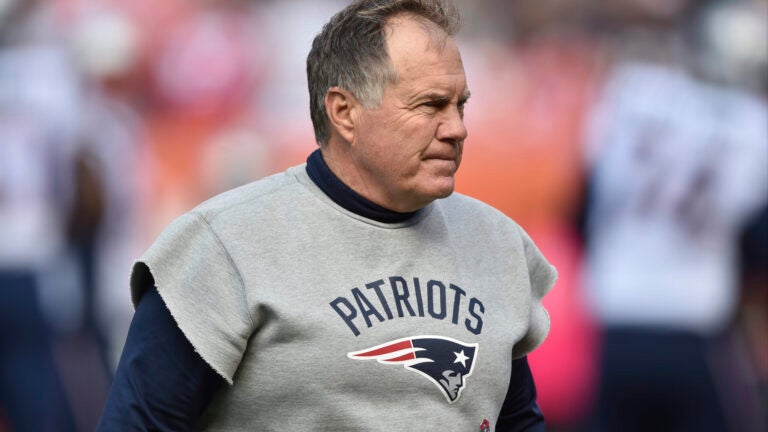
Due to space and narrative limitations I couldn’t shoehorn in all of the information from Riddick that I would have liked. But it was fascinating hearing him talk about what Belichick was like then, and how much it still means to Riddick to have played for him. So here are a few outtakes from Riddick that stand alone as insights, starting with his belief that Belichick is very similar now to the coach he was in Cleveland, albeit with much more cachet with his players (six Super Bowl trips and four wins do tend to have a positive effect on a coach’s reputation).
“When we were in Cleveland, we didn’t have the consistent success he has now. So there was occasional pushback from some players,’’ said Riddick. “Not necessarily rebelling or defying what he was saying, but it wasn’t the same kind of almost mindless buy-in there is now because he hadn’t established himself as a head coach just yet. But you knew what he was telling you would work on the football field. He had the keys setting you up to be a very good player.
“Now, players just unquestionably believe in him. When he tells you how to attack an opponent and that if they just, do it the way he tells them, they’ll win. As a player, when you hook yourself up with somebody like that who can impact your career, that’s what you want. That’s what players want. They want to be impacted in that way.”
That didn’t always apply to others in the organization, Riddick said. Belichick had his own way of doing things that didn’t jibe with the Browns’ standard operating procedures in those days.
“He totally revamped everything,’’ said Riddick. “To be on the cutting edge on setting up the scouting department, how players were taught, what attributes were most important, how the strength and conditioning program worked, he was trying to get all of that done. He was trying to take football to the next level, so he wasn’t concerned with how he was being perceived.
“He got caught up in the perfect vortex of [expletive] that didn’t allow people to find out good things were going to be. He found out certain things, certain mistakes that he made that he hasn’t repeated since he was in New England, roster construction and bringing in certain guys that in hindsight he would like to have a do-over. He made his mistakes. He was still learning how to be the ultimate CEO. I’m not surprised at all that once he got to New England that after learning some things the way we all do, by trial and error, that he figured out what he wanted and built that Death Star up there.”
Riddick said that in the moment he knew he was getting a special kind of coaching, not only from Belichick, but from defensive coordinator Nick Saban, who has become one of the most accomplished college coaches of all time.
“I had never been in such a situation and haven’t been since then where so much was put on you mentally and physically every single [expletive] day. You will be a pro, or you won’t be.
“It wasn’t just him. It was him and Nick at the same time,’’ said Riddick when asked if he ever felt like the coaches were trying to break him. “There were times when I didn’t know if I wanted to play. You never felt good enough from the time you walked in the door until the time you left. But I understand it now. If you keep your head down and keep pushing and keep trying to do things the way he asks you to do them, and you start getting results, the thing is he will reward you. He will play you. He will start cutting you some slack. He’s not just going to ride your [expletives] unmercifully. He’ll be like, ‘OK, I’ve seen you show that you can do this, and while you didn’t do it this time, I trust that you will. I’m not going to ride you this time.’
“For a while, I didn’t even know Nick knew my name. I thought my name was a four-letter word or my jersey number [42]. Then one day we’re sitting there in the middle of the season, in the ’94 season, and we’re all stretching before practice, and he walks up to me and stood in front of me and said, ‘You’re the money backer this week in sub.’ I kind of looked around like, ‘Are you talking to somebody else?’ And he said, ‘I’m looking at you. Just making sure you’re ready to go, 4-2.’ From that point on, that’s when Nick’s approach to me changed. It was almost like he was like, ‘OK, I see that you’re one of the guys that can handle this.’ It’s not for everyone, because there are some guys who just wilt under that kind of pressure.
Riddick said that it was remarkably satisfying to be in that circle of trust, and the feeling hasn’t faded as the years have past. That’s the impact Belichick (and Saban) had on him.
“You value it even more when you get out and you’re done,’’ he said. “When you’re in, you’re surviving. But like anything else in life, you don’t really appreciate it until you look back on it and realize how much it affected you, and in other things that you do.
“As tough as Bill was and can be, there’s a side to him that has compassion. He’s not just this football robot. He recognizes the human element of the game. If you hit the right subject with him, he will absolutely give you an education on football history and how important certain players are, how important other coaches have been. It’s cool when he does that.
““I’ll tell you as a 47-year-old guy, off doing his own thing and all, it’s funny how someone as respected and revered as him, you still kind of look at him as the coach,’’ said Riddick. “Right now he doesn’t have any influence over my career at all. About a year ago I heard him on WEEI doing an interview and they were talking to him about all his former players who had been in the media and how well they’re doing. He’s got a bunch of ‘em between Rodney [Harrison] and Tedy [Bruschi] and [Scott] Zolak does stuff and [Mike] Mayock, Damien [Woody]. They had mentioned a few guys. ‘So-and-so and so-and-so and so-and-so is doing media, how do you feel about that?’ And his answer was, ‘Yeah, I also have Louis Riddick, who I coached in Cleveland.’ That’s the first thing he said.
“And it’s funny. I’m not a little kid. I’ve got kids of my own. But for someone who played for him, for him to mention that first thing, it meant a lot to me. When he talks about you, it means that you’re doing something right.”
Chad Finn can be reached at [email protected]. Follow him on Twitter @GlobeChadFinn.



To comment, please create a screen name in your profile
To comment, please verify your email address
Conversation
This discussion has ended. Please join elsewhere on Boston.com