
Tom Brady, NFL to meet in court this week
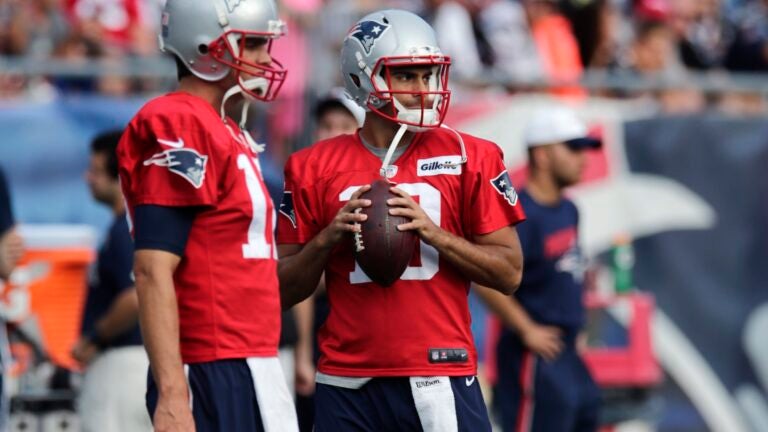
The NFL and Tom Brady outlined their arguments in their ongoing fight over the quarterback’s Deflategate suspension in twin filings with U.S. District Court on Friday. In two days, they’ll be put to the test.
Per a schedule laid out in an order last month, Judge Richard Berman will bring the two sides to the settlement table on Wednesday morning in New York City in hopes of not having to rule himself.
That Berman has opted to oversee the hearing himself is a departure from typical protocol that indicates the judge is pushing them to settle this themselves, according to a Boston Globe report.
“Ordinarily the judge that decides the case is going to have a third party engage the mediation, so this is a little bit unusual,’’ New York University labor law professor Samuel Estreicher told The Globe. “He must see some basis for an agreement, because he’s getting involved. He must think there’s some basis for resolution.’’
The Globe notes the meeting is technically public, but probably won’t stay that way:
Berman’s office confirmed that the settlement conference will begin at 11 a.m. in the judge’s courtroom, and will technically be open to the public — but probably not for long. Both the NFL and NFLPA probably will make a brief opening statement in front of everybody, but then the parties are expected to move to the judge’s chambers, where each will have an opportunity to present its case and engage in private mediation. No cameras, cellphones, or any electronic equipment will be allowed in the courtroom.
Friday’s filings further demonstrate just how diametrically opposed the sides are in their cases, so if Berman hopes to reconcile them, he has his work cut out for him.
The NFL’s arguments center on the broad powers to impose and uphold punishment given to Commissioner Roger Goodell in the current collective bargaining agreement between the league and the NFL Players’ Association, through which Brady filed his motion to vacate the suspension. Further, it dismisses Ted Wells’ independence as irrelevant despite Goodell’s publicly touting it as such, and points to piles of precedent that show courts are highly deferent to arbitration decisions without regard to whether the sides’ arguments have merit.
Story continues after gallery
The front pages of Tom Brady’s suspension
[bdc-gallery id=”111593″]
Indeed, if the sides can’t agree and Berman is forced to issue a ruling by the agreed-upon Sept. 4 deadline, it will focus exclusively on whether Goodell acted fairly and within his powers, and not on whether the evidence supports Brady’s guilt – a distinction the NFL emphasizes in the introduction to its filing:
Contrary to the Union’s request, a court is “not authorized to review the arbitrator’s decision on the merits despite allegations that the decision rests on factual errors or misinterprets the parties’ agreement.’’ MLBPA v. Garvey, 532 U.S. 504, 509 (2001) (per curiam). The Court must confirm the award if it “draws its essence’’ from the CBA. Saint Mary Home, Inc. v. Serv. Emps. Int’l Union, Dist. 1199, 116 F.3d 41, 44 (2d Cir. 1997). In other words, even if the Courtwere “convinced’’ that the arbitrator “committed serious error,’’ the Award could not be vacated so long as the arbitrator was “even arguably construing or applying the [CBA] and acting within the scope of his authority.’’
In contrast to the league’s filing, the NFLPA argues the severity of Brady’s punishment is far out of line with previous violations it considers similar – a Panthers ball boy drew a league warning when he heated a ball on the sidelines last season, and suggestions Packers quarterback Aaron Rodgers prefers his balls overinflated drew no response at all – and that Roger Goodell was biased and thus should not have heard Brady’s appeal much less upheld a punishment he rubber-stamped. It further argues the NFL unfairly withheld notes and denied Brady’s request to question co-Wells Report lead investigator and NFL Executive Vice President Jeff Pash, that Brady had “no notice’’ he could be suspended four games for being “generally aware’’ of a scheme to tamper with footballs and for failure to cooperate, as the NFL says he did by not providing investigators with, and subsequently destroying, his cell phone.
That lack of notice was key in the appeal cases of both Ray Rice and Adrian Peterson, whose suspensions were reversed in arbitration and in court, respectively, on such grounds, according to the NFLPA’s filing:
The Award also asserts that Brady had notice because all Player Contracts provide that players may be suspended for conduct detrimental to the League. See Award 16-18. This too was rejected in Peterson and Rice. Like Brady, Peterson and Rice knew from their Player Contracts that they could be punished for conduct detrimental, but Judge Doty and Judge Jones both ruled that players could not be subjected to a disciplinary policy when they only had notice of a prior version. Peterson 12-14; Rice 16. As Goodell testified, under the CBA, the NFL is “required to give proper notification’’ of player discipline.
Should the two sides not come to an agreement Wednesday, they will reconvene a week later for further settlement discussions and, should they break down, oral arguments by which Berman will issue a decision.
And six days after that Sept. 4 deadline, the Patriots will open their season against the Pittsburgh Steelers, whether or not Brady is in the huddle.




To comment, please create a screen name in your profile
To comment, please verify your email address
Conversation
This discussion has ended. Please join elsewhere on Boston.com