
NFL Play Prediction Technology Leads the Next Wave of Analytics in Sports
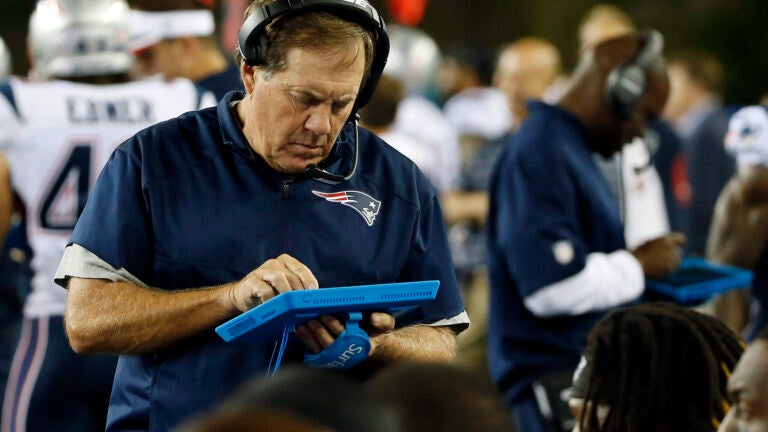
Here’s a hypothetical situation to think about. It’s Super Bowl XLIX, and the Seahawks have the ball on the 1-yard line with under a minute to play. It’s second and goal, and Patriots defensive coordinator Matt Patricia – a tech-savvy gameplanner with an aeronautical engineering background – looks down at his Microsoft Surface tablet and sees a probability chart that tells him how likely it is that the Seahawks will hand the ball to Marshawn Lynch, and how likely it is that they’ll try something else, like a quick slant over the middle.
Would it have made a difference in how the next play transpired? We’ll never know. But what we do know is the NFL is going to experience a revolution of analytics and advanced stats, because there’s too much data available and too many smart people who know how to translate that data into a more competitive game.
Tech firm Booz Allen Hamilton is working on the technology to predict offensive plays in NFL games. Known for its work with the federal government, Booz Allen is expanding its horizons for innovation, and sports is an area where its making significant progress.
The “Booz Allen BlitzD’’ app, created in partnership with Microsoft to run on the Surface tablets given to all coaches on the sideline, is one example of that progress.
“What we do is we take all the play-by-play data that occurred over the course of the last season,’’ said Ray Hensberger, a Principal Lead for a Sports and Analytics Group at Booz Allen, in an interview with Boston.com. “Using that data, we train the models, and you could then in real time, given a certain play, what down it is, what the two teams are, where you are on the field, the time left on the clock, and so on and so forth, you could actually say the likelihood that the next play is going to be a run to the left, run to the right, run up the middle, pass deep middle, pass deep left, and so on.’’
Hensberger said his team’s research showed NFL teams only have time to watch about 4 of their upcoming opponent’s games in the week leading up to the contest, so the BlitzD app offers more data and the ability to update in real time during the game.
“The intent being, with an app like this, that’s built to run on the Microsoft Surface, could actually be used in game by a defensive coordinator to say, ‘this is the likelihood of the offense doing this play next,’’’ Hensberger said.
More data driven decisions are needed in the NFL, according to Hensberger, because the league is far behind leagues like MLB and the NBA when it comes to integrating data and analytics into the sport.
“It’s very much a copycat league in terms of what works, everyone is going to do that. But the NFL is really focused on parity, so everyone being at the same level and having the same advantages, that rings true for technology and I think analytics particularly on the field in maintaining what they call ‘the integrity of the game,’’’ Hensberger said. “They want everyone to have access to the same type of data in the same type of way, equally.’’
Another obstacle facing analytics in the NFL is the teamwork required on every play. Whereas baseball is mostly a series of individual matchups (pitcher vs. hitter, fielder vs. fly ball), football is complex enough that it’s hard to quantify credit and blame on 11 players on each team on each play.
Here’s the million (maybe billion) dollar question: With sports generating massive amounts of data (Hensberger said MLB and NBA arenas have camera systems that generate about seven terabytes of data per game) and new ideologies about how to use that data are presented at events like the Sloan Conference, how do we use this information to our advantage?
“Where we sort of differentiate ourselves in this area, and our view of the world, really is to start making data-driven decisions,’’ Hensberger said. “We’re taking military grade technology and analytics that we’ve done for the Department of Defense, literally picking that technology up and dropping it in the sports area because we’ve done this before, we know that data can drive decisions, and there’s a lot of value to be driven out of it.’’
Even data miners like Hensberger know there will be resistance to changing the way sports work. Former and athletes are sometimes quick to dismiss analytics as “nerds trying to get in the game.’’ Hensberger knows there is a real value to analytics, but human intuition and gut feelings will always have a place in sports. One way to get everyone on board with data and analytics, Hensberger says, is to use them to make the game safer.
“You can look at the health aspect of things, mitigating injuries. There’s physiological data that you can now obtain about the athletes to help their training regimens, to prevent them from getting an injury. Rather than over-train you can actually make sure their training regimens are exactly what they’re supposed to be, based on what their bodies are saying,’’ Hensberger said. “That’ll benefit everyone. Teams will prevent losing millions of dollars due to injury, fans will see the players that they want to see play, and the players themselves will extend their careers.’’
Teams are already starting to use advanced data on the business side of operations, so it’s not just the on-field product that’s being impacted. If you bought Red Sox tickets off StubHub last season, you might have paid more than you otherwise would have thanks to Booz Allen Hamilton’s “Know Your Multiple’’ technology.
“For the Red Sox the work was around predicting the price of a seat on secondary market behaviors. So secondary market would be your StubHubs of the world, your SeatGeeks, those guys,’’ Hensberger said. “The way that their pricing strategies had been were sort of manual.’’
Hensberger refered to the old ticket strategy as a “thumb in the wind’’ plan that failed to maximize profits. The “Know Your Multiple’’ system used scientific data to determine which seats fans were willing to pay more for.
“When we put some data behind it, we’re actually able to create heat maps in the stadium showing ‘hey, this section that is literally across the aisle from the section next to it, there’s a seven-times price difference when you look at the secondary market. People are willing to pay seven times more for these tickets than you guys are actually charging. So the amount of money the Red Sox were leaving on the table was pretty significant when you multiply that times 80-something games a year at home,’’ Hensberger said.
It takes effort, and it takes math, but it’s efficient business. For all the money the Red Sox have invested in their roster, the franchise has offset some of those expenses by bringing their own flavor of “Moneyball’’ to their business plan.
Hensberger said the biggest takeway from the Sloan Conference was that there’s an enormous appetite for analytics in sports, and it’s growing annually. Fans and teams are buying in, and Hensberger predicts a bright future for organizations that learn to utilize data and integrate analytics into its processes.
“Some teams are all in on it, and some of them are still a little skeptical about it, and that’s okay,’’ Hensberger said. “But the ones that are going all in on it I think are going to be the ones that will have success not only on the field but in the stands as well and in their entire business model going forward.’’




To comment, please create a screen name in your profile
To comment, please verify your email address
Conversation
This discussion has ended. Please join elsewhere on Boston.com