Bobby Orr deserved better in #GOATMadness
The case for Number Four as Boston's greatest.
COMMENTARY
Our #GOATMadness bracket presented Boston sports fans with a very welcome problem. In a completely democratic way, we’ve been asking readers to choose between legends. In almost every respect, I have to conclude that they chose wisely.
The major exception to this was Bobby Orr. Though Orr would probably shy away from comparisons with people like Tom Brady or Bill Russell, he is absolutely in their class. In some ways, he might even be above it.
This made his elimination to Larry Bird in the Round of Eight perhaps my greatest disappointment with the bracket. Nothing against Bird – beyond sharing a last name, he’s absolutely one of my favorite Boston sports icons – but Orr’s accomplishments merited at least a Final Four matchup with Brady.
His name was most frequently brought up in user emails that I received in the course of the bracket. And in my discussions with Bostonians over the last few weeks, many relayed a similar sentiment: Orr might not be the definitive Boston GOAT, but he warranted a seat at the table.
What stands out in any review of Orr’s career isn’t simply his statistical accomplishments or the awards he won, but of achievements in a broader, grander scope. His success was hockey’s success. His victory belonged equally to his teammates, and to his sport. This was because Orr, as Ken Dryden put in his book, The Game, altered what was believed to be possible.
“He was the rare player who changed the perceptions of his sport,” Dryden wrote.
“It was Orr who broke down the barriers separating offense and defense,” Dryden explained. “Lining up as a defenseman, when the puck dropped be became a ‘player,’ his game in instant and constant transition, until there was no real transition at all, neither defenseman nor forward, both defender and attacker, he attacked to score and keep from being scored against; he defended to prevent goals and to create chances to score.”
Of the more standard measurement for greatness, Orr produced plenty of those as well. Consider:
- He won the Norris Trophy (given to the NHL’s best defenseman) a record eight consecutive years.
- He won the Hart Trophy (given to the league’s most valuable player) three consecutive years.
- He shattered the previous record for most points in a season by a defenseman (59), eclipsing it seven times, and more than doubling it four times.
- Arguably his most impressive statistical achievement was winning the Art Ross Trophy (awarded for most points). No defenseman before or since has ever won it, and Orr did so on two occasions.
- In 1970, he won the Hart, Norris and Ross trophies, also taking home the Conn Smythe Trophy (playoff MVP). It was a feat that has also never been matched.
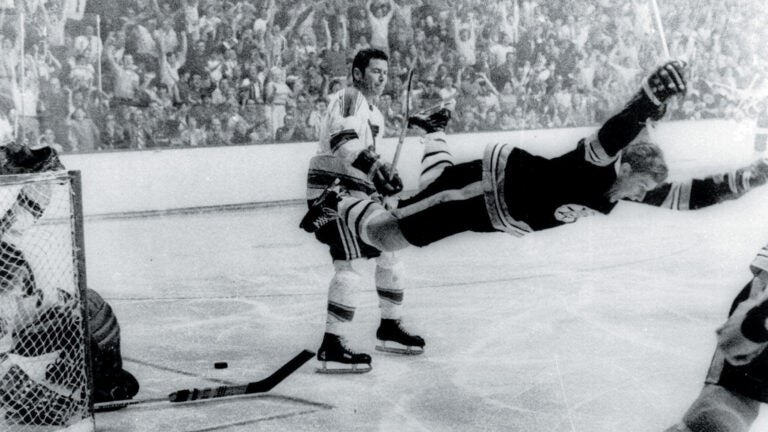
And in 1970, Orr’s finest hour represented the culmination of his time in Boston to that point. He not only won all of the awards, but scored the winning goal to bring the Stanley Cup back to Boston for the first time in nearly three decades.
Having debuted in 1966 as an 18-year-old, he helped lead Boston hockey out of the wilderness. The Bruins spent the seven seasons before Orr’s arrival watching helplessly as the team finished either last or second to last each year.
With him, they experienced a meteoric rise. It cut to the core of what made him unique. Not only possessed of otherworldly talent, Orr was the unusual superstar who elevated his teammates above even himself. Instead of bending the game to him, he did the opposite.
“The profound exception,” Dryden labelled him.
In the 1970-71 season, the Bruins (only a few years removed from being the worst team in the league) played the regular season as if they were in a league by themselves. Driven by Orr’s relentless pace, the only four players in the league to break 100 points were all Bruins. Orr himself totaled 139. Phil Esposito shattered the single-season scoring record with 76 goals, while Orr fittingly became the first player in history to notch over 100 assists (finishing with 102). His most impressive regular season was best measured in the success of his teammates.
“Look at him,” Orr’s then-roommate and Bruins assistant trainer John Forristal said in 1970. “He’s the key to everything—to the Boston Bruins, to the National Hockey League, to the whole game of hockey. And he skates like he’s afraid he’ll be sent back to the minors. He takes chances like a rookie.”
Though his career lacked the longevity of other legendary Boston athletes, it subtracted nothing from his impact. He changed his sport, an indelible claim that few can make. And he elevated hockey in Boston, inspiring a generation after him.
“Years before I ever heard of Lake Placid or the Olympics, before I knew the name of a single Russian hockey player, I was a kid in Massachusetts who wanted to be the next Bobby Orr,” wrote gold-medal winning USA goaltender Jim Craig. That anecdote alone, considering the impact Craig had himself on the hearts of American fans in 1980, helps illustrate Orr’s importance on New England hockey.
The discussion of Boston’s GOAT is crowded by a list of supreme contenders. Any claim that it’s a settled argument sounds specious and ignorant. Yet it’s impossible to start or finish such a discussion without Orr. As he so deftly did on the ice, he elevates Boston’s list of greatest athletes.