
Sign up for the Today newsletter
Get everything you need to know to start your day, delivered right to your inbox every morning.
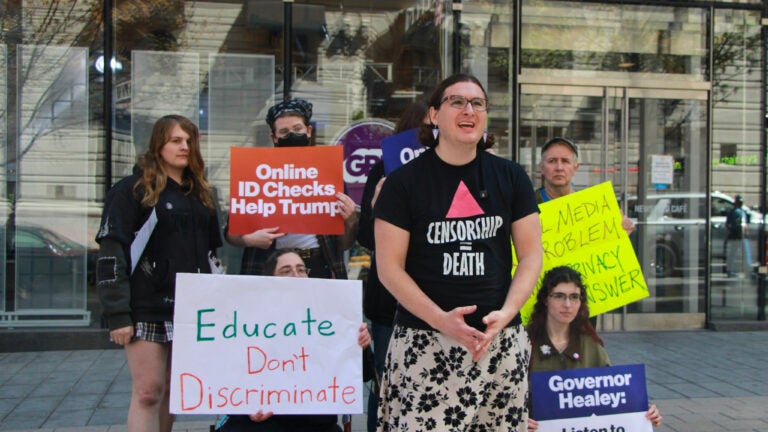
As Gov. Maura Healey continues to push proposed legislation that seeks to crack down on social media platforms, she responded Tuesday to criticism from those who say that her ideas are unworkable and could actually give social media companies more sensitive user data.
The legislation, unveiled by Healey earlier this month, would mandate that social media companies implement “age assurance” systems on their platforms.
Social media companies would have to make sure that default settings for users under the age of 18 automatically disable common features like auto-play videos, infinite scroll, and feeds based on user-specific algorithms. These default settings would have to disable location tracking and notifications, while restricting access overnight and during school hours.
Users under the age of 15 would have to gain a parent or guardian’s consent in order to modify these default settings.
About a dozen people gathered outside the Boston Public Library Tuesday to protest the legislation while Healey spoke on GBH’s “Boston Public Radio.”
Fight for The Future, a nonprofit focused on the intersection of technology and human rights, organized the protest. Director Evan Greer said the organization opposes the legislation to protect children’s safety and First Amendment rights.
She said requiring users to upload a government ID or submit a face scan violates a user’s right to speak anonymously.
“If I have to upload my government ID to criticize Trump on social media, and I’m afraid that might get me in trouble, or get my family deported, or any number of other consequences, I am less likely to speak,” Greer said. “That means my free expression rights are being curtailed by a government policy.”
Opponents argue the “age assurance” systems would pose a safety hazard for children. Age verification, Greer said, actually benefits large tech corporations by allowing them to “continue operating their destructive business model” while preventing minors from using the platform.
For protester Alec Sennott, a music teacher in Wilmington, he is concerned that the policy is too “invasive.” Many of his students who identify as LGBTQ+ view social media as a safe space and a place to find community, he said.
“I don’t want a closed internet in the same way that other countries we find to be oppressive,” Sennott said. “While, as a teacher, I sympathize with wanting to keep kids’ mental health safe on social media … the enforcement mechanism is too invasive.”
Kate Fractai, a software engineer, said social media is crucial for learning and interaction. She explained that many young people organize events, including those that are politically-based, on social media.

“That is the communication method that they are able to get,” she said. “Without some type of communication method, we’re going to be discouraging kids from being politically engaged and politically active and affecting their communities in positive ways.”
After the GBH segment concluded, Greer got the chance to speak directly with Healey, and Greer said the group plans to meet with Healey next week to further discuss the legislation.
Healey was asked about these criticisms Tuesday on GBH. She maintained that her legislation seeks to take power away from social media companies and deliver it into the hands of families and young users.
The governor stressed that her legislation does not specifically require users to provide companies with their photo ID or biometric data. Healey also said that she is receptive to concerns voiced by members of marginalized groups.
“I am very sensitive, as my team is, to concerns about kids, whether it’s kids in the LGBTQ+ community or elsewhere, being able to find community online,” she said. “I have to believe that there is a way to come up with something sensible that protects the health and wellbeing of our kids, who are really, deeply impacted by the prevalence of these social media platforms in their lives.”
Healey spoke about how language in the legislation requires that social media companies delete the accounts of minor users upon receiving requests from either that user or their guardian. The governor was asked whether she trusts these companies to actually delete these accounts if they are asked.
“I think to do nothing is just not the way to go,” she said. “They understand their technology enough to do what needs doing, we just need to require it by law.”
The governor expressed a sense of urgency, saying that officials need to take action to prevent heightened levels of anxiety and depression that are thought to be tied to heavy social media use.
But these proposals are also still “under development” in some capacity, Healey said. The legislation gives the attorney general the authority to lay out regulations identifying “commercially reasonable and technically feasible age assurance methods.”
On the modern internet, user privacy is already severely at risk, Healey said.
“If anybody thinks in this day and age that they have some sort of privacy online as it exists, give me a break,” she said. “We live in a world where the platforms have complete and total control … I want users, in this case our young people, to have control.”
Get everything you need to know to start your day, delivered right to your inbox every morning.





Be civil. Be kind.
Read our full community guidelines.To comment, please create a screen name in your profile
To comment, please verify your email address