
Sign up for the Today newsletter
Get everything you need to know to start your day, delivered right to your inbox every morning.
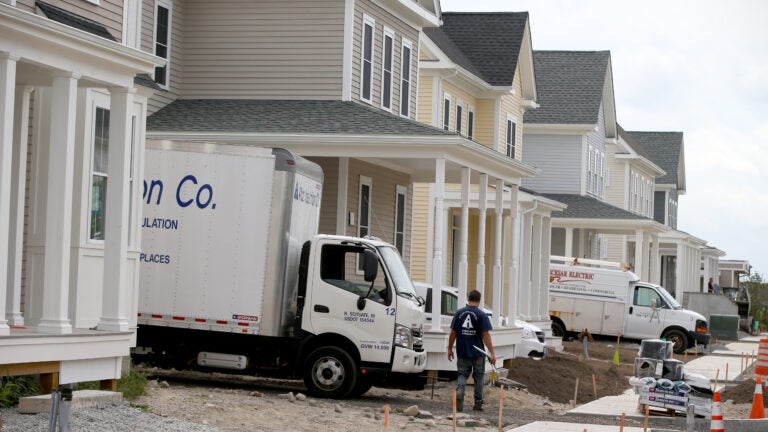
Gov. Maura Healey unveiled plans last week to slash environmental review requirements for certain developments, a move aimed at accelerating housing construction across Massachusetts.
Experts say the proposal is unlikely to immediately ease the state’s deepening housing crisis. But it’s a step in the right direction.
“I don’t want to be overly optimistic and say this will be a panacea, but I think this is part of a suite of policies from Gov. Healey’s administration that has been really great and really aimed at streamlining the process to build new housing,” said Katherine Einstein, associate professor of political science at Boston University.
She continued, “On its own, this is not going to solve the crisis, but I think it’s great as part of the solution.”
The Healey administration, in a release, says that the new draft regulations will reduce environmental review times for housing projects from one year or more to 30 days.
“At a moment when contractors, builders are struggling out there with things that we can’t control in Massachusetts — inflation, tariffs, and the like — this is a way that we can help you,” said Healey at a press event last Tuesday at a housing development site in Medford.
She continued, “This is about cutting red tape so that we can cut more ribbons on more new homes and get to more reasonably priced housing around this state.”
Earlier this year, the Unlocking Housing Production Commission presented a report showing lengthy environmental reviews for new housing developments, which can delay projects for months and years, resulting in significant, unexpected added costs — potentially rendering projects financially infeasible.
Projects that meet the qualifying housing criteria, such as being 67% residential, meeting a density threshold, and being constructed outside of a flood zone, will be able to move quickly through review by the Massachusetts Environmental Policy Act (MEPA) Office.
The proposed rules will allow qualifying housing projects to complete MEPA review with only the simpler Environmental Notification Form (ENF) rather than requiring the development of a detailed Environmental Impact Report (EIR).
The new regulations will also simplify the process for specific ecological restoration projects, such as cranberry bog restoration and partial dam removals. An estimated 23% of these projects filed with MEPA since 2022 would now only require an ENF.
The draft regulations were filed with the Secretary of State’s Office and are open to public comment. On Oct. 14 and 15, there will be virtual information sessions and public hearings.
“We’re going to use every tool that we can to get the cost of housing down and build more homes,” Healey said at the event.
Albert Saiz, the Daniel Rose Professor of Urban Economics & Real Estate and faculty director of the Urban Economics Lab at MIT, said the environmental maps outlining regulations in Massachusetts are already clear and easy to follow, which should make the streamlining process Healey proposes fairly straightforward.
For example, when wetlands are present on a property, it is clear that builders cannot disturb them, not even for an addition to a home. The buffer zone is calculated using satellite imagery and imposed on town and property maps. The information is available and easily accessible.
He added that Massachusetts offers more predictability than some other states, where developers face more uncertainty about whether local boards will approve their projects before starting the environmental review.
But since regulations are so clear-cut, speeding up the process doesn’t necessarily mean more projects will be approved, according to Saiz.
“I don’t honestly expect a huge increase in supply to come from this,” said Saiz. “Although good government is good government, and you always take it.”
However, Saiz said the housing market is also not helping the cause. Increasing construction and capital costs have made many projects no longer profitable.
Saiz said many developers are stalling construction as they look forward and sense a “forboding” downfall in the economy.
But eventually, the cycle will improve, said Saiz, and ultimately, it is “good policy.”

Get everything you need to know to start your day, delivered right to your inbox every morning.





To comment, please create a screen name in your profile
To comment, please verify your email address
Conversation
This discussion has ended. Please join elsewhere on Boston.com