
New lighting? Designers offer tips for upgrades that shine.
Here’s why you should embrace ceiling fans again.
Are you dim when it comes to home lighting? I am (no shade, please). When moving into my 1920s-era Colonial a decade ago, I was delighted to buy in my dream town of Arlington, so much so that I ignored the fact that there was absolutely zero ceiling lighting save an overhead hall light shaped like a nipple. These unsightly 1970s throwbacks are known in the industry as “boob lights,” I later learned.
A decade later, we still rely on lamps, though I’m slowly adding ceiling lights to our bedrooms. Are you in the same shadowy position? If so, here are bright tips from four lighting and design professionals to make your home truly shine.
Become a fan of “fandeliers” or “aire-deliers.” Make your home both bright and breezy with this chandelier-ceiling fan hybrid. Hardly your grandma’s ceiling fan, they’re statement pieces that combine form with function.
“They’ve come a long way in the last four to five years. They are not boring ceiling fans: They have really cool light fixtures built into the fan,” said Michelle Lee Parenteau, who runs interior design firm Michelle Lee Designs in Johnston, R.I. The experts recommended the sleek options from Minka.


Get subtle with smaller, linear recessed lighting. “High-performance, small-aperture recessed lights have become all the rage. You used to see big, huge, 6-inch glare bombs in your ceiling. Now, smaller, recessed LED lighting is really hot, because you can have high-performance fixtures with smaller lights — a beautiful linear strip. Architecturally, it’s very cool,” said Lucy Dearborn from Lucia Lighting & Design in Lynn. She likes the 4-inch linear LED versions from Alcon Lighting.
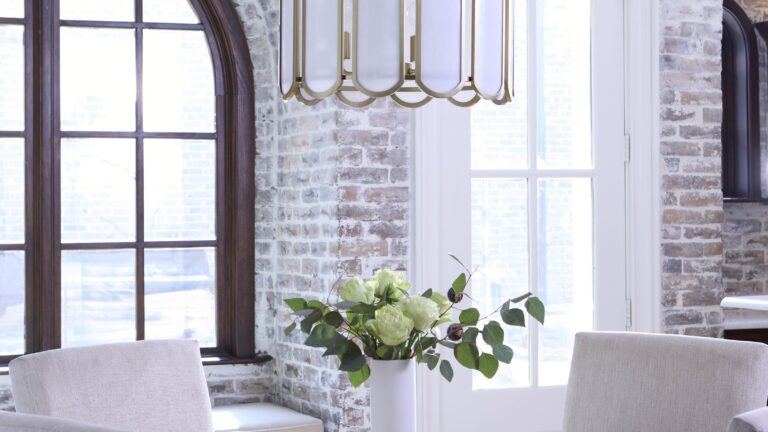
Alabaster is awesome. Soft. Soothing. Texturally intriguing. “Alabaster is back. It’s so warm and pretty. It glows,” said Dearborn, noting that it is often paired with warm gold leaf. She’s a fan of this pendant version from designer favorite Hubbardton Forge, crafted in Vermont.
Down lighting gives your rooms a lift. Set flush into the ceiling, these can create a warm, minimalist effect. Cindy Collings from Mashpee’s Cdesign & Partners recommended the 4-inch, dimmable, energy-saving LED version from WAC.
“They cost a little more than your average brand, but the advantage is you can control the temperature and adapt it to your space, based on how you use the room,” Collings said.
For example, customize your kitchen to a soft, yellow 3000 kelvin, or use a bluer 6000 kelvin in an office. (The Home Depot also makes a slightly less expensive version.)
Go decorative without going broke. For higher-end statement pieces, designers do adore Hubbardston Forge — “It’s jewelry for your home,” said Collings — but for budget-friendly options, Collings recommended browsing the wares at Hinkley and Kichler, lighting retailers that offer luxury looks across price points.
“Midcentury modern seems to be making a comeback with white frosted glass” and finishes in matte black, brass, and white, Collings said. She likes this one from Hinkley.

Flatter yourself. Nancy Goldstein, principal at Marblehead’s Light Positive, advises clients to avoid mounted lighting above bathroom mirrors. It might look pretty, but it can be very unflattering.
“It creates shadows from your brows, shadows under your nose, and shadows on your neck. Downlight is just not complimentary lighting. It’s much better if you have the room to select two sconces for either side of the mirror, what I call more ‘human lighting,’ level with your face, rather than above you,” Goldstein said. “Don’t skimp on the powder room.”


Diversify your kitchen. The kitchen should be a haven for variety, and that goes for lighting, too.
“Unless you have very bright pendants over your island that provide quite a lot of light on the surface, do not go for pendants or beautiful decorative fixtures alone,” Goldstein advised.
She recommended adding recessed lighting with a 2-inch aperture, particularly for low ceilings (higher ceilings can have larger sizes), angled for just the right amount of illumination.
Avoid wafer lights. These are popular with contractors because they’re thin and easy to install.
“But the quality of light is generally not great. Some are better than others, but the smallest size is really four inches or so, and the light is slightly regressed or right at the ceiling plane, which makes them very glary. It’s not a good look,” Goldstein said.
Consider layered lighting for visual intrigue. Layering isn’t just for hair: It’s a smart lighting strategy, too. Task lighting, general lighting, and accent lighting are all part of good lighting design, Dearborn said.
“The interior design community is getting savvier about layered lighting. This means wall sconces, art lighting, and high-performance recess lighting, to create a layered effect,” she said. “Don’t expect one fixture or one set of fixtures to do all the work.”

Kara Baskin can be reached at [email protected]. Follow her @kcbaskin.








To comment, please create a screen name in your profile
To comment, please verify your email address
Conversation
This discussion has ended. Please join elsewhere on Boston.com