
The Devastation of Nepal’s Cultural Sites
The earthquake’s damage to historic sites in Nepal is a huge loss for everyone.
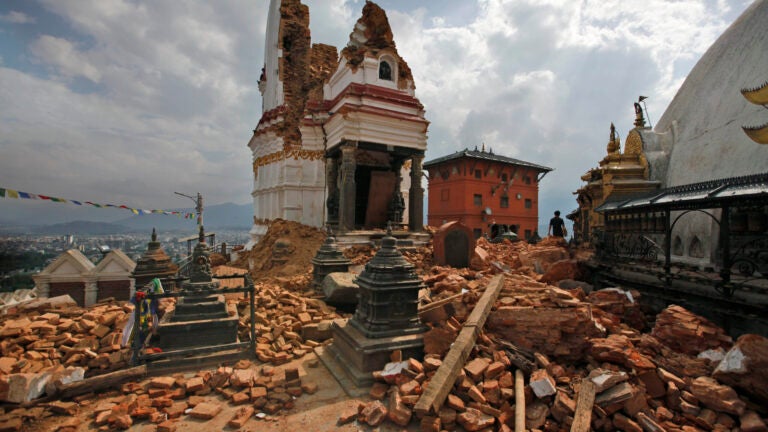
The landscape of Kathmandu will never be the same. That’s what Pralhad KC, owner of Prem-la in Boston’s Back Bay neighborhood said of his home city after an earthquake brought down historic palaces and temples in the region on Saturday.
He is not alone in his sentiment.
“It’s pretty startling and pretty awful devastation,’’ said Professor William Fisher, professor of international development and social change and dean of graduate studies at Clark University, of the damage in the Kathmandu Valley.
The Kathmandu Valley is a UNESCO World Heritage Site, and a preliminary assessment by the organization found the sites in the Durbar Squares of Kathmandu, Patan, and Bhaktapur were almost fully destroyed.
The cultural loss is just a piece of the greater destruction caused by the earthquake. Nepali police told the Associated Press that the death toll from the 7.8-magnitude quake was 5,266 as of Wednesday evening, not including the 19 fatalities on Mount Everest. Thousands have been injured and tens of thousands are homeless.
“They’re World Heritage Sites for a reason,’’ said Fisher. “I think it’s not just the loss to the Nepalese, but it’s a part of our human heritage and our historical heritage.’’
He described the damaged sites as living museums now irrevocably changed, if not lost, to the active fabric of the cities they were once a part of.
“People went in and out of them,’’ he said. “These were part of their daily lives, they were part of their social lives, they were places they hung out, they were places they worshipped. And yet, for tourists, they were an open museum that you could walk through and visit.’’
Fisher, an anthropologist who first went in Nepal in 1974 and is the author of Fluid Boundaries: Forming and Transforming Identity in Nepal, said the Kathmandu Valley was divided into three different kingdoms in the 17th Century. He said the World Heritage Sites are the heart of the three cities with the valley: Kathmandu, Patan, and Bhaktapur.
He said each city has a Durbar Square, the central square hosted temples and the king’s palace. Each of the three squares are World Heritage Sites that have been restored in recent years.
“They’re all sites of active tourism, but those temples and those sites are also part of what’s the heart of the social and spiritual life within the valley,’’ he said. “So they would include a whole array of different types of temples in those places.’’
Historic Nepal Sites Destroyed
[bdc-gallery id=”330490″]
Fisher said, based on the photos and videos he’s seen, the damage is startling in Bhaktapur and Kathmandu.
“A good friend of mine went through it and noticed that seven major temples had completely collapsed during the earthquake,’’ said Fisher of the damage in Patan. “Not all of those were in the Durbar Square area, in the main World Heritage Site area, but a number of them were.’’
In other regions like India and Tibet, Fisher said a lot of the historical/spiritual heritage of Hinduism and Buddhism has been destroyed by invasions, wars, and natural disasters. But Nepal was one of the few places in South Asia where the spiritual heritage, traditions, and temples that go back centuries were maintained.
“It’s not just the loss of the buildings themselves, but that the buildings are part and parcel of a living heritage,’’ Fisher said. “It’s not just that we had this thing we could go look at that reminded us of the past, but that these temples were deeply entwined with the daily life and the living spiritual and social life of the people of Kathmandu who were following a kind of practice that we just don’t see anywhere else, even in South Asia.’’
What was in Kathmandu was amazingly unique, he said.
“The loss of this stuff is just really enormous,’’ he said. “I’m mean there’s just nothing to be compared to it. We don’t have any of this anywhere else. We’ve just totally lost it.’’
Fisher compared the loss of the temples to the loss of the Buddhist statues in Afghanistan that were blown up by the Taliban.
“That’s just irreplaceable,’’ he said of the statues. “There’s just no way we could ever get those back again.’’
Because the has been a lot of effort in recent years to restore World Heritage Sites, Fisher said there is some hope that some sites in Nepal could be rebuilt.
The last major earthquake to the area in 1934 also caused a lot of damage to the temples in Kathmandu, he said. Some, but not all, were rebuilt.
“We can expect that there will be some rebuilding of the temples that we’ve lost this time,’’ Fisher said. “Certainly the temple complexes that have been damaged, we would expect to be repaired. But some of the devastation this time has just been complete.’’
But even with the restoration after the 1934 earthquake, he said the city changed and wasn’t the same.
“We can expect that this dramatically changes the way we relate to those cities and what’s at the heart of these cities,’’ he said of this week’s earthquake. He said the city is likely dramatically changed for decades to come.
Fisher said he hoped that, once Nepal has begun to recover from the earthquake, and there is a better understanding of the damage done, there would be international support for the restoration of the sites.
“Anybody who’s ever visited there, anybody who’s from there cannot but weep in thinking about what has been lost,’’ he said.
[fragment number=0]




To comment, please create a screen name in your profile
To comment, please verify your email address
Conversation
This discussion has ended. Please join elsewhere on Boston.com