Sign up for the Today newsletter
Get everything you need to know to start your day, delivered right to your inbox every morning.
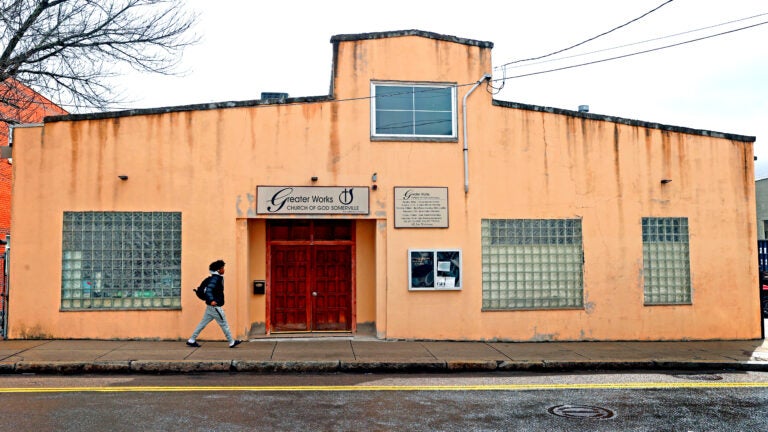
SOMERVILLE — Where there was once bloody violence and criminal plotting, there is now preaching of salvation and grace.
The auto garage that once acted as thede facto headquarters for one of Greater Boston’s most notorious organized crime outfits of the past century is now the Greater Works Church of God Somerville.
For a decade, this was the Winter Hill Gang’s office for its gambling and loan-sharking business. It was at this address that James Sousa was killed in October 1974, after gangsters were worried he would cooperate with police following a botched rip-off of a local dentist in a fake gold bullion sale. Years later, one mobster, recalling that slaying, said “There was blood everywhere.”
Like so many formerly gritty spots throughout the region, the building’s interior has become something else entirely. It’s dominated by a mural of people being baptized in a river, flanked by screens welcoming worshipers to the church. The carpet is purple, as are the seats. During one recent Sunday service, about 20 people were in attendance.
The Rev. Collin Green led them in prayer and song. After the service, he acknowledged the sordid history of the property, bringing up the prior owner and longtime leader of the Winter Hill Gang, the late Howie Winter, unprompted. He said the neighborhood is no longer a place where people need to look over their shoulder.
“It’s changed,” he said. “It’s not that way. God is in the building.”
But not all the changes from how it was to how it is are for the better. He mentioned the local housing crunch, saying one congregant, who grew up in Somerville, travels to attend services from Worcester, where housing is more affordable.
It’s a transformation playing out across the region. As Greater Boston has gentrified, it has become less of a backdrop for working-class, clannish noirs that hinge on loyalty and limited life choices directed by Ben Affleck or Martin Scorsese. It’s now more of a hub of gentrifying young professionals, skyrocketing housing costs, and concerns about displacement.
Holly Simione, 56, grew up a short walk away from the former Somerville garage-turned-church. When she was a kid, she knew who the “bad guys” were in the neighborhood. While she was in middle school, a man on the run from police hid in her yard. Simione was on the porch, she recalled. He pointed a gun at her but didn’t fire. That was the neighborhood back then.
“I remember being mindful of people but not being afraid of them,” she said.
Now, Marshall Street itself has two dozen properties assessed at more than $1 million, according to city records. Winter Hill, according to some residents, may be home to some of the last slices of un-gentrified Somerville, but is not immune to the market forces that have seen rents skyrocket locally. Others say, no, Winter Hillhas already been gentrified, just not as much as, say, Davis Square. They all agree the neighborhood is not what it used to be. And it’s hardly alone.


Down Interstate 93 in South Boston is the former location of Triple O’s Lounge, a hive of misdeeds. In another age, here is where James “Whitey” Bulger held court, a bookmaker disappeared, at least one bar fight led to a gangland slaying, and a Bulger protégé worked the door. It is now a joint called Fox & the Knife, where you can order $38 scallops. Not your grandfather’s Southie, to say the least.
In the same neighborhood, the so-called Haunty, a notorious cottage where mobsters killed and buried bodies in the basement, has been razed. In its stead, there are condominiums, all of them assessed at more than $1.7 million. (One of the units sold for $1.9 million in 2022.)
“It was always going to be replaced by something like this,” said Joshua Lown a post-doctoral research associate at Boston University’s Initiative on Cities, as he stood next to the building that replaced the Haunty.


A mob associate of Bulger’s once testified that he said he stood guard as Bulger killed Arthur “Bucky” Barrett, 45; Deborah Hussey, 26; and John McIntyre, 32, on separate occasions inside the Haunty. Their bodies were buried in the dirt cellar. When the house was being sold, they were exhumed and buried on Halloween night 1985 near Florian Hall.
Now at the address, there is a new building featuring a bump-out on a corner, an architectural flick to historic housing in Boston, Lown said in an interview.
“There’s some nod to the triple-decker look,” said Lown.
Gentrification, he said, can be a squishy term.
“Nobody is saying ‘I don’t want nice stuff,’” he said. “What they’re saying is we resist nice stuff because it often brings displacement.”
In the Seaport, the pier where Bulger gunned down two people has become a testament to Boston’s nouveau riche. Nearby are gleaming towers of glass housing biotech companies, trendy cocktail places, and expensive apartments to house the people who work, eat, and drink around there. Much of the neighborhood used to be parking lots.

In Dorchester last year, one restaurant found out what can happen when you fail to account for the grimmer chapters of the city’s history. The owner of Savin Bar and Kitchen was forced to take down a photo of Bulger after local outcry. Neighborhood residents had said the Bulger photo was especially inappropriate considering the mobster brutally killed Eddie Connors, who owned Bulldogs, a restaurant on the same site in the early 1970s.

Farther north, the North End’s Prince Street was once home to the Mafia in Boston. There, federal authorities raided and bugged what was the headquarters of the Angiulo family in the early 1980s. Some things haven’t changed; the building remains in the Angiulo family to this day, according to records with the Suffolk Registry of Deeds. But much has. For one, the North End is considerably less Italian than it was in the heyday of the Boston branch of the Mafia. And the neighborhood, like so much of the city, has been battered by gentrification.
The biggest crime on Prince Street nowadays may be a $19 espresso martini.


Six miles away, there is a house on Guild Street in Medford where a Mafia induction was recorded by federal agents decades ago — a singular coup for American law enforcement.
Here, on Oct. 29, 1989, blood was drawn from each of the inductees’ trigger fingers, a holy card with the image of a family saint was burned, and gangsters recited an oath: “As burns this saint so will burn my soul. I enter alive into this organization and leave it dead.”
There are no indicationsof that past nowadays, as the neighborhood is a solidly middle-class, suburban enclave just off the Fellsway. Here, gangsters may have come and gone, but real estate remains a good investment. The house where the induction ceremony took place was sold in 2019 for $600,000 and is now likely worth more.
“It comes down to the money,” said Joe Leeman, a retired Boston police lieutenant who is a historic tour guide in Boston. “Everything is so expensive to live here … so there’s not a lot of nonsense anymore.”
Leeman grew up in Charlestown but has lived in South Boston for years. Both neighborhoods, once home to the more rough-and-tumble elements of the city’s milieu, have evolved. His property value has gone up drastically over the past 10 years, he said.
While Boston’s cost of living is a chief deterrent for organized crime, there may be other factors at play. Namely, the government has legalized some sectors that were key for organized crime for decades. Sports betting is legal in Massachusetts, which cuts into illicit loan sharking and betting operations. Recreational marijuana is also a legal reality in the state, although Leeman acknowledges that the market for harder, still illegal drugs is still very much there.
If the paths for a neighborhood are between remaining intertwined with organized crime and gentrification, Leemansaid,without question, the latter is better.
But, nowadays, he said, “There’s no organized crime to speak of.”
Back in Winter Hill, so much has changed for long-term residents like Simione.
“As it should,” she said.
Still, she said, “I was OK with ‘Slummerville.’”
She pausedfor a moment.
“That’s where I grew up.”
Jeremiah Manion of the Globe staff contributed to this report.
Get everything you need to know to start your day, delivered right to your inbox every morning.