
Sign up for the Today newsletter
Get everything you need to know to start your day, delivered right to your inbox every morning.
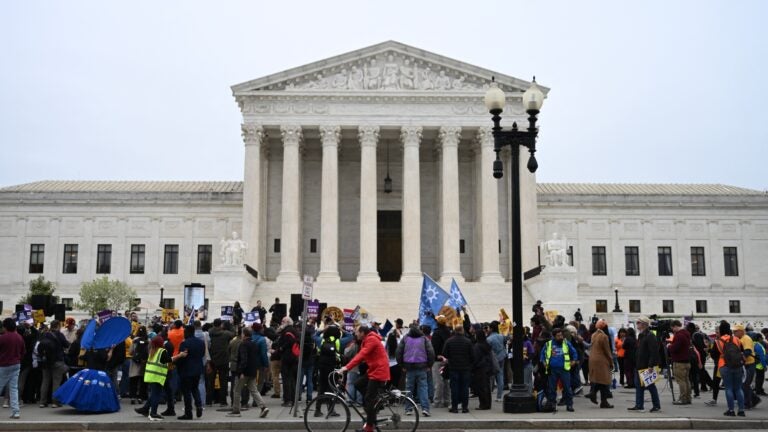
Massachusetts residents and advocates are waiting for a U.S. Supreme Court decision that could determine whether the federal government can end Temporary Protected Status for Haitian immigrants, a ruling that would directly affect tens of thousands of residents in the state who rely on the program.
The case comes after the Department of Homeland Security announced in September that it would end TPS for Haiti, which was first granted following the country’s devastating 2010 earthquake.
The Supreme Court is weighing whether the Trump administration can revoke TPS for Haitian and Syrian immigrants after the U.S. Court of Appeals ruled in March it cannot terminate the program. Last week, the Supreme Court heard arguments on the administration’s appeal.
The case’s outcome could set precedent for more than 1.3 million TPS holders nationwide and affect the over 45,000 Haitian residents relying on TPS in Massachusetts.
During Wednesday’s hearing, the court’s six-to-three conservative majority appeared to be sympathetic to arguments allowing the federal government broader discretion to end TPS protections, according to Reuters.
Following the hearing, Massachusetts advocates and attorneys are assessing the possible outcomes and the future of Haitian and Syrian immigrants in the state.
Boston immigration attorney Jeannie Kain said she predicts the case will be a “close call.”
Kain described the arguments supporting the continuation of TPS as strong. Lawyers argued the administration did not take the proper steps when deciding to end TPS and that the termination was motivated by Trump’s “racial animus.”
Still, Kain said the court’s conservative majority may ultimately outweigh legal arguments.
“What I think are strong arguments are not necessarily what those justices are going to think are strong arguments,” she told Boston.com. “I hope they make the right choice.”
Giselle Rodriguez, a Boston-based immigration attorney, said she is not optimistic about the outcome.
“The odds seem to be in the government’s favor, and I suspect the court may frame the issue as one tied to foreign policy, which could make it non-reviewable in their view,” she told Boston.com.
If that happens, Rodriguez added, the issue could return to lower courts to address procedural questions about how TPS was terminated.
“Unfortunately, this leaves many people in a difficult state of limbo,” she said.
Kain said many of her Haitian clients are experiencing an “immense amount of fear” about potentially being forced to return to Haiti, where armed gangs control large parts of the country and political instability has intensified.
“It’s hard to advise people about what to do, because it just seems like the Trump administration is really intent on getting rid of all their options,” Kain added.
Community leaders say the uncertainty is taking a toll on families in Massachusetts.
“I have to keep being hopeful,” Carline Desire, executive director of the Association of Haitian Women in Boston, told Boston.com after the hearing. “And we keep telling our folks, ‘You got to be hopeful.’”
Desire, who has spent the past decade advocating for Haitian TPS holders, said she found the tone of the Supreme Court justices discouraging.
“It was disheartening,” she said. “I think it’s a lot of false information that’s being fed to the judges … Folks are a little bit on edge, but we will continue to fight.”
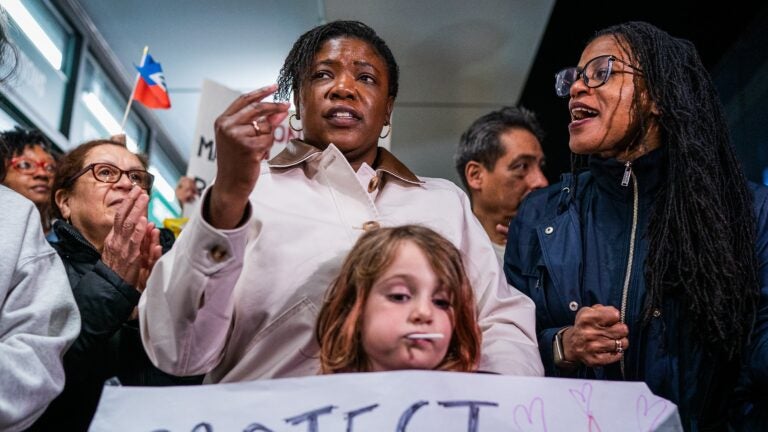
During Wednesday’s hearing, dozens of Massachusetts advocates and officials rallied in support of immigrants who could be affected by the court’s decision.
Among the advocates was Boston City Councilor Ruthzee Loujiene, the first Haitian American elected to Boston municipal government, who recalled in a statement traveling with her father, a Haitian immigrant, to D.C. advocating to protect TPS seven years ago.
“We know that the Trump administration did not follow the law, and we hope that the Supreme Court will recognize that as well despite their recent deference to strong presidential and executive power,” Loujiene said in a statement.
“Our Haitian neighbors deserve a pathway to permanence,” she added.

Massachusetts Attorney General Andrea Campbell filed an amicus brief April 13 — co-led with the attorneys general of California, New York, and Illinois — urging the court to affirm the lower court order temporarily blocking termination of TPS for Haiti and Syria.
The brief emphasized the economic and social contributions of TPS holders, citing estimates that roughly 75,000 Haitian TPS holders work in labor-short industries with significant workforce gaps.
Haitian TPS holders are a significant part of Massachusetts’ health care workforce, which is severely short-staffed. They also fill vital roles in other regional sectors like hospitality.
Kain said that in Boston in particular, losing Haitian immigrant workers could have far-reaching economic consequences.
“We have a large Haitian community, and we need them in the workforce,” she said. “It’s going to be a disaster for all of us, not just the Haitians but all of us Americans.”
Since the issue began, Campbell has filed multiple briefs in support of TPS protections, in September, February, and March.
“My office will continue to use every legal tool available to protect our immigrant communities and challenge unlawful actions brought by the federal administration,” Campbell said in a statement issued Wednesday.
A spokesperson for her office said further comment will come after the Supreme Court issues its ruling.
Earlier this month, Rep. Ayanna Pressley, co-chair of the House Haiti Caucus, pushed bipartisan legislation to extend TPS for Haitians for three more years. The measure still has to be voted on in the Senate.
“We are so lucky to have so many champions on our side like Pressley,” Desire said.
Regardless of the outcome, Desire said the plan is to continue fighting for the Haitian and other vulnerable immigrant communities.
“We just have to keep on fighting,” she said. “We are resilient people, and we’ve been at it since the beginning of the nation.”
Get everything you need to know to start your day, delivered right to your inbox every morning.



Be civil. Be kind.
Read our full community guidelines.To comment, please create a screen name in your profile
To comment, please verify your email address