
Senate strikes deal to vote on spending bill just as funding expires
“It is good for the country that we have reached this bipartisan deal. It wasn’t easy, but our persistence has been worth it.”
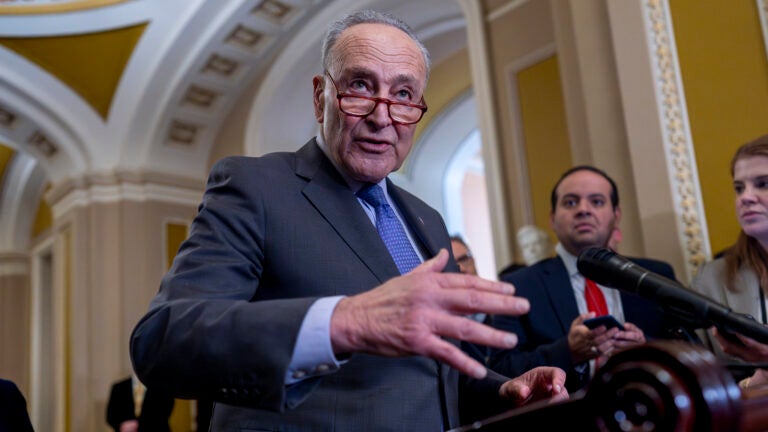
WASHINGTON — Senators struck a deal late Friday night to pave the way for the passage of a $1.2 trillion spending bill to fund more than half the government, with a final vote set for the early hours of Saturday morning.
The agreement, which allowed Senate Republicans to hold a series of politically charged votes on proposed changes, came after hours of haggling that threatened to push the government into a brief partial shutdown over the weekend. Instead, it appeared that the funding lapse, which started at midnight, would last a matter of hours and have no practical effect.
“It’s been a very long and difficult day,” Senate Majority Leader Chuck Schumer, D-N.Y., said in announcing the deal. “But we have just reached an agreement to complete the job of funding the government. It is good for the country that we have reached this bipartisan deal. It wasn’t easy, but our persistence has been worth it.”
The White House said that President Joe Biden would sign the bill on Saturday and that the government had halted shutdown preparations. But the delay underscored the difficulties that have plagued spending negotiations from the beginning, and was a fitting coda to an excruciating set of talks that are on track to fund the government six months behind schedule.
It capped an extraordinary day on Capitol Hill that began with a bipartisan vote to speed the measure through the House, which set off a conservative revolt and prompted one Republican to threaten a bid to oust Speaker Mike Johnson from his post.
Earlier Friday, in a 286-134 vote that came down to the wire in the House as leaders scrounged for the two-thirds majority needed for passage, Democrats rallied to provide the support to overcome a furious swell of opposition by conservative Republicans.
Infuriated by the bipartisan spending agreement, the hard right balked, and Rep. Marjorie Taylor Greene, R-Ga., began the process of calling for a vote to oust Johnson.
The bill’s passage came at a steep political price for Johnson, who was forced to violate an unwritten but sacrosanct rule among House Republicans that Greene alluded to against bringing up legislation that cannot draw support from a majority of their members. Just 101 Republicans, fewer than half, supported it.
That left it to Democrats to again supply the bulk of the votes to push the bill through.
This article originally appeared in The New York Times.





To comment, please create a screen name in your profile
To comment, please verify your email address
Conversation
This discussion has ended. Please join elsewhere on Boston.com