
Newsletter Signup
Stay up to date on all the latest news from Boston.com
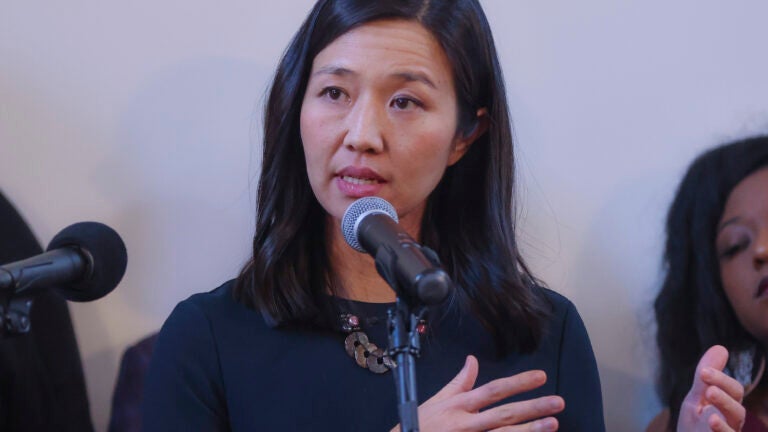
Mayor Michelle Wu on Thursday rolled out an ambitious $67 million plan to bolster Boston’s affordable housing supply by creating and preserving 802 income-restricted units across the city.
“We’re very grateful to have a once-in-a-generation opportunity to show how much impact happens when you invest in housing across the entire community,” Wu said during a press conference at the former Blessed Sacrament Church in Jamaica Plain, one of the development sites included in the plan.
The projects span eight neighborhoods — Allston, Chinatown, Dorchester, Jamaica Plain, Mattapan, Mission Hill, Roxbury, and South Boston — and will include units available for rent and purchase, the mayor announced. Of those units, 160 will be income-restricted senior housing.
There are 17 projects in all, including Blessed Sacrament Church.
The Boston Archdiocese shuttered the church in 2004 and sold the building, and “for almost 20 years, this beautiful space has been sitting empty, waiting for the vision and team to recognize and realize its potential, and the coalition to do that,” Wu said.
The Hyde Square Task Force purchased the building in 2014 “with this big dream that we were going to make sure it remained a piece of the community,” said Celina Miranda, the organization’s executive director. “And here we are.”
Soon, Wu said, the site will house 55 mixed-income rental units and a new performance space for the Hyde Square Task Force creative arts program.
“This is exactly what we want to see all across the city: Treasured community spaces maintained and even expanded in the uses that match the needs of our communities today,” she said.
The projects covered in the plan will be constructed on both public and private land, built through partnerships with for-profit and non-profit developers, Wu said.
“Affordable housing is the foundation that everything else needs to be built upon, and I’m so grateful to have so many partners in this work in Boston rethinking it from every angle,” she said.
Her office said in a news release that municipal and federal funds administered by the Mayor’s Office of Housing account for more than $32.5 million in funding for the projects. Another $13.9 million can be traced to the city’s Linkage program, where developers in large-scale commercial projects are required to make a contribution to the Neighborhood Housing Trust.
The city is making use of federal recovery money as part of its plan, Wu said, though she noted that those limited funds will eventually run dry. To that end, she reiterated the need for sustainable revenue sources to fund affordable housing, particularly a proposed real estate transfer fee that is now pending in the state Legislature.
Speaking at Thursday’s press conference, City Councilor Kendra Lara described the new affordable housing plan as a step forward for Boston.
“This is getting us one step closer to really building a city of Boston that is for all of us, and it won’t be the last time that we’re going to be celebrating more affordable housing, more creative performance space, and more creative solutions to the housing crisis that we see ourselves in today,” she said.

Stay up to date on all the latest news from Boston.com



To comment, please create a screen name in your profile
To comment, please verify your email address
Conversation
This discussion has ended. Please join elsewhere on Boston.com