

Newsletter Signup
Stay up to date on all the latest news from Boston.com
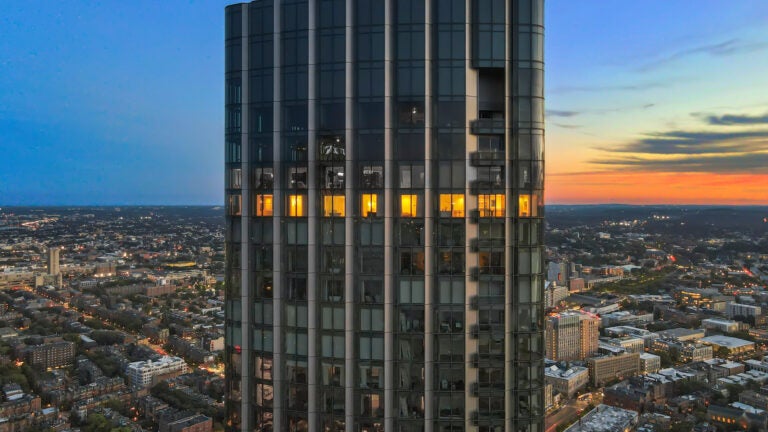
Inaction on Beacon Hill has cost Boston tens of millions of dollars that could have gone toward desperately needed affordable housing, according to a new report.
The report, from Washington, D.C. think tank Institute for Policy Studies, focuses on the city’s attempts to establish a luxury real estate transfer tax.
Boston previously sought to pass a luxury transfer tax in 2019, but the home rule petition never made it through the state Legislature. Mayor Michelle Wu signed a new petition earlier this year proposing a fee of up to 2% on real estate sales over $2 million. That bill remains on Beacon Hill, though the Massachusetts House of Representatives advanced the legislation last month.
In the meantime, Boston is losing out on potential revenue, according to IPS.
“Beacon Hill inaction has cost the City of Boston tens of millions, perhaps hundreds of millions, of dollars of revenue that could have been deployed to help solve the city’s housing problems,” the report said.
The report’s authors looked at six luxury buildings: Echelon Seaport — which includes towers at 133 Seaport Boulevard and 135 Seaport Boulevard — Pier 4, One Dalton Place, The Archer, and The Sudbury.
Analyzing real estate sales above $2 million at these properties, IPS determined that Boston has left more than $12.4 million on the table since mid-December 2019. If the city had levied a transfer tax on every sale in all six buildings, it could have raised $19.8 million, according to the report.
A more aggressive strategy at the six properties — leveling a 2% transfer fee on units sold for more than $2 million and a 4% fee on units $4 million and more — would have raised $29.8 million for affordable housing investments.
And those investments are badly needed; 52% of the city’s renters are cost-burdened, meaning they spend more than 30% of their income on rent, according to a March presentation from the Mayor’s Office of Housing. The same presentation noted that only 0.8% of rental listings were affordable to households making $50,000 or less.
The IPS report identifies three “invisible forces” fueling Boston’s housing crisis: an explosion in short-term rentals, an increasing shift toward corporate ownership of rental housing, and an increase in global billionaires looking to park assets in U.S. real estate markets.
“These forces compound the existing problem of inequality-fueled gentrification, driving up the cost of land and housing, putting homeownership out of the reach of the working-class, and increasing housing insecurity for tenants,” the report explains.
In addition to passing Boston’s home rule petition for a transfer tax, IPS recommended adding progressive transfer tax thresholds — that is, increasing the fee depending on the cost of the property — and levying an “empty homes tax” to target vacant properties.
The report’s authors also recommended that the ownership behind real estate LLCs and trusts be made more transparent through a public registry, and that properties owned anonymously face an annual property surtax and a 1% higher transfer tax rate in the meantime.
In some places, the authors note, “anonymous buyers are snatching up thousands of single-family homes and apartments, raising the question for policymakers: Who is buying our community?”

Stay up to date on all the latest news from Boston.com



To comment, please create a screen name in your profile
To comment, please verify your email address
Conversation
This discussion has ended. Please join elsewhere on Boston.com