
5 takeaways from the Pennsylvania Senate debate
Lt. Gov. John Fetterman and Mehmet Oz traded blows over abortion, fracking and empathy for working people in the first and final debate of their closely watched Senate race.
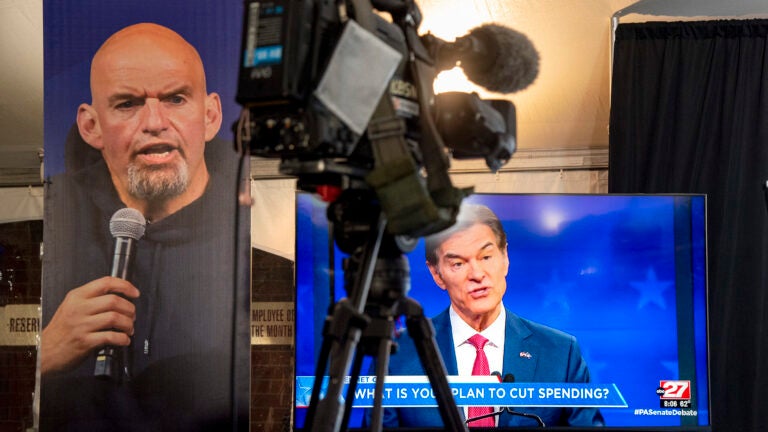
Lt. Gov. John Fetterman of Pennsylvania and Mehmet Oz, the celebrity television doctor, collided Tuesday in one of the most closely watched debates of the midterm campaign. The Pennsylvania Senate matchup was both highly personal and unusual, as viewers watched Fetterman, a Democrat, rely on closed captioning to accommodate for the lingering effects of a stroke he had in May.
Fetterman set out to show Pennsylvania voters that he is ready to serve — and to take on a Republican opponent who has recently gained ground in a race that could decide control of the Senate. He repeatedly called the Republican a liar, invoking what he called “the Oz rule — that if he’s on TV, he’s lying.” Oz didn’t hold back either, casting Fetterman as “extreme” and accusing him of misrepresenting his positions.
Here are five takeaways from the first and final debate of one of the most consequential Senate contests in the nation:
Fetterman is asking voters to bear with him.
For many voters, the debate was their first extended chance to see what Fetterman looks and sounds like after his stroke. He could sound halting, sometimes jumbling words, using the wrong one, and occasionally sounding off-key. He opened the evening by saying, “Good night.”
His performance will test whether voters regard his impairments as temporary or even humanizing setbacks, or whether it fuels questions about his fitness for office.
Fetterman was mindful of that challenge. From his opening remarks, he framed his experience as a comeback story still in progress.
“I had a stroke,” he said. Referring to Oz, he continued, “He’s never let me forget that. And I might miss some words during this debate, mush two words together, but it knocked me down, but I’m going to keep coming back up.”
Fetterman sometimes failed to prosecute a crisp case against his opponent, a television veteran, or to vigorously or extensively answer some of the criticism that came his way.
But he could also sound energetic and passionate, drawing contrasts on issues like abortion rights and urging his opponent to run against Sen. Bernie Sanders, given how much Oz tries to link the left-wing Vermonter to Fetterman. He also sought to use his illness to connect with others who are struggling.
“This campaign is all about, to me, is about fighting for everyone in Pennsylvania that ever got knocked down,” he said.
Swing-state Republicans are still struggling with abortion questions.
Three times, Oz was asked whether he would support a federal ban on abortions after 15 weeks of pregnancy, as Sen. Lindsey Graham of South Carolina has proposed.
And three times, Oz declined to give a straight answer, offering a vivid illustration of how difficult some Republican candidates are finding it to navigate the abortion debate after Roe v. Wade was overturned — especially candidates like Oz, who are seeking to appeal to suburban moderates who support abortion rights without alienating the conservative base.
Oz, who has previously said that terminating a pregnancy any time is “still murder,” said he saw abortion as a state issue and even inserted an addition to Democrats’ often-repeated line about abortion being a decision made by a woman and her doctor.
“I want women, doctors, local political leaders — letting the democracy that’s always allowed our nation to thrive — to put the best ideas forward so states can decide for themselves,” Oz said.
Fetterman jumped on the topic.
“If you believe that the choice of your reproductive freedom belongs with Dr. Oz, then you have a choice,” he said, promising to vote to codify abortion protections into law, given the opportunity. “If you believe that the choice for abortion belongs between you and your doctor, that’s what I fight for.”
Oz pins Fetterman to his progressive past.
At several points, Oz — sometimes assisted by the moderators’ questions — called Fetterman out on disowning progressive policies he once espoused (he endorsed Sanders in the 2016 presidential race).
On fracking, which supports thousands of jobs in the state, Fetterman maintained, “I’ve always supported fracking,” even though, as recently as 2018, he said that he did not.
Oz also pressed Fetterman for having said in 2015 that he favored decriminalizing not just marijuana but drugs “across the board.” That was a “radical position,” Oz said — a theme he returned to throughout the debate to paint Fetterman as outside the mainstream.
But on one position, ending the legislative filibuster in the Senate, Fetterman gladly owned his view. When Oz accused him of wanting to “bust the filibuster,” in other words, allowing bills to pass without a 60-vote threshold, Fetterman responded: “That is true. That is true.”
Both men use relatability and real estate as cudgels.
At a moment when inflation is biting nearly every American, each candidate sought to nail the other as too privileged to relate to the plight of working people. Oz “has never met an oil company that he doesn’t swipe right about,” Fetterman said, a reference to his rival’s personal investments.
Fetterman repeatedly brought up Oz’s multiple properties, or as he put it at one point, “10 gigantic mansions.”
Oz — protesting that he wanted to speak about economic policies — responded that “the irony is that John Fetterman didn’t pay for his own house; he got it for $1.”
Indeed, Fetterman, who served for 13 years as the mayor of Braddock, Pennsylvania, a job that paid only a token salary, was supported by his relatively affluent family until he was elected lieutenant governor at 49. He purchased an industrial-style loft in Braddock for a dollar from a sister, who had paid $70,000 for it.
Both men largely stand by their party leaders.
President Joe Biden’s weak approval rating has many battleground Democrats keeping him at a distance.
But Fetterman was more supportive than many when discussing Biden, a native of Scranton, Pennsylvania, who was once known to Democrats in the state as Pennsylvania’s third senator. Asked if he supported a Biden run for president again in 2024 — a question many Democrats are dodging — Fetterman replied directly, “if he does choose to run, I would absolutely support him.”
And pushed on whether he disagreed with Biden on any policies, Fetterman paused for a while before replying that the president could do more to combat inflation.
“But at the end of the day, I think Joe Biden is a good, good family man, and I believe he stands for the union way of life,” he said, also noting low unemployment numbers.
Oz, for his part, won the Republican nomination with an endorsement from former President Donald Trump — a man who is anathema to some of the moderates he is trying to court. Asked if he would support a Trump 2024 run, he initially punted.
“I’ll support whoever the Republican Party puts up,” he said, shifting to talk up his interest in bipartisanship. But pressed on the question, he replied, “I would support Donald Trump if he decided to run for president.”
This article originally appeared in The New York Times.





To comment, please create a screen name in your profile
To comment, please verify your email address
Conversation
This discussion has ended. Please join elsewhere on Boston.com