
Andrea Campbell wants information about ‘inaccuracies’ in Boston police data
"It's clearly demonstrating that there's some weird trends going here or some fluctuation in the data that's quite unreliable."
Related Links
-
Local News
Boston councilors met to talk over progress on following new police reform measures. City police did not attend.
-
Boston Politics
‘Turning point’: Women of color are increasingly emerging as leaders in Boston
-
Local
Civil rights complaint filed against Boston over lack of diversity in contract work
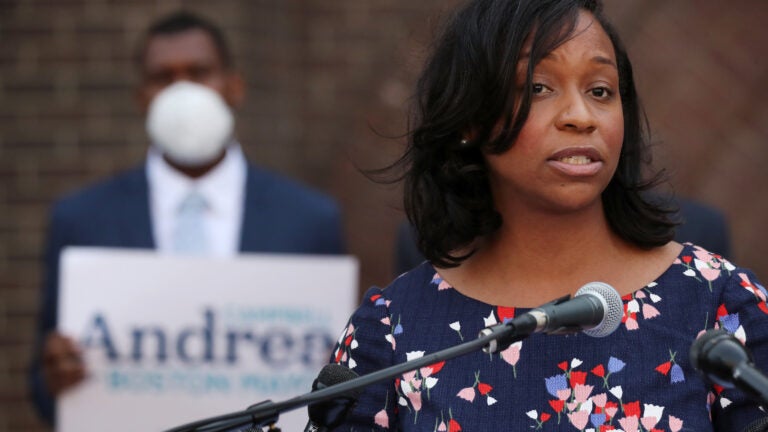
City Councilor Andrea Campbell is seeking clarity regarding alleged inaccuracies in publicly available Boston police crime statistics for the previous two years — data sets in which many incidents law enforcement responded to were either recorded more than once or saw “significant fluctuations” year over year.
The data, available on the city-run platform Analyze Boston, logs when and where incidents police respond to occur as well as the types of incidents that officers respond to every day. The data is often used to inform and shape public policy as well as the work and priorities of advocates outside the criminal justice system.
But Campbell, also a candidate for mayor, told fellow councilors Wednesday that there are inaccuracies in the data available for 2019 and 2020, which were first brought to her attention by Citizens for Juvenile Justice, a local nonprofit aimed at improving the state’s juvenile justice system, late last month.
Leon Smith, executive director of Citizens for Juvenile Justice, said Thursday the nonprofit was analyzing data for an ongoing project when it discovered the problems in the city data, which he commended officials for making available to the public online.
“At a time now, when communities are really demanding more transparency regarding the police and their role in communities, it’s really a positive step to have this type of front-facing data,” he said in an interview. “But when we looked at the data, and we began to really dig into it, we noticed some errors that really need to be fixed in order for it to truly be an accurate reflection of policing in Boston.”
Specifically, the city’s data set available for 2019 recorded 784,771 total incidents that year and the 2020 data lists 2,578,366 total incidents, while data for previous years listed annual totals of approximately 100,000 incidents, according to Campbell, who chairs the council’s public safety and criminal justice committee.
“Citizens for Juvenile Justice found that each incident is duplicated between twenty and thirty times, with every field being identical in both the preview feature of the web portal and when downloading the data as a .csv file,” Campbell wrote in a hearing order on the matter she filed Wednesday.
The 2021 data collected and posted so far also appear to have the same issue.
“There was also some troubling information in there in that some of the … numbers of incidents (reported) went up,” the councilor said, referring to “unique incidents” recorded in the data sets. “So for example, in the 2020 data set, assessed in January 2021, there were 29,194 unique incidents. But by comparison, there were close to 91,000 unique incidents in the data sets on Feb. 25, 2021, just a month later.
“And so it’s clearly demonstrating that there’s some weird trends going here or some fluctuation in the data that’s quite unreliable,” Campbell added.
Overall incidents for both years also increased after each year ended, according to Campbell’s hearing order.
The 2019 statistics listed 98,000 incidents as of Nov. 17, 2020, and then 662,000 incidents by Jan. 21, 2021, and 784,000 by Feb. 25, 2021, with most being duplicates, Campbell wrote. Meanwhile, 2020 data jumped from 2.1 million incidents in January 2021 to 2.5 million last month.
Campbell is also seeking answers as to why Boston police changed how it categorizes the incidents it includes in the annual data round-up.
She cited, for example, how offenses previously listed as “burglary-commercial-attempt,” “burglary-commercial-force,” and “burglary-commercial-no-force” have been consolidated into a single offense listed as “burglary-commercial.”
According to Smith, offenses such as disturbing the peace, disorderly conduct, and rioting were all consolidated into a category called “gathering causing annoyance, noisy party.”
Disturbing the peace and disorderly conduct are offenses that commonly bring young people into the criminal justice system and often in cases where de-escalation techniques “could have resolved the situation rather than arrest,” he said.
“When you conflate it into a larger category, it really blurs the line,” Smith said. “So you know, something like annoyance or a party, it’s something you’re more likely to see happening on college campuses, as opposed to an inner-city young person questioning why they’re being stopped and being charged.
“It’s important to look at data and be able to say, ‘OK, let’s understand the narrative behind the data,'” he continued. “And when you push a lot of these offenses together, that becomes a little more difficult.”
Similarly, Campbell said the consolidations “can obscure the police department’s activity [making] it difficult to effectively and accurately analyze, which is important to folks who want to look at trends and to really develop solutions on how you respond to incidents of violence in a more effective and impactful way.”
Campbell also said many offense descriptions were “inexplicably renamed” last year.
Boston police did not respond to a request for comment Thursday.
With her hearing order filed, Campbell is requesting councilors, police, the city’s analytics team, other officials, and the Citizens for Juvenile Justice meet to discuss the data sets in question as well as the reasons why the categorization and description changes were made.
“We know that the data that we release is critically important to actually solve incidents of violence, to reduce it, but most importantly, to develop a strategy that will actually work,” Campbell said.
Read the hearing order:
Get Boston.com's browser alerts:
Enable breaking news notifications straight to your internet browser.



To comment, please create a screen name in your profile
To comment, please verify your email address
Conversation
This discussion has ended. Please join elsewhere on Boston.com