
Hillary Clinton and Bernie Sanders try to sell unity to a divided New Hampshire crowd
The Vermont senator made his endorsement official, though not all of his supporters in attendance were pleased.
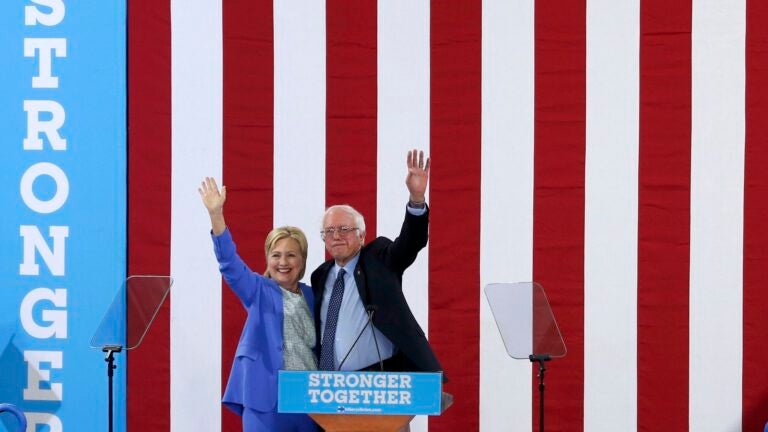
Hillary Clinton could have picked an easier place to sell unity than a progressive stronghold in the state where her former opponent won his first primary.
Nevertheless, standing together inside the packed and energized Portsmouth, New Hampshire gym Tuesday, Clinton and Bernie Sanders urged a vocally divided crowd to put aside differences to defeat presumptive Republican nominee Donald Trump.
“I can’t say how enjoyable this election is going to be now that we are on the same side,” said Clinton, the presumptive Democratic nominee.
Sanders spoke first Tuesday, making his endorsement of his former Democratic primary rival official, drawing on common ground and a common purpose.
“I have come here today not to talk about the past but to focus on the future,” he said. “That future will be shaped more by what happens on November 8 in voting booths across our nation than by any other event in the world.”
While bringing his campaign to an end, the Vermont senator applauded the effect of his “political revolution” and a party platform he called “by far the most progressive” in its history.
“Our job now is to see the platform implemented by a Democratically controlled Senate, a Democratically controlled House, and a Hillary Clinton presidency,” Sanders told the crowd.
After an at times contentious primary campaign, the return of the top Democratic candidates to New Hampshire evoked memories of 2008, when then-Sens. Barack Obama and Clinton rallied together in the state in an attempt to bring together embittered supporters.
At the time, nearly four out of 10 Clinton supporters said they would not vote for the soon-to-be Democratic president, much as 2016 polls show Sanders supporters just as reluctant to back Clinton in the general election. FiveThirtyEight reports that one in five Sanders supporters say they’ll vote for a third-party candidate.

Inside and outside the high school gym—draped in banners reading “Stronger Together”—Sanders supporters made their presence, and reluctance, known.
Sam Weaver, a Sanders supporter from Webster, Massachusetts, said he walked out of the event when he heard Sanders was actually going to support Clinton. Standing outside the school, demonstrating his support for the Vermont senator, Weaver said he still does not think the nomination is set in stone and plans to travel to Philadelphia at the end of the month to protest the Democratic convention.
“I can’t cave in on my morals” he said. “I’d rather stick with someone that is hopefully going to make the change I hope to see, rather than stick with someone I think will give us more of the same.”
Weaver said he plans to vote for Green Party candidate Jill Stein, if Sanders is not nominated.
During introductory speeches inside the gym, Clinton and Sanders supporters launched dueling “Hillary” and “Bernie” chants, at times shouting over each other. In one instance, however, both of those chants were dwarfed by chants of “unity.”
Admitting their differences, Clinton and Sanders made a point of listing the many issues on which they are on the same side, particularly compared to their Republican rivals: the minimum wage, abortion rights, LGBT rights, health care, student debt, the tax code, climate change, immigration reform, criminal justice reform, campaign finance reform, and nominating justices to the Supreme Court, among others.
“Think about the Supreme Court justices that Donald Trump will nominate and what that will mean for the civil liberties, equal rights, and the future of our this country,” Sanders said. During both candidates’ speeches, the loudest applause lines were ones denouncing the GOP candidate.
Jane and Johnathan Windsor, a married couple from Newmarket, New Hampshire, who attended the rally, said they were split during the primary and hoped to see Democrats nominate a “more progressive candidate.” Nevertheless, they both said they planned to enthusiastically support Clinton in the general election.
“If you don’t vote for her, you’re essentially voting for Trump,” said Jane Windsor, who supported Clinton during the primary as well, unlike her husband, but said she came around relatively late. Both credited Sanders with pulling Clinton closer to the ideological left.
Windsor was surprised how mixed the crowd was and said Sanders would have to be “strong and vocal” to assuage die-hard supporters, like Weaver.

“The profound lesson I have is this campaign is not about Hillary Clinton or Donald Trump or Bernie Sanders,” the Vermont senator said Tuesday, urging his supporters to follow his lead and work to elect Clinton. “It’s about about the needs of the America.”
“There is no doubt in my mind that as we head into November, Hillary Clinton is far and away the best candidate to do that,” he added.
Despite Clinton clinching the nomination in June, Sanders had said that he would stay in the race until the Democratic National Convention in late July, in a campaign to “transform” the party. That pledge angered some Democrats who wished to see the party rally around Clinton sooner.
All the while, however, Sanders consistently voiced his support for Clinton, as well as his intentions to work to defeat Trump in November. And following recent moves by Clinton and the national party to embrace some of Sanders’s more progressive proposals, the Vermont senator had all but formally endorsed Clinton as the Democratic nominee.
On Tuesday, he made it official—and said he plans to be “in every corner of the country” working to get Clinton elected in November. In turn, the former secretary appealed to Sanders supporters
“We need to go big and bold,” she said, pledging “the biggest investment in new good-paying jobs since World War II” and reiterating her opposition the Trans-Pacific Partnership trade deal, which has recently served as a dividing line between the progressive and more moderate factions of the Democratic Party.
Clinton also hoped to utilize the organizing and fundraising strength of the historic grassroots movement that was Sanders’s campaign.
“We accept $27 donations too, you know,” she said.





To comment, please create a screen name in your profile
To comment, please verify your email address
Conversation
This discussion has ended. Please join elsewhere on Boston.com