
Get the latest Boston sports news
Receive updates on your favorite Boston teams, straight from our newsroom to your inbox.

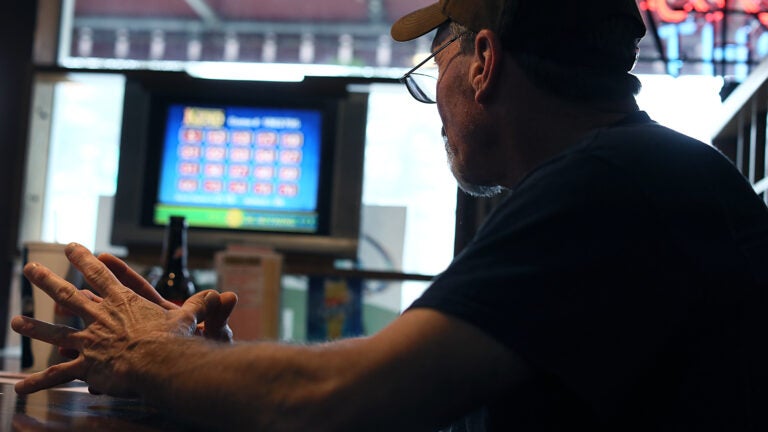
As millions of Americans prepare to place bets ahead of Super Bowl LX, gambling activity is reaching record highs — and so are concerns about problem gambling in Massachusetts.
The American Gaming Association estimates that U.S. sportsbooks will handle approximately $1.76 billion in wagers on Super Bowl LX, a nearly 27% increase from last year.
In Massachusetts, where sports betting was legalized in August 2022 and has expanded rapidly, recent data show strong economic gains alongside mounting public health concerns.
The Massachusetts Gaming Commission reported $98.47 million in taxable sports betting revenue in December 2025, generating a record $19.6 million in tax revenue for the Commonwealth. Sportsbooks accepted more than $845 million in wagers that month.
While most bets are casual, addiction specialists warn the “ubiquity” of gambling is increasing risk for vulnerable individuals.
Problem gambling, also known as gambling disorder, is a recognized addiction similar to substance use disorders.
“We diagnose a gambling disorder just as we would an alcohol use disorder or an opioid use disorder,” said James McKowen, a clinical psychologist and clinical director of the Addiction Recovery Management Service at Mass General Hospital.
Like other addictions, gambling triggers the dopamine system in the brain. The rush of winning — or even just anticipating a bet — can reinforce the compulsive behavior, according to McKowen.
Recent research suggests the problem is growing in Massachusetts. A University of Massachusetts Amherst study found that among gamblers:
Take it from Patriots wide receiver Kayshon Boutte. The 23-year-old recently chronicled his own struggles with gambling addiction in an essay in The Players’ Tribune titled “How the Hell Did I Get Here?”
“I’d wake up early in the morning, and the first thing I’d do was bet,” he wrote. “I’d stay up late and bet. All day. All night.”
“I knew I was addicted,” Boutte said.
“It is probably related to the ubiquity, now, of online gaming,” McKowen said.
The easy access to mobile sports betting apps, prop bets, and online casinos makes gambling more frequent and harder to control – not to mention the omnipresence of sports betting ads in places far and wide.
Gambling becomes problematic when it shifts from entertainment to compulsion, McKowen said. While it only affects about 1-2% of the U.S. population, there are red flags to look out for. They include:
McKowen noted that gambling is increasingly used as a coping mechanism for those struggling with mental health issues.
“This idea that gambling reduces my stress and I get a dopamine rush, it’s really reinforcing using it as a tool to deal with emotional challenges or mental health issues,” he said.
The Super Bowl itself can heighten risk, he said. Gamblers with a deep knowledge of the game or the team might believe that they’re making an educated guess with their bets — but this is misleading.
“This is actually just a false belief. It’s still just chance. But there’s a sense of perceived skill involved, which can be a piece of the enticement,” he said.
Dr. McKowen emphasized that help is available — and early intervention is key. In Massachusetts, gamblers can “self ban,” through the Voluntary Self-Exclusion Program. This allows gamblers to voluntarily exclude themselves from casino gambling, sports wagering, or both for a certain amount of time.
“It’s not foolproof, but it can be a nice behavioral strategy to help you,” McKowen said.
Treatment options include cognitive behavioral therapy, medication, and peer support groups such as Gamblers Anonymous, he added.
For immediate support, contact the National Gambling Helpline 1-800-662-4357 or accessing resources through the Massachusetts Gaming Commission.
Ahead of Super Bowl Sunday, McKowen warned, “for someone who’s vulnerable, it becomes a different kind of animal, and they can really struggle.”

Receive updates on your favorite Boston teams, straight from our newsroom to your inbox.



To comment, please create a screen name in your profile
To comment, please verify your email address
Conversation
This discussion has ended. Please join elsewhere on Boston.com