‘It’s difficult not to take ghosts home with you’: Why David Robichaud decided it was time to leave broadcast news after almost 40 years in the business
"It’s a very personal decision."
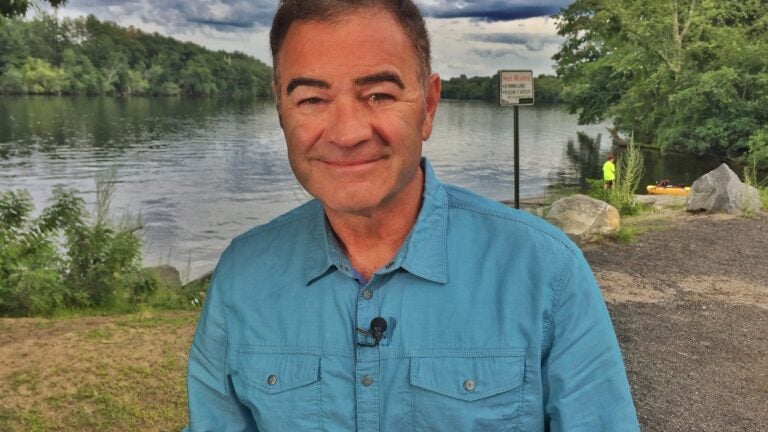
David Robichaud first walked through the doors of WBZ in the spring of 1983. At the time, he was senior at Bridgewater State, participating in the school’s internship program with the station. On July 20, the Emmy award-winning reporter made his exit from broadcast journalism, after four decades of delivering news to television screens across Greater Boston. The native of Concord, Massachusetts, said he feels blessed to have been a part of the Channel 4 organization as long as he was, but he is looking forward to returning to his alma mater, where he will take up the position of Assistant Vice President for Content Strategy and Development.“It was an incredibly difficult choice,” the 57-year-old Concord resident told Boston.com. In an interview with Boston.com, Robichaud reflected on his time at WBZ, the stories he’s proudest of, and what went into his decision to leave the news business.(Editor’s note: This interview has been edited for length and clarity.)Boston.com: You said you started as an assistant assignment editor at WBZ in 1985. How did your career progress at Channel 4?David Robichaud: It was actually a crazy, unconventional journey. What happened was I was an assignment editor for many years. I was at the station Christmas party one year, and I had done karaoke the year before — Barry Manilow. The next year we actually had a band, so everybody asked me to get up and sing with the band. I said, ‘OK, what the heck.’ So I got up with the band, I sang, ‘After the Lovin.’ It kind of brought the house down.The general manager at the time came up to me after that and said, ‘We have to figure out a way to get you on TV.’ What they did is they put a remote camera over the assignment desk where I worked and at 6:55 the anchors would come to me, ‘OK, for a look at what stories we’re covering today, let’s go in and talk to David Robichaud.’ That was really how it began, with sort of a glorified tease. A way to tell the viewers what stories were coming up that day. But what happened is it morphed into this very spontaneous, unscripted thing where Suzanne Bates and Joe Shortsleeve and myself would end up talking about whatever current event, sometimes our personal lives, and it took on a life of its own.

Robichaud with Charles Austin.
And because the segment became a very popular part of our morning show, the news director just said, ‘You know what, you’ve been in news for a while now, would you like to give reporting a try?’ So what I would do is I would be a regular assignment editor five days a week, but on the weekend I would go out with a reporter, do some interviews, do a little writing on the side, and hand in these scripts and these stories that wouldn’t make air yet because they wanted to see if I was good enough. And they eventually let me on TV a couple times as a freelance reporter and then they offered me a contract. And that was in 1995 — the first time on the air.
I was very blessed to be able to get that opportunity and seize it and keep it going for all these years.
What would you say were some of the best parts or best memories of working at Channel 4 over the years?
Meeting, and working with, giants of the industry. People that really inspired me. Charlie Austin, who just passed away this year. John Henning was a big mentor of mine, wonderful man, such a gentleman. Joe Shortsleeve, a mentor of mine, who’s out of the business now. And the countless people behind the scenes — photographers, editors, writers, who I’ve worked with over the years.
And then I think this job — what I tell people all the time is — you have a front row to history and sometimes that can be great.
And sometimes that can be bad.

Robichaud in the field.
I remember back in the ’90s meeting the most charismatic person I’ve ever met in my life. It was in the hallway of the Copley Plaza Hotel. He was shaking hands with everyone, and he would instantly remember your name and 10 minutes later call you by your name. Everybody. The valet guy, the chambermaid, my photographer at the time.
This gentleman was the governor of Arkansas at the time — Bill Clinton.
So you get to meet history-makers and interview history-makers and have a front row seat to history. And oftentimes that’s great.
But, what comes along with that? I spent eight days at ground zero after 9/11. Several sleepless nights and days working after the marathon bombings here. Those are the things — those are the ghosts you take home.
Is there a story that you would say your proudest of in your career?

Robichaud traveled across the country with a lifesize cutout of Tom Brady for a segment of “Robi on the Road.”
That’s hard. There’s just so many. You try to — or at least I try to — inspire people with every story that you do. It’s difficult to think of one off the top of my head. But one of the most fun things I ever did was I took a lifesize, cardboard cutout of Tom Brady with me across the country in 2007 when they made the Super Bowl. We stopped in every Patriots enemy territory along the way. It was really fun.
It was a segment that I used to do call ‘Robi on the Road.’ And those are the segments I loved doing the most because in those stories, nobody dies. Nobody gets killed. Nobody’s indicted. Nobody’s in court. They were profiles of people who do amazing things in their community, unique things in their community, that help and inspire others. And those are the stories that I enjoyed doing the most.
When did you decide that you were ready to leave the field and move on to something new? What went into that decision and how does it feel to be moving on after so many years?
I have always had a deep love and commitment for my alma mater. From the day I graduated in 1983, I’ve been on various alumni committees down there. I go to every homecoming I can. I’ve been asked to speak on behalf of the school many, many times, and I use that as my platform to encourage people to take advantage of public higher education and not to have what I call ‘low state college self-esteem.’ So I’ve always, always, always been involved with my college.
But to answer your question… I tell you, I’m surprised that after 9/11 I didn’t get out. Because the cumulative effect of covering a story like that for eight days in a row for several 16-, 18-hour days in a row — I remember taking advantage of the Red Cross down there, they offered us mental health counseling. And I took advantage of that a few times because you just feel like you’re going to lose your mind.

Robichaud reporting in New York after the 9/11 terrorist attacks.
I refer to it as — you know — it’s difficult not to take ghosts home with you. That’s not to make anybody feel bad for me or bad for journalists in general. But I think if you ask any of my colleagues or competitors, they’ll tell you the same thing.
When you’re a general assignment reporter, a lot of times you end up doing what I call, ‘Murder Incorporated.’ Every single day is you’re knocking on the door of someone, ‘Oh, I’m sorry to bother you. It’s so tragic that your daughter was killed on prom night. Would you talk to us, would you show us a photograph of her?’ The next day — knock, knock, knock — ‘I’m so sorry to hear your son was killed in Afghanistan, would you share his story with us? Would you talk with us?’ The next day — knock, knock, knock — ‘I’m so sorry your grandfather was killed by a hit-and-run driver, are you going to the arraignment of the suspect today? Would you like to talk with us?’
Over and over and over again.
There’s a cumulative effect of that, [and] I never got cynical about it. That’s something I’m most proud of. You can’t. You can’t take any life for granted.
But after a while it just wears on you.
Every one of those stories, my goal was let’s make this victim into a person. Let’s present to our viewers the story of this person who passed away in such a tragic manner, but let’s humanize them. What were their hobbies? What were their joys? What did they accomplish in their interrupted life? Not how devastated their family is, not sensationalizing that. But geez, let’s not let this person go out as a statistic.
I think that was always the goal.
But in the back of my mind, I had [to] let my bosses know that I can’t do this anymore. I have an opportunity to go tell only good stories, only positive stories, only uplifting stories. No more heartbreak, no more tragedy, no more bad people doing bad things to good people. I’ve had a enough. Enough.
That’s not a reflection on my industry or my bosses or my coworkers or anything. It’s a very personal decision.
When I heard about this opportunity, I just thought, ‘Wow, I would have the opportunity to be like the editor and chief of that institution and tell the inspirational stories our incredible alumni and our hardworking and ambitious students and our incredibly talented professors.’ And that appealed to me so much.