
Sign up for the Today newsletter
Get everything you need to know to start your day, delivered right to your inbox every morning.
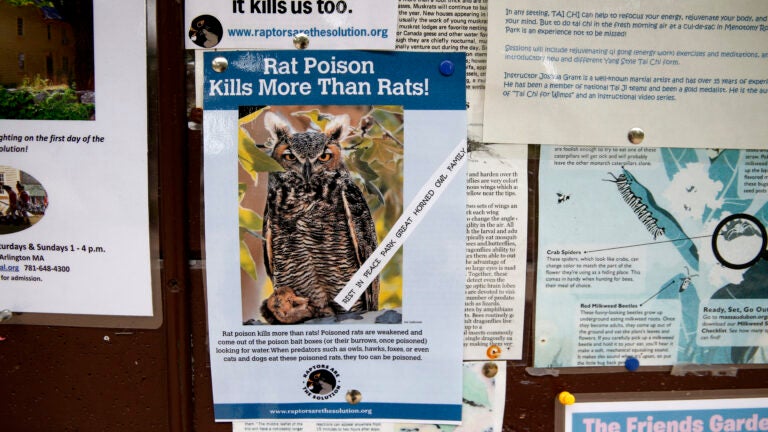
By the middle of the 20th century, bald eagles were pushed to the brink of extinction. Conservationists made a dedicated effort to save the iconic species, and their work paid off: bald eagle populations are now in the midst of a major comeback, both nationally and in Massachusetts.
But, a new threat is looming, one that endangers a wide variety of animals in addition to the bald eagle. Anticoagulant rodenticides, particularly newer versions of these poisons known as SGARs, are harming wild animals and pets throughout Massachusetts, experts say.
Wildlife veterinarians have been alarmed by SGAR use for decades, but public knowledge and advocacy has skyrocketed in recent years, leading to a fresh sense of momentum and optimism among those who want to see a statewide ban.
A bald eagle known as FAE was found dead in Arlington last month. Its body was brought to the Tufts Wildlife Clinic, where a postmortem examination took place. Last week, the results of those tests became public: FAE died from SGAR poisoning.
“Analysis of liver tissue was positive for three second-generation anticoagulant rodenticides. These results, along with the presence of significant hemorrhage in the absence of evidence of traumatic injury on the post-mortem examination, support a diagnosis of anticoagulant rodenticide toxicosis as the cause of death in this eagle,” Maureen Murray, director of the Tufts Wildlife Clinic, said in a statement.
For those who monitor bald eagles in eastern Massachusetts closely, FAE’s death was particularly tragic because of her connection to MK, an eagle that died in 2023. MK was found alive in Arlington, but rescuers were ultimately unable to save her from SGAR poisoning. FAE had mated with MK’s “widower” following that eagle’s death, according to a group called Save Arlington Wildlife.
While the SGAR-related deaths of bald eagles are high-profile events, the threat is much more widespread, according to Heather Packard, a community organizer at Mass Audubon who oversees that organization’s “Rescue Raptors” initiative.
“The scope of the problem is so broad,” she said. “It isn’t just the bald eagles that are being harmed.”

Second-generation anticoagulant rodenticides, or SGARs, are rodent poisons that work by preventing blood clotting within the animals that consume them. They are slow-acting, taking between two and 10 days to kill a rodent. As the poisoned rodent dies, they become sluggish and easier to pick off by predators.
SGARs bioaccumulate, or build up over time, in creatures that consume them, even indirectly. It is in this way that SGAR poisoning has become a serious threat to birds of prey, foxes, and even coyotes. Pets are at risk as well, either because they consume SGARs directly or eat poisoned rodents.
Retailers are federally prohibited from selling SGARs to consumers, but licensed pest control companies can use the poisons.
Zak Mertz, CEO of New England Wildlife Centers, said the organization has been treating animals with anticoagulant rodenticide poisoning for close to 20 years. NEWC operates two wildlife hospitals, where veterinarians see a minimum of 50 patients a year that have been poisoned with rodenticides.
Caring for these animals is a unique and lengthy process, he said. There is nothing veterinarians can do to pull the SGARs out of an animal’s system directly. Instead, veterinarians work to support the animals as their bodies heal. Mertz recalled one instance where an owl with SGAR poisoning was kept at a wildlife hospital for 352 days before it could return to the wild. That owl’s parents and its sibling all died after consuming the same poisoned rat.
In the past, wildlife veterinarians could usually rehabilitate animals with rodenticide poisoning within about three months. Now, it is rare for them to be able to do so in under six months, Mertz said. He attributed this to the increased danger posed by SGARs compared to their “first generation” precursors. Mertz also worries that pest control companies could be increasing their SGAR use.
“An incredible amount of resources go into every single one of these patients that are poisoned,” he said.
But, Mertz is now seeing a surge in attention to the issue, and is hoping that support can translate into a statewide ban on SGARs.
“While it’s heartbreaking to treat patients that are suffering from SGAR toxicity all the time, it’s really pretty amazing to see the level of awareness that’s grown,” he said.
The death of MK in 2023 became the “spark” of the current wave of advocacy, Packard said. Hundreds rallied in Arlington after that eagle died, calling for lawmakers to crack down on SGAR use.
Local officials in many places across Massachusetts have taken action. Individual cities and towns can ban SGAR use on municipal property, something at least 48 communities have done in some capacity, according to data maintained by Packard.
Municipalities do not have the authority to restrict SGAR use on private property, and those that want to do so must file home rule petitions with the state Legislature. This is a long and inefficient process that so far has not resulted in any communities getting the approvals they seek, Packard said.
Twenty municipalities have filed home rule petitions looking to ban SGAR use during the current legislative session, Packard said. Fourteen more have home rule petitions pending in various states of approval at the municipal level that have yet to be filed with the Legislature.
“The goal has always been to get a statewide ban,” Packard said. “But the state, in spite of overwhelming evidence, has not acted. So cities and towns are taking it into their own hands to ask for an exemption because they know that it’s the right thing to do for their communities.”

Individual bills that would restrict SGAR use have been pending on Beacon Hill, but lawmakers are now using other methods to increase the odds that SGAR restrictions are finally approved.
Last week, the state Senate unanimously adopted an amendment to its sweeping environmental bond bill that would allow municipalities to restrict or ban anticoagulant rodenticides without needing legislative approval. The bond bill itself was also passed and is now moving to the House.
That amendment was spearheaded by Sen. Michael Moore of Millbury. Although Moore is a proponent of a statewide SGAR ban, he assessed that a local option would be more palatable for his colleagues in the Senate, he said. The amendment’s passage ensures that lawmakers will be able to bring the issue to a conference committee with members of both the House and the Senate later this year, he said.
During the bond bill process, grassroots advocates “pummeled” senators with calls to approve SGAR restrictions, Packard said. Moore saw this firsthand, saying that he and his colleagues received a notable surge in calls and emails.
“The response from the community has been profound, and it has really grown,” Packard said. “The momentum we see at the State House is completely because of local grassroots dedication, commitment, and hard work.”
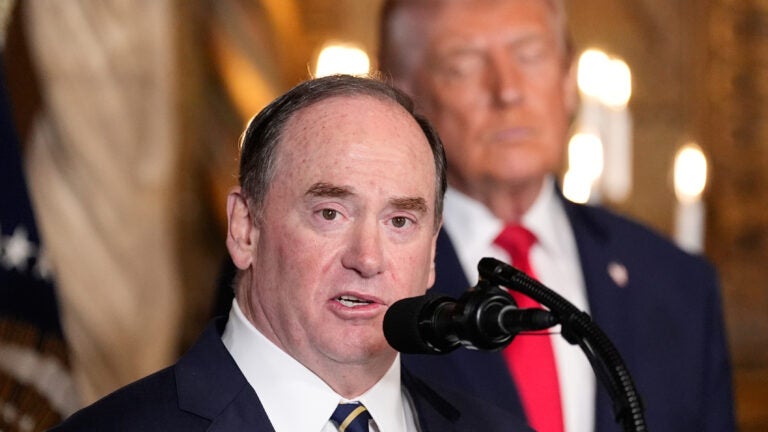
On the House side, Rep. Jim Hawkins of Attleboro filed an amendment to the fiscal year 2027 budget that would restrict the use of anticoagulant rodenticide statewide. A vote on individual amendments is scheduled for early next week, followed by a full vote on the budget.
Hawkins said he was “very surprised” to see that Moore pushed for a local option, rather than a statewide ban. He worries that a “patchwork” of rules could prove problematic down the road. Still, Hawkins is supportive of any steps that lead to more restrictions.
“We’re not taking any chances with this, we’re trying every option to get it through,” he said.
Moore, for his part, said he was supportive of Hawkins’s budget amendment.
“Whatever vehicle is going to allow us to get this implemented sooner rather than later, I’m in support of,” Moore said. “I do think we have a lot of momentum going in right now, and there’s a good chance for us to get it somewhere, either in the bond bill or the budget.”
While there are reasons for optimism, Moore also sounded a note of caution.
“Nothing is finished until it is signed by the governor,” he said.
Get everything you need to know to start your day, delivered right to your inbox every morning.



Be civil. Be kind.
Read our full community guidelines.To comment, please create a screen name in your profile
To comment, please verify your email address