
Sign up for the Today newsletter
Get everything you need to know to start your day, delivered right to your inbox every morning.
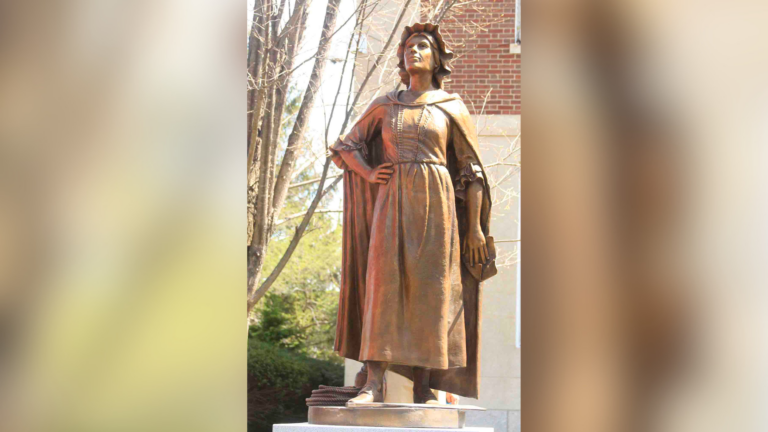
A Medford woman credited with playing a key role in the Boston Tea Party was honored Monday with a statue unveiled outside Medford City Hall.
Sarah Bradlee Fulton, often referred to as the “Mother of the Boston Tea Party,” helped disguise participants by painting their faces and concealing their clothing, according to the Boston Tea Party Ships and Museum. She also waited for their return and disposed of the disguises.

The statue, unveiled on Patriots’ Day, caps a long-running effort led by Laura Duggan, a historian, actress, and playwright who hosts the show “Looking Back at Medford History.”
Duggan began the project in early 2024 and later founded a nonprofit, Looking Back at Medford History, to raise funds with the help of donors.
“I came across this woman who was dubbed the ‘Mother of the Boston Tea Party,’ and I wondered, ‘How did a Medford woman become the mother of the Boston Tea Party?’” Duggan told Boston.com.
As her research deepened, Duggan said she came to see Fulton as “quite a remarkable woman” — one she had never encountered in her own studies.
“Women involved in various parts of history are often overlooked or forgotten,” she said. “I felt that she really needed to get some recognition for what she did.”
Fulton’s contributions extended beyond the Boston Tea Party, Duggan said. After the Battle of Bunker Hill, she organized women to care for wounded soldiers. In 1776, Fulton carried an urgent message through British lines along the Charlestown waterfront on behalf of John Brooks to George Washington.
During the siege of Boston, Fulton also confronted British soldiers who had seized a wood shipment meant for American troops. She reportedly chased them down, grabbed the oxen pulling the wagon, and turned them around — even daring the soldiers to shoot, according to the museum. The soldiers were so astonished by her bravery that they surrendered the wood without resistance.
Fulton died in 1835 at 95 years old and is buried in Medford’s Salem Street Cemetery.
Duggan said the idea for a statue was rooted in permanence.
“A statue would be something with some lasting power to help people here, locally, remember this woman,” she said.
Duggan noted Fulton’s monument is one of only a few statues honoring women connected to the American Revolution.
“I think more people should know about her, because the women have not gotten the attention as to what they have contributed in the past for our country,” she said.
Duggan added that the statue is meant not only to honor Fulton but also to inspire others.
“She’s a symbol to inspire you to contribute to your community and fight for freedom,” she said.
Get everything you need to know to start your day, delivered right to your inbox every morning.



Be civil. Be kind.
Read our full community guidelines.To comment, please create a screen name in your profile
To comment, please verify your email address