
Sign up for the Today newsletter
Get everything you need to know to start your day, delivered right to your inbox every morning.
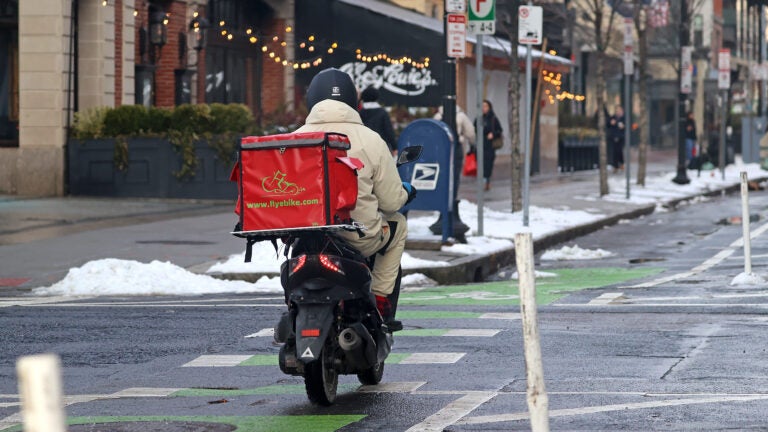
A Boston City Council member this week filed multiple measures that would significantly restrict the use of e-bikes, mopeds, or other motorized scooters in the city.
Councilor Ed Flynn is renewing a push to effectively ban the use of these vehicles by third-party food delivery drivers. He is also leading a new effort to potentially require that all riders of e-bikes that can travel more than 30 mph register their vehicle with the state and have a valid driver’s license.
Speaking during Wednesday’s City Council meeting, Flynn referenced multiple recent tragic events when advocating for the changes. Last year, a man died after being struck by an e-bike near Copley Square, and a teenage boy died after riding an electric dirt bike into a car in Stoneham.
Flynn referenced a Boston Globe opinion piece that ran last November where three Massachusetts General Hospital doctors raised concerns about the lack of oversight on e-bikes and similar vehicles. In that piece, the authors pointed to one study that found a 293% increase in e-bike injuries between 2019 and 2022 and another that found a nearly 100% annual increase in e-bike injuries.
“This is about acknowledging what our medical professionals and law enforcement have noted as a growing trend, to take action for safer streets, prevent more tragedies. This is about public safety. This is about public health,” Flynn said.
The new measure Flynn introduced would ban e-bikes that can travel more than 20 mph from bike lanes and sidewalks. It would also ban “high-speed” e-bikes, ones that can exceed 30 mph, from those areas. It would require that operators of high-speed e-bikes be older than 16, register their vehicle with the RMV, hold a valid driver’s license, and comply with all equipment, lighting, signaling, and traffic requirements applicable to mopeds or motorcycles. People who violate these rules would face fines of up to $250.
Separately, Flynn re-filed an ordinance that would ban third-party delivery drivers, including those working for companies like GrubHub and DoorDash, from using e-bikes and mopeds.
Last April, the City Council approved an ordinance filed by Mayor Michelle Wu that requires third-party restaurant delivery companies to obtain new permits to operate in Boston. To receive the permits, companies have to share certain data with the city and prove their drivers have liability insurance. Noncompliant operators face a potential $300 fine per day. Small businesses and grocery delivery companies like Instacart are excluded from the requirements, as are companies like UPS, FedEx, and Amazon.
Flynn’s proposal would amend that ordinance. He argues that it is “unrealistic” for the city to be able to enforce those rules given the hundreds of delivery app drivers who routinely operate in Boston. He said that he has heard consistent reports from residents about these operators running red lights, weaving between cars, using sidewalks, and driving the wrong way down busy city streets.
When Flynn introduced the idea of banning the use of these vehicles by third-party food delivery drivers last year, he received solid pushback from colleagues. They raised concerns about jeopardizing the livelihoods of low-income workers and spoke about the need to pressure the delivery companies themselves instead of individual operators. Only one other councilor signed on to the proposal at the time. This week, six others added their name to the ordinance.
Both of Flynn’s measures were referred to committees for review.
DoorDash pushed back on Flynn’s proposed ban, saying in a statement that such a policy would immediately eliminate a third of all the company’s Boston deliveries. The ban would cost local businesses millions of dollars and leave thousands of workers without a reliable income, a company spokesperson added.
“We couldn’t agree more with the push for safer, more responsible two-wheeled delivery, but an outright ban would have catastrophic consequences for the city’s local economy and would force more deliveries back into cars–meaning more pollution and more congestion. We remain a partner for the City as we work towards meaningful solutions together that will help keep Bostonians safe without damaging the city’s economy and sustainability efforts,” the DoorDash spokesperson said.
Flynn attributed the current lack of safety surrounding e-bikes and similar vehicles to two major factors. In 2022, the city “encouraged” large third-party food delivery companies to prioritize the use of two-wheeled vehicles, he said in a statement. Simultaneously, these companies are incentivizing workers to prioritize speed over safety in order to deliver more orders and get higher ratings from customers, he added.
“The result has been a significantly worsened pedestrian safety crisis, with mopeds and e-bikes going over 20 mph through red lights and stop signs nearly every day,” Flynn said in a statement. “No reasonable person believes the rules of the road can continue to be optional. It can no longer be the Wild West on the streets of Boston.”
Get everything you need to know to start your day, delivered right to your inbox every morning.



To comment, please create a screen name in your profile
To comment, please verify your email address
Conversation
This discussion has ended. Please join elsewhere on Boston.com