
Sign up for the Today newsletter
Get everything you need to know to start your day, delivered right to your inbox every morning.
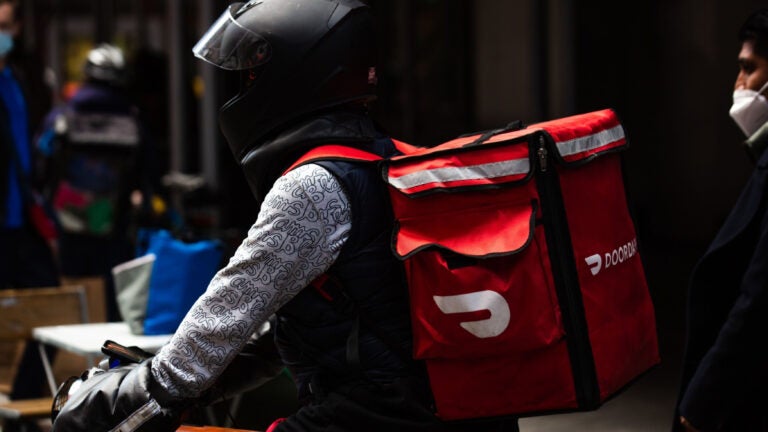
The city will soon require third-party restaurant delivery companies like Uber Eats, Grubhub, and DoorDash to obtain new permits in an effort to improve pedestrian safety.
On Wednesday, the Boston City Council voted 11-2 to pass the amended ordinance, with Councilors Erin Murphy and John FitzGerald in opposition. The legislation will go into effect in nine months.
The ordinance, initially filed by Mayor Michelle Wu in February amongst growing concerns over reckless driving, illegal parking, and increased traffic congestion, will require the companies to register with the city’s transportation department.
The companies will also need insurance coverage to protect those involved in crashes with delivery drivers, and to submit data to the transportation department to facilitate safety and congestion management.
The ordinance applies to all third-party food delivery companies in the city making over one million orders annually.
The ordinance excludes small businesses with a small number of delivery drivers, or those made by FedEx, UPS, or Amazon. It also excludes grocery delivery companies, such as Instacart.
If a provider fails to obtain a permit, they will be fined $300 per restaurant daily or $300 per order.
The amended ordinance did not include a controversial proposed 15-cent delivery fee for enforcement and related infrastructure improvements. Councilors removed the fee after voicing concerns that it would be passed on to consumers, local businesses, or delivery operators.
“For far too long, third-party delivery platforms have operated in Boston as if the rules don’t apply to them,” said District 8 City Councilor Sharon Durkan, who voted for the ordinance but raised concerns about it not including the fee to help combat the problems the companies cause on the streets.
“Their business models prioritize speed and profits over safety and accountability, leaving residents, pedestrians, and even their own drivers, to deal with the consequences of reckless and lawless behavior on our streets,” she continued.
A DoorDash spokesperson told Boston.com that the company was pleased the Boston City Council listened to their concerns over the fees.
“Hundreds of Boston customers, Dashers, and merchants made their voices heard loud and clear about some of the consequences that this ordinance could have had, and we’re glad the council listened to their warning,” the spokesperson said.
Grubhub also expressed appreciation for removing the 15-cent fee, but still has concerns.
“We are particularly pleased by the removal of the delivery tax that would have devastated couriers and restaurants throughout Boston,” a Grubhub spokesperson told Boston.com in a statement. “While we still have concerns about the ordinance’s approach to street safety and its potential impact on delivery costs, we remain committed to working with lawmakers on comprehensive solutions.”
Uber Eats did not immediately respond to a request for comment.
The amendment also added additional measures to protect consumer data and changed the city’s reporting data from monthly to quarterly. As part of the ordinance, the companies must submit to the city data such as the number of orders, whether drivers delivered multiple orders at once, the type of vehicle used, the distance, and the time it took to make the deliveries.
Councilors raised concerns about insurance availability for delivery modes like bicycles and e-bikes, which might not exist.
Councilor Gabriela Coletta Zapata, chair of the Committee on Government Operations, said the ordinance’s passage will require industry cooperation in developing feasible coverage options.
Insurance requirements include liability coverage if an uninsured or underinsured operator is involved in an accident. The coverage must cover at least $50,000 for the operator’s injuries, $100,000 for anyone involved, and $30,000 for all damages to property.
DoorDash already provides third-party auto liability coverage to protect the public and occupational accident insurance for Dashers when an incident occurs.
During the hearing, Councilor Ed Flynn said the drivers for these companies are not following the “rules of the road,” and the problem has increasingly gotten worse.
“Almost every day, someone tells me about someone going through a red light, a stop sign, or the wrong way on a one-way street or (are driving) on the sidewalk,” said Flynn.
“In my opinion, this ordinance is a good start,” he continued. “Boston can no longer be the Wild West.”

Get everything you need to know to start your day, delivered right to your inbox every morning.



To comment, please create a screen name in your profile
To comment, please verify your email address
Conversation
This discussion has ended. Please join elsewhere on Boston.com