
Sign up for the Today newsletter
Get everything you need to know to start your day, delivered right to your inbox every morning.
Will Massachusetts eliminate the MCAS exam as a high school graduation requirement? Will certain psychedelics be legalized and regulated? Will the state auditor have the authority to audit the Legislature? Could Sen. Elizabeth Warren’s time in congress be at an end?
While residents won’t have definitive answers to these questions and others until November, new polling data from The Boston Globe and Suffolk University released this week gives one of the clearest views yet of how Massachusetts voters are leaning.
The poll of 500 likely Massachusetts voters found that, unsurprisingly, the Democratically-dominated state is prepared to go blue once again in a presidential election. Vice President Kamala Harris leads former President Donald Trump 61% to 32%. In 2020, President Biden outperformed Trump in Massachusetts with 65% of the vote compared to Trump’s 32%.
More intrigue can be found in other areas of the ballot. This year, Massachusetts voters will weigh in on five ballot questions, the most to be put in front of voters since 2000.
Question 1 concerns whether or not State Auditor Diana DiZoglio should be given the specific power to audit the state Legislature. DiZoglio has been making the case that an audit is needed to restore public confidence in the Legislature and make it more efficient. Senate and House leaders have blocked her efforts. Opponents to the passage of Question 1 say that it would undermine the separation of powers between the branches of government and increasingly politicize the Auditor’s office.
DiZoglio’s pitch appears to be working. The latest Globe/Suffolk poll shows almost 71% of voters planning to support the measure, while nearly 16% oppose it.
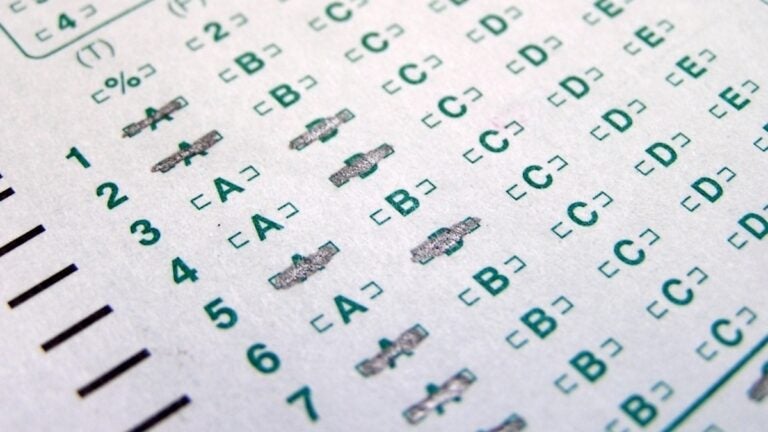
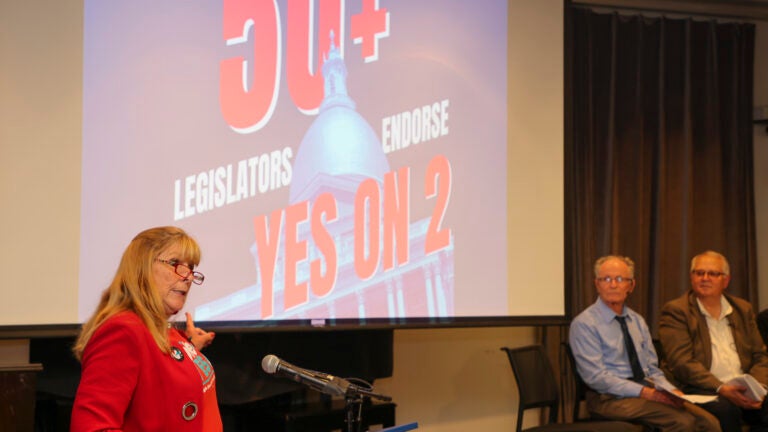
Question 2 could have a major effect on education in Massachusetts, a state that boasts some of the best public school systems in the country. Currently, students must achieve certain marks on the standardized MCAS test to earn their diplomas. If Question 2 passes, those graduation requirements would be eliminated and replaced by standards set by individual districts and state education officials. Students would still be required to take the MCAS.
The Massachusetts Teachers Association has put its full weight behind passage of Question 2, arguing that using MCAS scores as mandatory graduation requirements disproportionately affects low-income students and students of color. They also say that the requirement forces teachers and students to orient their entire school year solely around the test. Opponents to Question 2, which include Gov. Maura Healey, say the MCAS holds students to a high standard that should be maintained.
The Globe/Suffolk poll found that almost 58% of voters are in favor of eliminating the MCAS graduation requirements. Almost 37% oppose the measure.
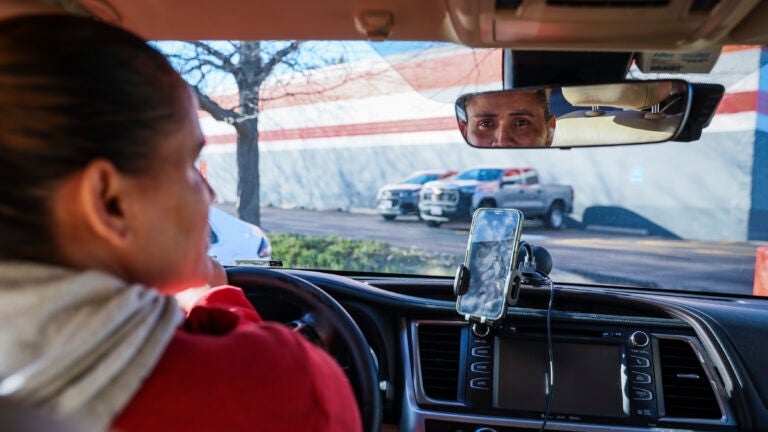
Question 3 would give rideshare drivers at companies like Uber and Lyft the power to form unions for collective bargaining. Proponents argue that many drivers need to increase their financial security and flexibility. The option to join a union is guaranteed for most workers, but rideshare drivers are currently, and unfairly, excluded, they say. Opponents say that Question 3 would only raise prices for riders while lining the pockets of union officials instead of the drivers themselves.
Nearly 59% of Massachusetts voters support the passage of Question 3, while nearly 34% oppose it, according to the poll.
Question 4 puts the focus on psychedelics. It would make Massachusetts the third state, behind Oregon and Colorado, to implement limited psychedelic legalization. Those in favor argue that certain psychedelics can, under supervision, drastically help people struggling with conditions like depression, anxiety, and PTSD. Opponents say that the measure does not properly restrict at-home growth of psychedelic mushrooms and would fuel a black market that would put residents at risk.
The results from the Globe/Suffolk poll regarding Question 4 were incredibly close. Almost 47% of voters support legalization through the measure, while 46% oppose it.
Question 5 would increase the minimum hourly wage an employer must pay a tipped worker to the full state minimum wage, implemented over five years. Proponents say that greater financial stability and predictability for tipped workers would result from the measure’s passage. Opponents, which include the Massachusetts Restaurant Association, say that most servers and bartenders believe they’ll earn less if the state gets rid of the tipped minimum wage. Restaurants would be forced to raise prices and add service fees, potentially resulting in their closures, the opponents argue.
The Globe/Suffolk poll found that just under 40% of voters support Question 5, while almost 52% oppose it.
The poll found that Warren has a substantial lead over John Deaton, her Republican opponent. Warren, a national Democratic star who built her reputation on opposing corporate interests, leads Deaton by almost 59% to 35%.
Deaton is a personal injury lawyer who has been positioning himself as a moderate Republican in the mold of former Gov. Charlie Baker. The dynamics of the race could change next week, when he meets Warren for two debates. But right now, Warren’s brand of progressive politics appears to still be resonating with Massachusetts voters who may otherwise be less enthusiastic about the presidential race.
“The people who are voting for [Warren] love her. The people who are voting for Harris like her a lot,” David Paleologos, director of the Suffolk poll told the Globe. “There’s a difference. … There’s a kind of intensity of support [among those] who are voting for Warren.”
The Globe/Suffolk poll asked voters their opinions on the overall state of the country. Just 34% said that they believe the US is “headed in the right direction,” compared to almost 50% that say it is on the “wrong track.”
When asked which issue is the most important one facing the new president, 31% of voters said that it was “the future of American democracy.” About 24% said that it was the economy and inflation. No other answer garnered more than 13% of respondents.
“Massachusetts voters are sending the country a powerful message about the future of American democracy,” Paleologos said in a statement. “Even among people whose financial situation hasn’t improved over the last year, the future of democracy still ranks very high as the most important issue in 2024.”
Voters were asked about both the national economy and the Massachusetts economy. Only about 10% of voters said they would rate the national economy as “excellent,” while about 31% said it was “good,” 29% said it was “fair,” and 29% said it was “poor.”
In describing the Massachusetts economy, 10% said it was “excellent,” about 40% said it was “good,” 29% said it was “fair,” and about 20% said it was “poor.”


Get everything you need to know to start your day, delivered right to your inbox every morning.



To comment, please create a screen name in your profile
To comment, please verify your email address
Conversation
This discussion has ended. Please join elsewhere on Boston.com