In their own words: 3 students describe participating in Boston’s March for Our Lives
Tens of thousands of students participated in the movement against gun violence across the country.
Related Links
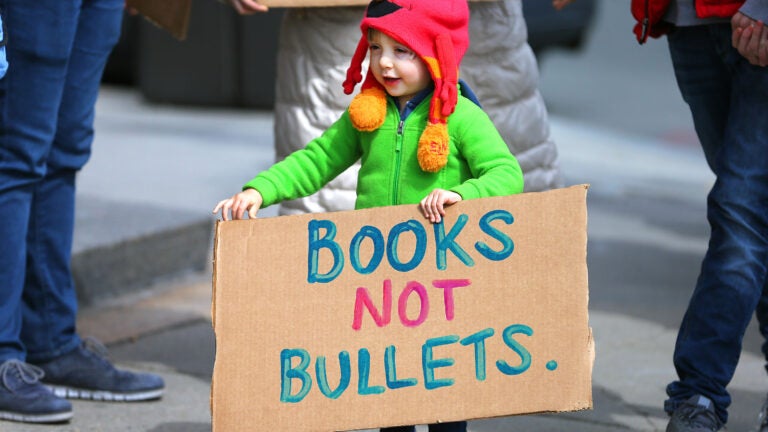
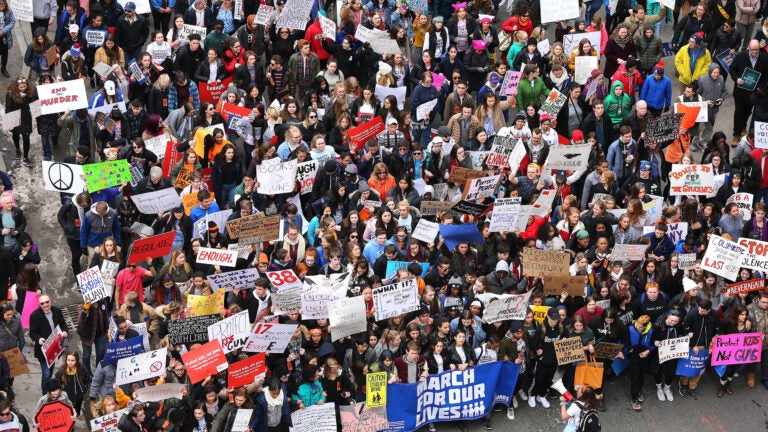
Thousands of students and their supporters marched through the streets of Boston on Saturday, with shouts of “time for change” and “never again” filling the air as they called for stricter gun control and rallied against mass shootings.
The March for Our Lives in Boston was one of hundreds of protests held around the world against gun violence, part of the movement organized by survivors of the shooting at Marjory Stoneman Douglas High School in Parkland, Florida, last month that left 17 people dead.
Boston’s march began at Madison Park Technical Vocational High School in Roxbury and ended with a rally on Boston Common, where speakers talked on stage about the impacts of gun violence in front of a massive crowd.
Boston.com spoke with three students who attended the march and the rally to learn more about why the teens were moved to participate and what they think needs to happen next. Below, what the local students had to say about the movement and how they felt to be part of the crowd on Saturday.
The interviews have been lightly edited for clarity and length.
Jonah Muniz
Age: 16
Grade: Sophomore
School: John D. O’Bryant School of Mathematics and Science
Hometown: Roxbury

Jonah Muniz.
Why did you attend Boston’s March for Our Lives?
I went to the march because I previously attended on Wednesday when we had the walkout. And I felt like it was the right thing to do, not only to be a consecutive participant with the marches, but also to send a message to Congress and the higher-ups that people are listening and they’re trying to send a message.
What do you want to change and why?
What I want to change is not only the AR-15 law but also use a modification in the Second Amendment that can establish safety in a school environment.
Can you describe what it was like participating in the March for Our Lives?
Participating on Saturday was a very magical experience. I went to Madison, and it was immediately filled with dozens of people, handing out flyers, talking about what they’re going to do and what was going to happen, how they were going to lead the march. And the leaders were there, and they [created] a very well organized and very beautiful experience in the beginning already.
What was the feeling in the crowd?
The crowd was ecstatic. They were very enthusiastic and ready to go and march on and send the message that we were trying to lead.
Was there anything that you were surprised by?
The thing I was surprised by was the ability that we all had of leading, but I was also surprised by how many youth there were, how organized the entire thing was. I was also very surprised by the people that you could see from the left and the right. I was surprised by the organization and just the individual people and hope that future events will come.
Now that a few days have passed, what do you think the impact of the march was?
I think we had a strong message, and I think that this is just phase one of many that will continue to go on in our community Our impact? We were able to notify Congress and notify the higher-ups that we matter — we are here. And I think that not only helps with gun control, but also gives Congress a reality check.
What do you think should happen next?
Honestly, for me, I just want to go to school knowing that I’m going to make it home safe. […] Because I’m a student, I’m studying for the MCAS right now, and I’m holding up a performance. That’s enough stress already. So I feel like my overall goal is just to have the teachers and the students worry about school, and school only, in their careers and in that establishment and not whether or not they make it out alive.
Is there anything else you want to say?
Overall I just really want to spread the message that regardless of political stances, regardless of whether or not you support this issue, people are dying. Over 30 school shootings have happened. It’s becoming more than just politics and money and the NRA. It’s a humanitarian issue, and we really have to establish that. Regardless of what you believe in, we can’t let any more innocent students die by the hand of a gun simply because they had to go to a certain school on a certain day.
Victoria Massey
Age: 17
Grade: Senior
School: Charlestown High School
Hometown: Boston

Victoria Massey.
Why did you attend Boston’s March for Our Lives?
I attended the rally because it is an issue that affects me, seeing that I’m still in school and it can happen to any school. And I really want to prevent that. I’m strong on getting more gun control, not meaning that you have to take away all guns, but that certain guns should not be accessed so easily.
And I definitely am one who is pushing for more gun control laws. It’s just something that affects me, and something that may affect my siblings also.
What do you want to change and why?
Like I said before, I want to make it harder for people to access certain guns. Certain guns, I feel like not a lot of people should have access to, and are really unnecessary to have in general. I feel that we need to have stricter ways to make it harder for people to get guns and certain guns — that they get a background check, that they’re not able to purchase a gun with an expired ID, and that they are thoroughly checked mentally and everything about them.
Can you describe what it was like participating in the March for Our Lives rally?
Participating in the rally was very overwhelming and very inspiring because there was an overwhelming number of people who participated. It was really hard for me to meet up with certain people I was going to meet there. But I felt very inspired by the speakers who spoke that day and the music that they decided to play while we were there, rallying. The different creative signs and what they were arguing for — it was very inspiring to see that many people wanted the same change to be done as I do.
What was the feeling in the crowd?
I definitely felt a certain rush of adrenaline, because of the overwhelming amount of people who were there, since I’m usually not in a setting full of a lot of people. And I just feel like everybody was united as one. And we were all chanting as one, and I feel like it was very inspiring. [It’s] something I definitely want to continue doing and being a part of different movements that affect me or affect others that I love and care about.
Was there anything that you were surprised by?
I was very surprised by the lack of African-Americans who attended the rally. It was predominantly white males and females who were there and children. And that’s something that I brought to my mother’s attention — how there wasn’t that many people of color who attended the rally, and I was just going through my mind of why and what the reason was.
What do you think the reason for that might be or how do you hope it might change?
I feel the reason why a lot of African-Americans did not attend the rally is because African-Americans have been fighting for the same change, for more strict gun control laws. Especially within neighborhoods that are predominantly black neighborhoods where there’s a lot of gun violence. We’ve been advocating for change for the longest, and we haven’t received that much attention. And I feel like a lot of people did not want to attend the rally because of that. They felt that other people who were not of color were receiving attention and they were given more attention than people of color who are advocating for change within their communities.
Something I told my mom is that I feel like even though we are arguing for change and don’t receive the same attention, that is something that we can work for, and we should still use the platform that the students have now who are majority white or of lighter complexion. We should still use that platform that they have to create that change and to fight for more gun control laws.
Now that a few days have passed, what do you think the impact of the rally was?
I feel like the impact was very severe. Not only was it in Boston, it was in Washington, it was in different states within the U.S. I feel like it showed a lot of people that when the youth get together, we can create change and we can create a big voice — more than just one person who is advocating for change within the community. That there is strength in numbers and strength with the students who attended, and there’s a lot of support of other teens and other adults who attended those rallies.
I just feel that we made a big, major statement that we are one and that we will advocate for change from our last breath and that it doesn’t matter what happens. We’re just going to continue going through those obstacles and trying to create that change within our communities.
What do you think should happen next?
Next? That’s a pretty hard question. Honestly I don’t know. I just hope that it’s not brushed aside. All the work and all the advocacy work that the youth and adults are doing, I just hope it’s not brushed aside and it’s not something that is just forgotten — not just a movement that is there but then is later on forgotten and no change occurs. I want change to come, but I know change will not happen the next day or even the day after that. For change to happen within our communities, it’s going to take time. And I just pray that that time is not too long, and that our questions are answered and what we hope for is given to us.
Charlotte Lowell
Age: 17
Grade: Senior
School: Andover High School
Hometown: Andover

Charlotte Lowell, an organizer of the Boston march, uses a bullhorn on Saturday.
Why did you attend Boston’s March for Our Lives?
I started to get involved in the March for Our Lives after organizing a sit-in at my high school following the Parkland shooting to essentially create a conversation in my high school about gun violence and about how it affects students, how it affects parents, how it affects teachers. And from there I started to start doing some grassroots organizing with some students in Somerville, Arlington, Cambridge — that area. And then I reached out to a couple people from March for Our Lives and got involved from there.
Essentially I’m involved because, as a white person, I have a lot power in spaces. And that allows me to use that power to amplify the narratives of people of color, especially, who have been advocating for gun reforms for years and years, but who have been silenced, who have been ignored. So being able to kind of emphasize the issues happening in Boston in relation to gun violence is really important to me.
What do you want to change and why?
I think a lot of things need to change in our legislation and our culture. I think we need strong gun laws in order to ensure that students feel safe both in their streets and in their schools. I also feel like our culture is highly militarized, and it teaches us that students shouldn’t feel safe in their schools, that our lives are less important than access to guns. And that’s a really terrifying and problematic culture to grow up in. When we’re expected to learn and grow in our schools, but we actually feel like our lives are at stake. That’s a terrifying thought.
Can you describe what it was like participating in the March for Our Lives?
Participating in the march on Saturday was incredible and empowering. It was like this huge coalition of students and parents and teachers from all over Massachusetts joining all at once to demand change. I feel like tons of students felt that their voices were heard for the first time in a long time. I think a lot were maybe having their first experience with political activism. And that’s an incredibly powerful thing to be a part of — teaching kids and students that their voices can be heard and that there are outlets for their voices to be heard. It was incredibly powerful for me to stand up and speak with students who marched with us and shouted and chanted with us. It was amazing.
What was the feeling in the crowd?
It was energetic and youthful and lively and also angry. And there was a lot of sorrow there. A lot of solidarity with victims of gun violence in Parkland and in Mattapan, in Dorchester, in Roxbury. We, the students, came from all over Massachusetts, so there were certainly a lot of folks from the suburbs, where the majority of the population is white, is maybe affluent, where a lot of people maybe have never physically experienced gun violence but still feel incredibly connected to the community living in Boston and wanted to show their solidarity.
Was there anything that you were surprised by?
I think I was — surprised isn’t the word — just in awe of the energy and resilience and resistance of young people. We came — three hours away for some folks — to join and march and chant about what we felt needed to change. And I just am so grateful that so many folks showed up to stand with us.
Now that a few days have passed, what do you think the impact of the march was?
I feel like students are still talking about it, teachers are still talking about it. It was a moment in history. Kids rarely have a platform to speak, you know many of us don’t’ even have the right to vote yet because we’re underage. We proved that just because we can’t vote, doesn’t mean we can’t speak out.
What do you think should happen next?
On a couple of levels, I know that we will continue to work and protest and organize until the change that we demand and that we deserve is made. I think our representatives and legislators need to take immediate action on gun reform policies in Massachusetts and in the United States. I think that the conversation needs to continue. As long as the changes that we need are still being worked on, we need to talk about gun violence and why it needs to end.
Is there anything else you want to say?
I would definitely say that moving forward we have plans in the works and stay active, stay engaged, stay involved.