
Sign up for the Today newsletter
Get everything you need to know to start your day, delivered right to your inbox every morning.
Salem is gearing up for record-breaking Halloween crowds as costume-clad visitors swarm the Witch City, ready to embrace the region’s haunted past. Just a few miles away in Danvers, meanwhile, a key piece of witch trials history sits empty and crumbling.
There, at the early American tavern Ingersoll’s Ordinary, the first three women accused of witchcraft in 1692 were initially scheduled to answer the charge, according to the Salem Witch Museum. As Daniel A. Gagnon, author of “A Salem Witch: The Trial, Execution, and Exoneration of Rebecca Nurse,” explained in a 2019 article, the tavern “played host to the screams, contortions, and finger-pointing” of the witch hunt in Salem Village, as Danvers was originally known.
The tavern’s colorful history includes one notable episode involving a phantom sword fight between owner Nathaniel Ingersoll’s foster son and the ghostly specter of an accused witch, according to Gagnon. Decades later, the local Revolutionary War-era militia regularly met at Ingersoll’s prior to the Battles of Lexington and Concord.
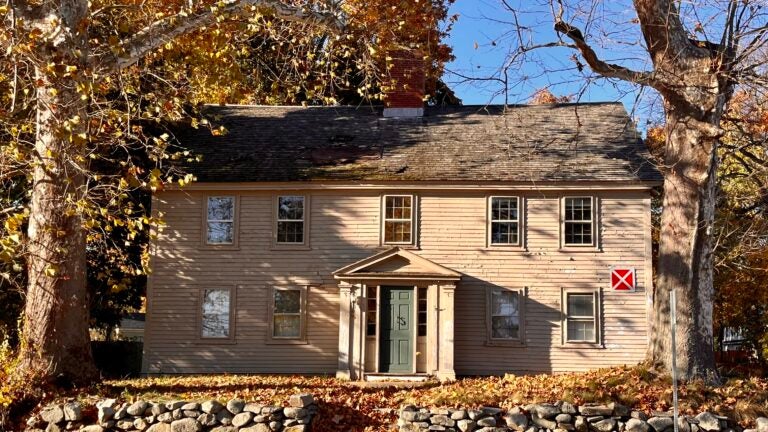
Now a private home, the property has sat vacant for more than a decade, its exterior suffering from years of storm damage and the owner’s alleged inaction. That leaves local officials racing against the clock to intervene and save Ingersoll’s Ordinary before more than three centuries of local history is lost for good.
“It can happen faster than people think,” said Aaron Henry, Danvers’s director of land use and community services. “If the wrong beam snaps or whatever in that roof, it could be potentially catastrophic for the structure in short order.”
As it stands, the house at 199 Hobart St. appears to be in poor shape, Henry explained, citing holes in the eaves that ensure easy access for birds and squirrels. One sill is “completely gone,” there’s a hole in the roof that’s been covered with a tarp for years, and the clapboards are “sloughing off,” said Danvers Historical Society President Dave McKenna.
A red sign with an “X” warns firefighters of potential structural hazards inside the home, which has been empty since New Hampshire resident Grenville Thoron purchased the property in 2011. A 17th-century barn in the backyard collapsed several years ago, sounding alarms about the site’s condition.
“That right now is just a pile of beams, and we don’t want to see the house go the same direction,” McKenna said.
He added: “To lose that building would be a travesty.”
According to McKenna, Thoron bought the property with historic preservation in mind and has toyed with the idea of opening the home as a museum. He reportedly approached the Danvers Historical Society and the Danvers Alarm List Company Inc., which operates the nearby Rebecca Nurse Homestead, but McKenna said neither organization had the finances or bandwidth to take on the property. Thoron did not respond to a request for comment.
McKenna, who has become something of a liaison between Danvers and Thoron, said the property owner previously lived on the North Shore and has historic family ties to the area. Both he and Henry said Thoron has generally refused to grant local leaders access to the home’s interior so they can assess the damage.
“And I said, ‘We need to get inside to see what condition it’s in, because we’re not going to take it not knowing whether we can afford to restore it or not,’” McKenna said, recalling his conversations with Thoron. “I mean, anything can be restored, no matter how bad it is, but it can cost an arm and a leg and your firstborn to do it.”
In a later update shared in a Facebook group for those who support the property’s preservation, McKenna announced Thoron is hiring someone to patch the roof and is preparing to allow McKenna inside with a waiver of liability.
“I sincerely believe the man wants to preserve it,” McKenna told Boston.com. “I think his motives are pure. I really do, and I commend him for spending his money to buy the place and do what he can to preserve it, but I think he may be overwhelmed.”
Over the past year, the town has escalated its efforts to intervene and preserve the home before it’s too late, Henry explained.
“Asking nicely hasn’t gotten [Thoron’s] attention,” he said.

While the home is included in Danvers’s Salem Village Historic District, those protections only extend to the outside of the property. Noting the home’s “rotting” exterior, a March report from the town’s Ad-Hoc Historic Preservation Study Committee found that previous bylaws offered no solution to save Ingersoll’s Ordinary from demolition by neglect. Danvers Town Meeting approved a new bylaw last spring to rectify the situation.
While Henry said the Ingersoll’s property is the “poster child” for the demolition by neglect bylaw, he noted the town isn’t looking to invoke the new policy at this time. Instead, Danvers has turned to the Massachusetts Attorney General’s Office to begin the receivership process, whereby a court-appointed receiver intervenes to make a distressed property safe and habitable. As Henry explained, receivership is less taxing on town resources than the demolition by neglect process, and the results may be more thorough.
The AG’s office confirmed it sent Thoron a letter to encourage him to voluntarily clean up the property, but said it has yet to receive a response. Typically when that happens, the office said it will file a court petition to appoint a receiver who will bring the property up to code. But first, the AG’s office said it is searching for a proposed receiver with historical property experience.
With the receivership timeline unclear, what’s the endgame for Ingersoll’s Ordinary?
“I think the easy answer for us would be that we’d love to see it back on the market and a place that a family could live,” Henry said of the historic house. “It’s a beautiful property, it’s in a great spot, and we’d love to see it contributing productively to the community again.”
Another option, he said, might be Thoron’s purported dream of turning the home into a museum.
“But again, those would require somebody doing something proactive with the site, and right now we just don’t have that actor on the other side of the table,” Henry said.
The plight has drawn significant public interest over the last several months, with more than 2,600 people signing a Change.org petition calling for the home’s preservation. Nearly 1,700 have also joined a Facebook group dedicated to the cause.
“There are a lot of people who want to see this place saved, including the town,” McKenna said. “And one way or another, it will be saved.”
According to McKenna, several people have said they’d be willing to donate funds for the home’s preservation, and grants could offer another funding source.
“But again, until we know what’s going on, it’s very difficult to even discuss options,” he said.
Efforts to preserve Ingersoll’s Ordinary have seen near unanimous support, attracting attention from national and local organizations, according to Henry.
“It’s been awesome,” he said. “I only wish that all of that support could somehow translate to getting some momentum and inertia going in the right direction, because it does seem like despite all of everyone’s interest, we are not much further along than we were six months ago.”

Get everything you need to know to start your day, delivered right to your inbox every morning.





To comment, please create a screen name in your profile
To comment, please verify your email address
Conversation
This discussion has ended. Please join elsewhere on Boston.com