
Sign up for Scenic Six
Navigate the endless possibilities of New England travel with Boston.com.
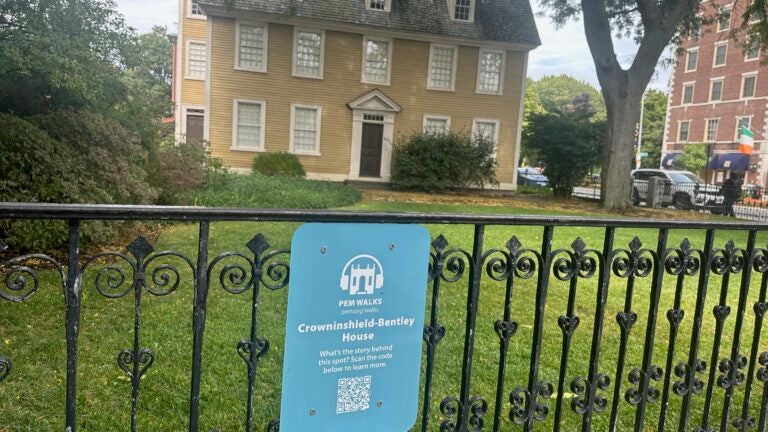
As Salem’s one million visitors stroll past a historic dwelling on Essex Street this month, they can unlock the secrets of the home with a scan of a phone.
Pedestrians in town for the monthlong Haunted Happenings festival can access a free audio tour of the 1729 Crowninshield-Bentley House, owned by the Peabody Essex Museum (PEM), by scanning a QR code posted on the fence. The service is part of the museum’s PEM Walks series, which launched in 2021 and offers “audio postcards” of buildings within the museum’s collection.
The Georgian-style home, on the National Register of Historic Places, was built for fish merchant and ship captain John Crowninshield, says Steven Mallory, PEM’s manager of historic structures, during the 6 minute and 53 second audio tour. Crowninshield was the son of a German physician who arrived in Salem in 1684.
The house originally stood a block away on the curb, Mallory says, and was moved to its current location on the museum’s campus in 1959. Salem was a major maritime economy in the 18th century, and Crowninshield was a successful captain as evidenced by the quality architecture of his house, he says.
After Crowninshield died at sea in 1766, the house passed to his widow and son, according to Mallory. In 1774, they both died within weeks of each other, so his son’s widow supported herself by renting rooms out for the next 35 years. A renter at the house, the Reverend William Bentley, lived in two rooms on the second floor from 1794 until his death in 1819.
Bentley, described by Mallory as “a collector of curiosities,” was a founding member of the East India Marine Society in Salem, established in 1799, which was an organization of Salem captains who collected objects as they sailed around the world and started the oldest collecting museum in America.
Bentley’s library of 4,000 volumes was “the largest in America at the time,” says Mallory. But he collected more than books.
Some of the curiosities Bentley accumulated in his rooms, according to Mallory, included a gigantic clamshell, historic prints, a palm branch and coconut, sculptures, busts, an armadillo skeleton, bottles with snakes and lizards, and a human skull. There is a complete list of Bentley’s possessions on exhibit in the house.
Bentley’s rooms were densely packed “in what appears to have been nearly a hoarding situation,” Mallory says.
The reverend’s diary, which he kept for decades, is now an “incredible historic document” that details the weather, news, “gossipy tidbits from Salem residents,” and more, according to Mallory.
The house also has a direct connection to the history of slavery in America, says Mallory, because a slave family lived on the third floor. They were legally freed in 1783 when slavery was abolished in Massachusetts, he says.
“Unlike the south, studies of New England slavery suggests that many enslaved people were more likely to live in the house with the family than in separate quarters,” Mallory says.
The house is open for tours from June to October.
Editor’s note: In the coming months, Boston.com will be featuring historical sites around Greater Boston as chosen by staff and suggested by readers. Enter your suggestion in the form below.

Navigate the endless possibilities of New England travel with Boston.com.





To comment, please create a screen name in your profile
To comment, please verify your email address
Conversation
This discussion has ended. Please join elsewhere on Boston.com