
Newsletter Signup
Stay up to date on all the latest news from Boston.com
Researchers from the New England Aquarium in Boston are collaborating with colleagues in Puerto Rico to help save the world’s largest turtle by using high-tech drones and special satellite tagging.
In 2018, a leatherback sea turtle that was tagged off the coast of Cape Cod made its way to Puerto Rico. The endangered turtles are known to be extensive travelers, with some swimming more than 10,000 miles a year. Despite their large size, their migratory behavior makes leatherbacks especially difficult to monitor.
So Kara Dodge, a research scientist at the aquarium, began working with Puerto Rican organization Amigos de las Tortugas Marinas to better study the creatures.
Since 2018, Dodge has made multiple trips to the Caribbean island to create a long-term satellite tagging project with the help of ATMAR and the Puerto Rico Department of Natural and Environmental Resources. Their focus is inter-nesting behavior of leatherbacks, meaning their behavior in between nesting events.
Female leatherbacks nest every two to four years. During a nesting season, a female will lay clutches of about 100 eggs every eight to 12 days. The eggs incubate for two months before hatching, according to the National Oceanic and Atmospheric Administration.
Dodge and her colleagues in Puerto Rico work to locate nesting beaches outside monitored areas, detect leatherback movement to other beaches, and track how turtles move after nesting into northern foraging areas, according to the aquarium.
“Leatherbacks in Puerto Rico currently have no critical habitat protections. There is almost no data to set those boundaries for coastal waters near important leatherback nesting beaches. The New England Aquarium is working with DRNA and ATMAR to collect this data, which can be used to protect leatherbacks during their critical breeding and nesting period,” Dodge said in a statement.

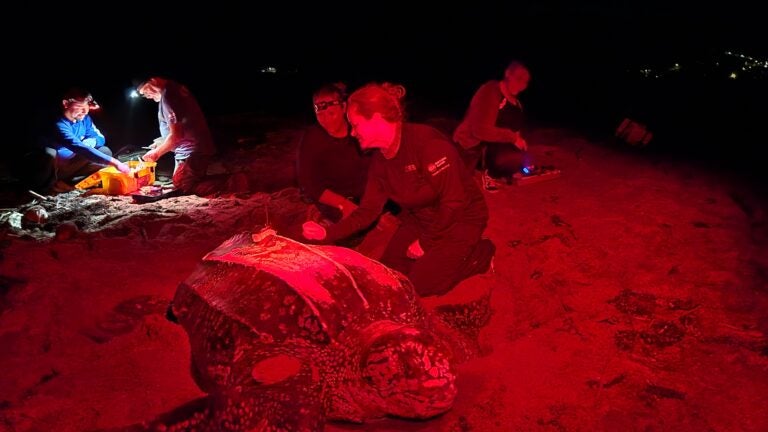
This May, Dodge spent a week in Puerto Rico. They attached five satellite tags to nesting leatherbacks while working in the southeastern part of the island.
Researchers need to keep an eye on the nesting turtles at night. They only have windows of about 10 minutes to apply satellite tags while turtles lay their eggs. To do this, ATMAR Founder and President Luis Crespo uses drones equipped with thermal cameras to sweep the beach.
“The drone is an amazing tool. It records both visual and infrared video simultaneously and allows us to spot the animals as they come out of the water,” Crespo said in a statement. “We are looking not only for the leatherbacks but nest predators, such as feral dogs or poachers.”
Satellite tags usually only last for as long as a year. This spring, the team in Puerto Rico got a rare opportunity to collect multi-year data on a few individual turtles. “Carmen” and “Noemi,” two leatherbacks that had been tagged in 2021, were tagged again this year.
The researchers working in southeastern Puerto Rico found 150 nests so far this year, a particularly low number. The tagging efforts should help explain these changing numbers.
Leatherbacks face a wide variety of threats, including the loss of nesting beaches. Coastal development and rising seas are eliminating the sandy beaches that they require. Leatherback nesting beaches are estimated to be declining at a rate of 4% per year, according to the aquarium. Artificial lighting near beaches can deter females from coming ashore and disorient hatchlings. Shoreline hardening or armoring, such as the installation of sea walls, can cause the complete loss of dry sand suitable for nesting, according to NOAA.
Vessel strikes are another major issue, as is their unintended capture in fishing gear. Last year, a 900-pound leatherback was found entangled in cinder blocks, buoys, and lines in Nantucket Harbor. It was safely freed by Coast Guard members.
Stay up to date on all the latest news from Boston.com




To comment, please create a screen name in your profile
To comment, please verify your email address
Conversation
This discussion has ended. Please join elsewhere on Boston.com