
Newsletter Signup
Stay up to date on all the latest news from Boston.com
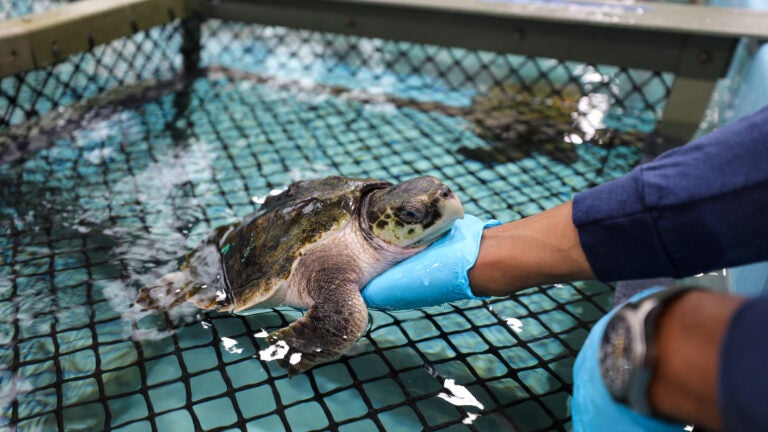
Tucked away in a Quincy shipyard, one nondescript brick building could pass for any other industrial facility from the outside: cold, uninviting, and somewhat lifeless. But take a step inside and an entirely new world opens up, one full of warmth, activity, and massive tanks of clear blue water.
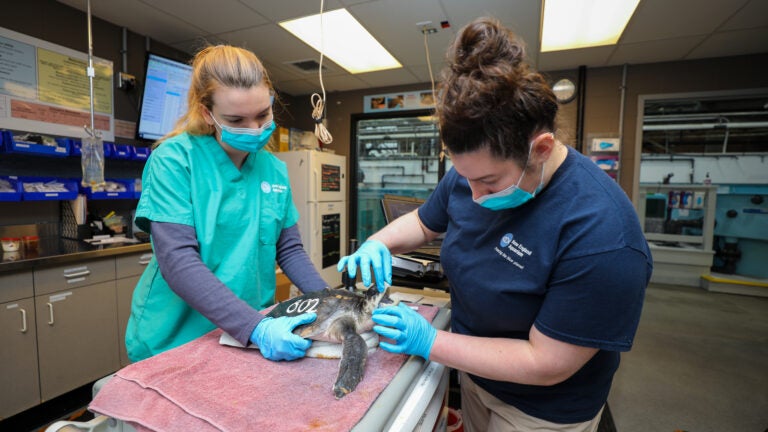
Each year, the lives of hundreds of endangered sea turtles are being saved here, at the New England Aquarium’s Quincy Animal Care Facility.
Many Massachusetts residents may not realize that sea turtles frequent New England waters. Adam Kennedy, director of rescue and rehabilitation at the aquarium’s Sea Turtle Hospital, was just as unaware once.
“Growing up in Massachusetts, I had zero clue that sea turtles actually were actively in our waters,” he said. “But we have them, and we have a lot of them.”
The turtles are not just in the waters off Massachusetts. Every year, hundreds in Cape Cod Bay become cold-stunned and wash up on local beaches. Hypothermic and close to death, these animals often suffer a litany of ailments, from infections to cuts and shell fractures. That’s where Kennedy and his team come in.
A typical stranding season lasts from late fall through early winter. Teams from the Mass Audubon Wellfleet Bay Wildlife Sanctuary comb the Cape’s beaches for cold-stunned turtles, saving them from the elements and helping them get into the care of the aquarium’s expert staff.
A total of 518 live turtles came into the Quincy facility during the 2022 stranding season. Throughout the fall and early winter months, most of them are treated relatively quickly, stabilized, and transferred to other facilities along the east coast and into the Midwest. But some turtles, just over 60 this year, do not recover quickly enough and must stay at the Sea Turtle Hospital for an extended stay into the spring.
This is where aquarium staff members are focusing their resources now, crafting individualized treatment plans for each turtle and caring for them until, hopefully, they can return to the wild.
Melissa Joblon, an associate veterinarian at the New England Aquarium, treats many aquatic species throughout the year. But caring for the sea turtles is special, she said.
“The sea turtle work is one of my favorite parts because there’s a true conservation aspect,” she said. “If we did nothing, they would just end up dying on the beach. It feels great to be able to know that we’re not only helping individual animals but we could be helping an entire population over time.”
Most of the work done at the Quincy facility centers on Kemp’s ridley sea turtles, the smallest in the world. A handful of Green sea turtles are also found cold-stunned and treated by aquarium staff.

Adult Kemp’s ridleys are usually found in the Gulf of Mexico, where females nest, but each year a significant number of mostly juvenile Kemp’s ridleys make their way up the eastern seaboard.
As they feed and grow, the animals move closer to the shore, according to Kennedy. Waters in the Gulf of Maine warm up in the summer months, allowing the turtles to funnel into Cape Cod Bay. This is valuable real estate in the summer, as the Cape’s water provides plenty of feeding opportunities for the animals.
But as fall hits and temperatures plummet, the turtles naturally try to swim south again. Due to the unique shape of Cape Cod, this is not so easy for the turtles in the bay.
“They’re naturally going to swim south… For them it’s not really intuitive to go north and then east to loop around,” Kennedy said.
Unable to reach warmer waters, the turtles try to conserve energy. They swim less and float towards the top of the water. Eventually, winds blow them onto Cape Cod beaches. Brutal weather conditions, human hazards like boats, and shoreline scavengers all pose threats to the helpless creatures.
“Sometimes these turtles look like they’re dead and you can’t tell the difference. Even when you poke them, they don’t react,” Kennedy said.
Pneumonia is by far the most common thing ailing the turtles that are found and treated throughout the stranding season, Joblon said. As their bodies get colder and hypothermia sets in, it is harder for the turtles to move and easier for them to inhale water.
Some have pronounced shell fractures, others have cuts or skin lesions. Sometimes turtles experience frostbite. Bacterial and fungal infections are common. Staff members employ a variety of techniques to diagnose the turtles, including MRIs, CT scans, and surgical scopes outfitted with cameras.
Around January, only the turtles that are seriously sick or injured remain.
“At first it’s almost like an emergency response and triage, I like that high-stress, fast-paced environment,” Joblon said. “But now this is really nice because we get to do more individualized care… we learn about each animal, what ailments they have, and how we can specifically treat them.”

Part of that individualized care involves getting a fun name. Staff, volunteers, and interns traditionally name the turtles receiving long-term care, and each year the names have a different theme.
This year, the turtles are named after pasta shapes. “Fusilli,” “Orzo,” and “Lasagna” were a few of the turtles receiving treatment in Quincy.
The recovering turtles are started in tanks of 55-degree water. They need to be warmed up, but gradually. Their tanks are then upped to 65 degrees, and then into the 70s.
Their conditions can fluctuate wildly on a daily basis.
“They might be looking like they’re doing really well, but we’ve certainly had turtles that may be eating and swimming perfectly fine one day and the next they’re not using a flipper, or they’ve stopped eating,” Kennedy said. “Although the prognosis for most of these turtles is that they’ll be released, there’s always a possibility that they won’t make it.”
About 78% percent of the turtles treated by the New England Aquarium survive, Kennedy said. The most common cause of death is severe lung infection, Joblon added.
A particularly nasty cold snap in late November and early December caused the staff to treat turtles with worse conditions than normal. Many did not survive, Kennedy said.
This month, a major priority for Kennedy and his team is getting the turtles to eat regularly again. Just like humans, sea turtles lose their appetites when sick. Each occasion where they have to come out of their tanks for treatment adds stress, Kennedy added. This can further impact their appetites.
Many turtles are emaciated. Much of their fat, and even muscles, are gone. Building up their body weight is key. A diet of herring, squid, shrimp, clams, and various greens usually does the trick, and staffers use appetite stimulants if necessary.
Surgeries, internal biopsies, and weekly full body exams will take up much of the staff’s time throughout the spring. This work not only saves specific turtles every year, but it can help future generations. By treating hundreds of turtles each year, the aquarium is conducting valuable research into the best ways to rehab sea turtles, like nailing down the proper dosage of medications or the right mix of antibiotics.
By April, the turtles that recover sufficiently will be transported to the Carolinas and Georgia for release. Those that need further treatment are usually released in Nantucket Sound in June, July, and August. A handful may still not be ready for release, and those animals will need to be moved to other facilities so that the team in Quincy has enough room for next year’s batch of stranded turtles.
When Kennedy first got involved in the sea turtle rescue effort, about 20 years ago, the New England Aquarium only treated “tens” of turtles each season, he said. Since 2010, that has shifted to hundreds each year.

2014 was a turning point, he said. That year, 692 live turtles came in for treatment, a record, according to Kennedy. Around then, researchers started noticing a worrying, warming trend.
“Around that time, everything started clicking, that the warming of the gulf of Maine is likely allowing more turtles to funnel into Cape Cod Bay, and then the cold sets in,” he said. “2014 kind of came out of nowhere, and we had to rapidly adjust.”
No stranding season has produced more cold-stunned turtles than 2014, but numbers are generally higher now than they were a decade or two ago, Kennedy said. The Quincy facility is only designed to house between 40 and 80 turtles long-term, and Kennedy does worry about exceeding capacity in the near future.
Some research suggests that they should prepare for thousands of sea turtles to wash up on Massachusetts beaches in the 2030’s, he said.
“Thousands of turtles is certainly a daunting thought, and we’re really not that far away from it.”
Still, essential conservation work at the Sea Turtle Hospital is humming right along, and aquarium workers are learning more about saving the iconic creatures every year.
For Kennedy, seeing the results of their hard work never gets old.
“It’s amazing,” he said. “They should be dead, they have various injuries, they sometimes have a heart rate of literally one beat per minute. And yet, six to eight months later, they look nothing like what they came in as… We’re making a huge difference in a critically endangered species that may not be here forever.”
Stay up to date on all the latest news from Boston.com





To comment, please create a screen name in your profile
To comment, please verify your email address
Conversation
This discussion has ended. Please join elsewhere on Boston.com