
The latest on the Karen Read murder case
Sign up for our Extra newsletter to get updates from the retrial and other breaking news alerts delivered to your inbox.
On the stand Monday:
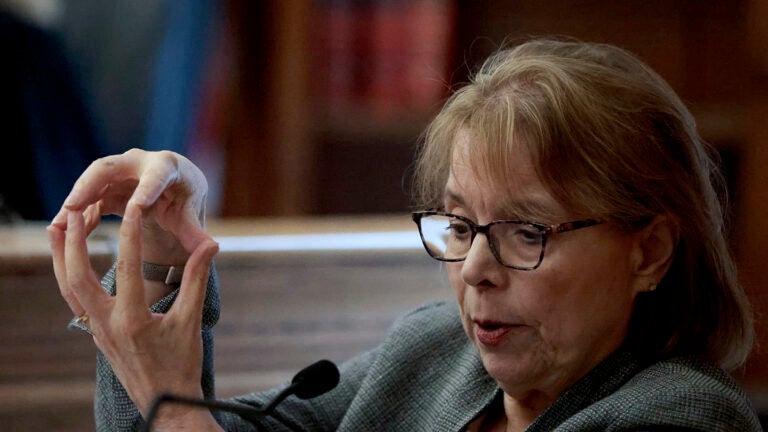
John O’Keefe sustained his fatal head injuries by falling backward onto “something that had a little ridge,” defense forensic pathologist Dr. Elizabeth Laposata testified.
She also said a laceration above O’Keefe’s right eye would be consistent with a fist or “some sort of object.”
Formerly the chief medical examiner in Rhode Island for 12 years, Laposata said she reviewed O’Keefe’s autopsy report and an accompanying report on the examination of his brain, a toxicology report, medical records, evidence photos, and “a hundred and some” autopsy photos, among other documents.
She estimated she’s probably conducted more than 3,000 autopsies herself and observed and reviewed “maybe 7,000 more” over her decades of practice.
“Looking at the injuries on the body and understanding what caused them is a huge part of forensic pathology,” Laposata explained.
Asked if she’s ever conducted or overseen autopsies of people who were involved in vehicle-pedestrian collisions, Laposata put the estimated count in the hundreds.
“Understanding wound patterns and injuries is a big part of forensic pathology, because we want to identify what caused a particular pattern,” she told jurors. “So understanding that whole complex bag of injuries begins when you start your forensic pathology training, which was when I started back in ’81.”
Discussing O’Keefe’s injuries in particular, Laposata said she saw evidence of blunt force trauma injuries to the back of his head, with a horizontal laceration to the scalp accompanied by “linear scrapes” vertical in orientation.
Defense attorney Alan Jackson asked Laposata to describe a coup-contrecoup head injury, and she explained the injury results in damage at the point of impact and “180 degrees opposite from that” on the other side of the head. Prosecution witness and neurosurgeon Dr. Aizik L. Wolf described a similar pattern when walking jurors through O’Keefe’s head injuries last month.
Laposata testified that O’Keefe’s head injuries were consistent with a coup-contrecoup injury. She cited the scalp laceration and accompanying scrapes, adding, “that tells me that Mr. O’Keefe went backwards onto something that had a little ridge, but it also had some irregularity to it to cause the different scrapes before you get to the tearing of the scalp.”
Laposata further noted skull fractures, brain bruising, and herniation of O’Keefe’s brain into the area of his spinal cord.
“That’s called brain stem herniation,” she explained. “And that is why the brain stops functioning and your body stops functioning when you have a severe head injury.”
Asked to elaborate on her testimony about a ridged surface, she added, “something with granularity hit — he hit first, then it moved up a little, broke the scalp, and then moved on a little bit above that.”
“Would you expect to see that if Mr. O’Keefe had fallen backward onto a perfectly flat surface?” Jackson asked.
“No, it has to be a surface that has some small ridges in it to make those little vertical patterns,” Laposata replied. Though he opined O’Keefe’s injuries were from a fall backward onto hard ground, Wolf previously testified that the wounds would not require a fall onto a ridged surface.
Jackson turned his attention to the ecchymosis, or bruising and swelling, around O’Keefe’s eyes. Laposata explained that when the brain “slaps forcefully against the base of the skull,” the delicate bones above the eye can break and cause some bleeding into the upper eyelids.
“So it kind of looks like you have black eyes, but there has not been any punch to the face,” she testified. “It only comes from the skull fracture.”
Laposata also noted a small, separate wound on O’Keefe’s right upper eyelid, and Jackson asked her about potential causes.
“Could that be from an object?” he questioned.
“Possible,” Laposata agreed.
“Could it be from a fist?” he pressed.
“Possible,” Laposata again replied, though Judge Beverly Cannone sustained an objection from prosecutors and spoke with the lawyers out of jurors’ earshot.
“Is it also consistent with a fist?” Jackson asked, returning from the sidebar.
“Sure, a fist is an object,” Laposata testified.
Cannone dismissed jurors for the day soon after, telling them Karen Read’s retrial is still proceeding on track. The trial will resume Tuesday with a full day of testimony.
With jurors out of the courtroom, the lawyers continued to discuss admissibility and logistics of the remaining witnesses’ testimony.
“I would like us to be as efficient for these jurors as possible tomorrow,” Cannone urged. “I’m not suggesting that today was a waste of time; everything we did was important, but it’s very difficult for the jurors to spend so much time back there.”
She said jurors seem to be “just about ready to get this case,” adding, “I don’t think anybody wants the jurors to tune out at this point.”
Cannone also suggested she felt some regret about giving jurors the day off from court last Thursday.
“Let’s be as efficient as we can possibly be,” she implored the lawyers.
“I promise you we are,” Jackson retorted. “It’s a murder trial, judge.”
Answering a follow-up question, he said he expects ARCCA biomechanics expert Andrew Rentschler will be the last defense witness.
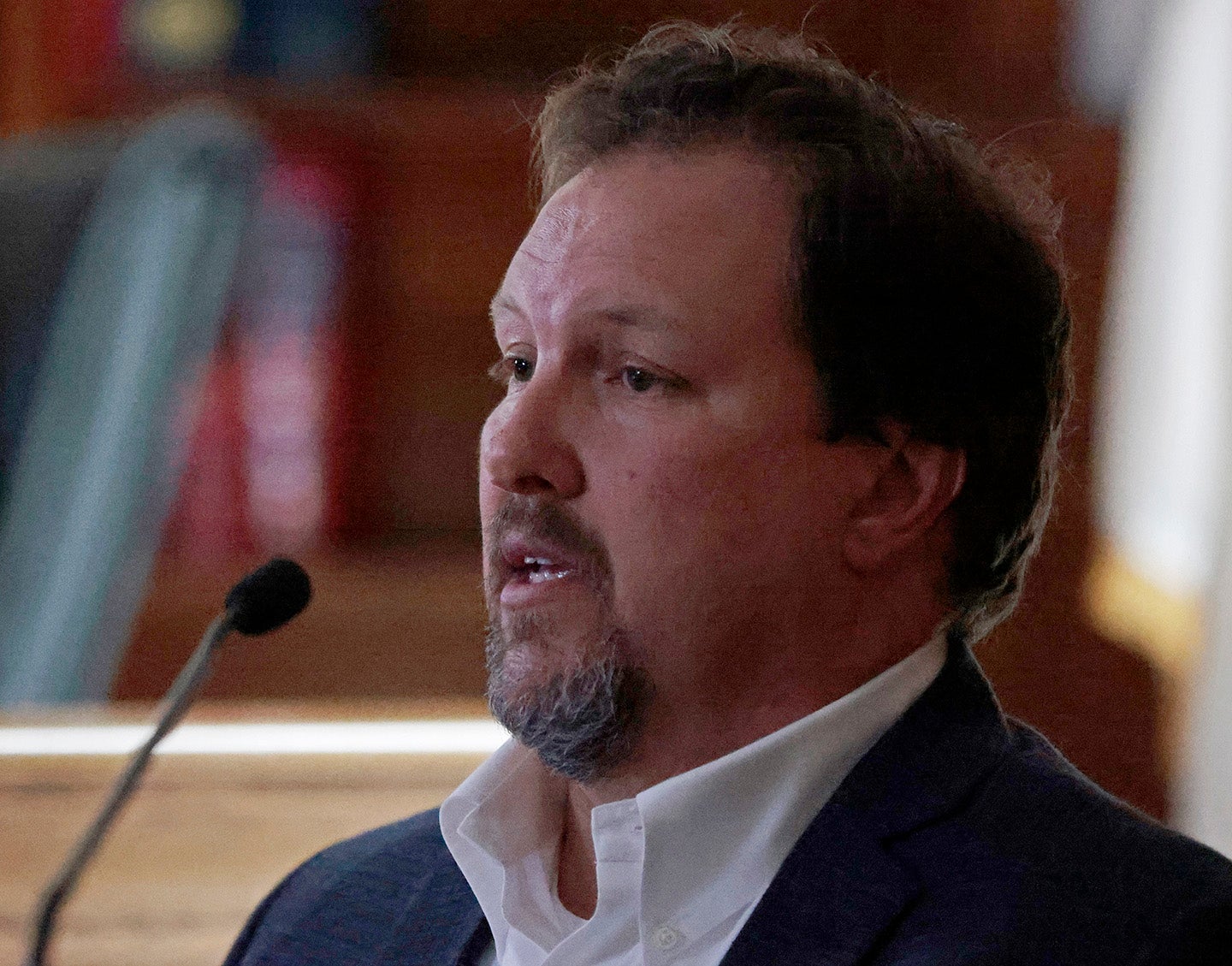
Returning to the stand, private investigator John Tedeman told jurors he measured the distance to the various entrances of 34 Fairview Road from the mailbox at the end of the home’s driveway.
Defense attorney David Yannetti asked Tedeman whether he had a chance to peer inside the home’s garage while taking measurements, and Tedeman said he did.
“Did you see concrete steps and a ridge there and a hard, concrete floor?” Yannetti asked, hinting at the defense team’s alternate theory that John O’Keefe was fatally injured inside 34 Fairview Road.
“Yes,” Tedeman replied as prosecutors raised an objection. Judge Beverly Cannone sustained the objection and struck Tedeman’s answer from the record.
Tedeman told jurors he measured 65 feet, nine inches from the end of the driveway to the home’s main door and 70 feet, one inch from the end of the driveway to the other front door. The end of the driveway to the garage side entrance was 78 feet, three inches, he added.
Stepping up for a brief cross-examination, special prosecutor Hank Brennan asked Tedeman if he measured the distance to walk from the area of a flagpole outside 34 Fairview Road, down the street, and up the home’s driveway. Tedeman said he did, though he wasn’t sure of the distance.
“Was it over 80 feet?” Brennan pressed.
“It was,” Tedeman confirmed.
Defense forensic pathologist Dr. Elizabeth Laposata is not qualified to testify as an expert on dog bite wounds, Judge Beverly Cannone ruled following the lunch break.
Cannone specifically cited concerns regarding “not just the experience, but the reliability of the methodology [Laposata] used and how it was applied.”
She contrasted Laposata with defense dog bite expert Dr. Marie Russell, explaining she determined Russell, a retired emergency room physician and forensic pathologist, was qualified “mainly from her experience in the ER, coupled with her being a [medical examiner].” Russell had also published papers on dog-inflicted wounds, Cannone noted.
Likewise, Laposata’s opinion that O’Keefe’s injuries were not consistent with a motor vehicle strike exceeded the scope of her expertise in some regards, Cannone asserted. She imposed other limitations regarding the scope of Laposata’s upcoming testimony.
Cannone also expressed frustration that Monday’s discussions about Laposata and other witnesses delayed further testimony in Karen Read’s retrial.
“We’ve done important work, but we’ve wasted an awful lot of the jurors’ time today,” she said.
Cannone added: “You can tell just by looking at this jury, they’re fed up.”
Defense attorney Alan Jackson pointed out prosecutors didn’t raise their concerns about Laposata’s anticipated testimony until shortly before she was due to take the stand.
As jurors reentered the courtroom, Cannone acknowledged they had been “extraordinarily patient” Monday.
With jurors gone on their lunch break, defense forensic pathologist Dr. Elizabeth Laposata faced voir dire questioning about her qualifications and experience.
Judge Beverly Cannone determined the voir dire hearing was necessary to define the parameters of Laposata’s upcoming testimony in Karen Read’s retrial. A clinical associate professor of pathology and laboratory medicine at Brown University’s Warren Alpert School of Medicine, Laposata previously served as the chief medical examiner for Rhode Island.
First up at bat, defense attorney Alan Jackson asked Laposata about her experience with dog bites and claw marks, questioning whether she’s offered instruction on dog bite wounds in the courses she’s taught about wound pattern recognition. Laposata said she has, confirming she’s also dealt with autopsies involving dog bites.
She estimated she’s performed autopsies on individuals involved in vehicle-pedestrian collisions “hundreds, maybe even a thousand” times.
Special prosecutor Hank Brennan pressed Laposata to identify one of the classes she’s taken regarding wound pattern recognition in dog bites, and the pathologist said she couldn’t offer a specific time and date. He also highlighted Laposata’s lack of training in biomechanics, specifically as it relates to accident reconstruction.
Brennan asked Laposata whether anything in her report for Read’s case points to specific training on wound pattern recognition relative to dog bites.
“No, it’s not appropriate,” Laposata answered. Responding to a subsequent question, she said her curriculum vitae doesn’t specifically mention wound pattern recognition for animal bites, as that skill typically falls under other types of pattern recognition.
Asked about other cases in which she’s testified about wound pattern recognition for dog bites, she replied, “I’ve testified in hundreds of cases. I can’t say that I remember any particular ones.”
“Would you be able to identify any of those for us today?” Brennan pressed.
“No,” Laposata replied. “Too many.”
Answering a question from Cannone, she testified she’s conducted “probably 50 or so” autopsies involving dog bites and supervised “maybe 75 more.”
Jackson argued Laposata is “eminently qualified” to testify on the issues of wound pattern recognition in dog bites and the cause and manner of death in vehicle-pedestrian impacts. Brennan, however, noted Laposata couldn’t point to a specific class or seminar she’s taken on differential diagnosis of dog bite injuries.
Cannone did not immediately issue a ruling on Laposata’s testimony. Court is expected to resume around 2:20 p.m.
Shortly before the lunch break, defense attorney David Yannetti began questioning private investigator John Tedeman, who took measurements and photos at 34 Fairview Road.
Tedeman, of Forum Investigations, explained Yannetti’s office contacted him last week because another investigator had a health issue and was unable to testify.
He told jurors he visited 34 Fairview Road on June 3 and met one of the current homeowners. A different family, the Alberts, owned the home on Jan. 29, 2022, when John O’Keefe was found unresponsive on the snowy front lawn.
Tedeman testified that he brought an iPhone and a wheeled measuring device to 34 Fairview Road and was given permission to enter the property. Yannetti displayed a photo of the home’s exterior and had Tedeman point out the various points of entry.
Judge Beverly Cannone called the lunch recess shortly before 1 p.m. Tedeman will resume his testimony after the break.
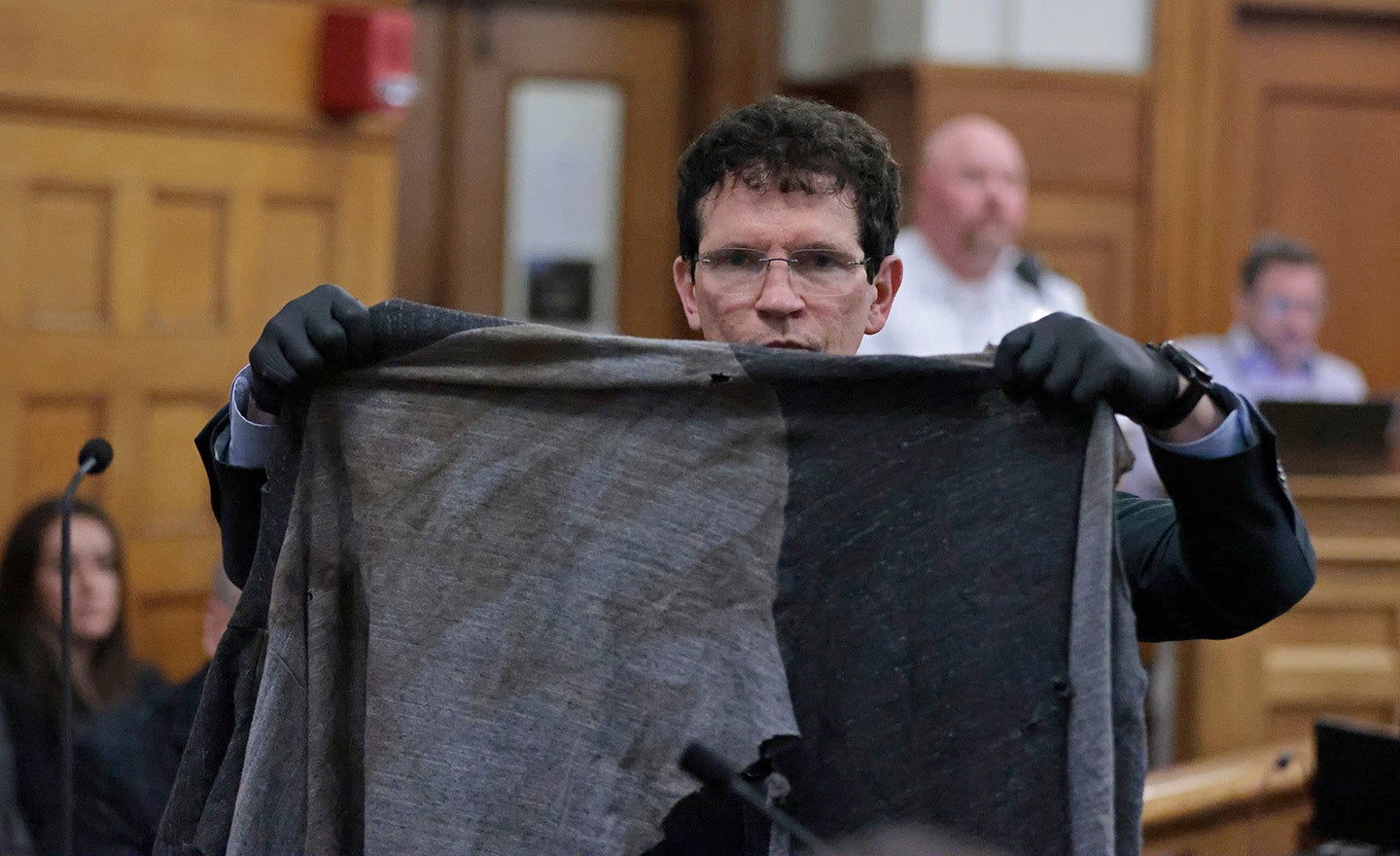
Karen Read’s attorneys demanded a mistrial with prejudice Monday after special prosecutor Hank Brennan embarked on a line of questioning suggesting holes on the back of John O’Keefe’s sweatshirt could have occurred during a collision.
In fact, Robert Alessi noted, a state criminalist cut the holes into the hoodie while examining and testing O’Keefe’s clothing.
“Those holes in the back of the hoodie sweatshirt are clearly, unequivocally, without doubt, caused [by] nothing to do with any type of event on or about Jan. 29, 2022,” Alessi asserted, furnishing documents from the criminalist’s file.
It’s no coincidence those documents were not already in evidence, he said, “Because if they were in evidence, they would clearly have prevented the stunt that we just saw occur with regard to [defense crash expert] Dr. [Daniel] Wolfe.”
Prosecutors “picked the most opportune, sensitive time to pull this stunt,” he alleged, pounding his hand on the lectern to emphasize his points.
“This is intentional. This is irremediable. This is on the key issue of this case: whether there was any collision at all,” Alessi continued. “The commonwealth has no case. They have no collision. They are desperate and are trying to create … specters of collision where the evidence doesn’t support it.”
He added: “We’ve come to the manufacture of evidence.”
In brief remarks of his own, Brennan said in his review of the lab paperwork and the sweatshirt, “it appears that I made a mistake.” He suggested Judge Beverly Cannone offer jurors a clarification and strike the line of questioning.
While Cannone rejected the defense team’s request for a mistrial, she allowed Alessi to hold the hoodie aloft for jurors and instructed the jury about the holes’ origin.
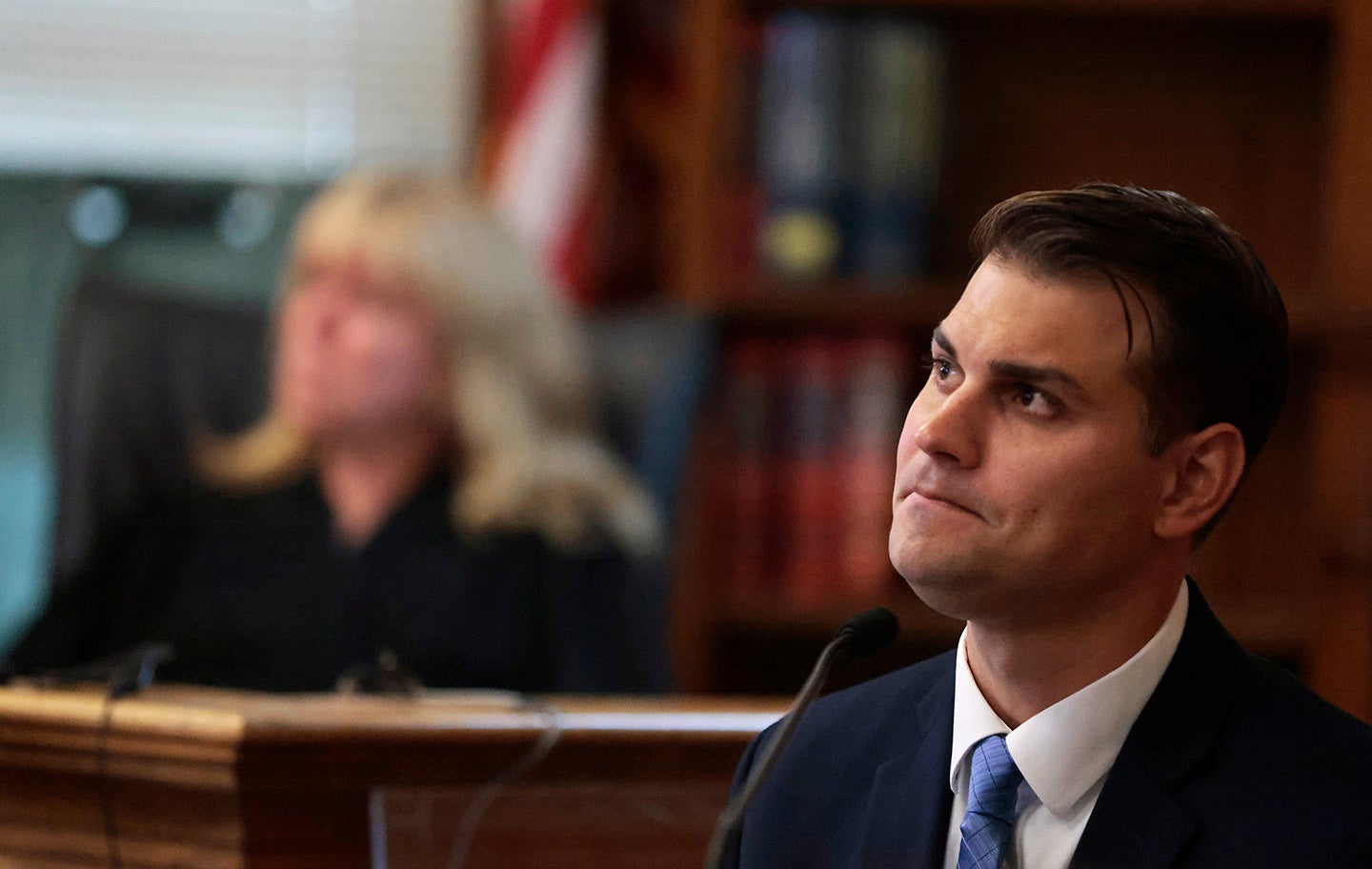
ARCCA crash expert Daniel Wolfe had his calculator out Monday morning as he crunched numbers and walked jurors through calculations for his analysis in Karen Read’s case.
Resuming his redirect examination, defense attorney Alan Jackson pointed back to Wolfe’s testimony that damage to one of the clothed dummies in ARCCA’s simulations was from road rash, or sliding contact with the pavement.
Questioning Wolfe Friday, special prosecutor Hank Brennan previously pressed the accident reconstructionist on his choice of dummy arm for some of ARCCA’s testing, suggesting John O’Keefe’s arm would have weighed around 11.8 pounds, while the dummy arm weighed only 9.38 pounds.
“Do you have any information, based on everything that you’ve reviewed, at all, about the actual weight of John O’Keefe’s right arm?” Jackson asked Monday.
“Nothing in terms of a weighed measurement of the arm, no,” Wolfe replied.
At Jackson’s prompting, he cranked out a series of calculations he said indicated the dummy arm was 21% lighter than the 11.8-pound estimate Brennan gave for O’Keefe’s arm. Brennan suggested Friday there was a 26.3% difference in the arm weights.
Returning for additional questioning, Brennan pressed Wolfe on his basis for choosing the 9.38-pound arm instead of a heavier one, and Wolfe testified that in his field, it’s acceptable to use the acceleration data and adjust the force based upon an increase in mass.
“The truth is, you have absolutely no study, no paper, no article that supports using a 9.38 arm for a 216-pound man who’s 6-foot-1,” Brennan alleged. “You have not one reference or study you can offer us right now, do you?”
Wolfe disagreed, noting prosecution accident reconstructionist Judson Welcher similarly used a dummy in the 50th weight percentile during his own drop test and adjusted for the mass of O’Keefe’s head in his calculations.
Brennan accused Wolfe of “feigning confusion” about prosecutors’ source for the 11.8-pound estimate for O’Keefe’s arm, earning an objection from the defense. He questioned whether Wolfe was intentionally trying to “inflate” the force for the tests’ speed “so it looked like the collision had to happen at a faster speed to cause a certain amount of damage.” Wolfe denied doing so.
Brennan also alleged Wolfe had no sources to support his use of a dummy arm for testing, asking if Wolfe was aware of expert literature indicating dummies should not be used for analyzing damage to someone’s clothing.
“I’m not aware of those studies, no,” Wolfe answered.
“As an inquisitive engineer, wouldn’t you want to know if there was legitimate studies in your work, in your profession, that suggests or states that you should not be using crash test dummies to determine injury to the arm as far as lacerations?” Brennan continued. “Would you want to know that?”
Wolfe suggested Brennan was confusing Wolfe’s role with that of his ARCCA colleague and fellow defense witness, biomechanics expert Andrew Rentschler. Brennan pointed to Wolfe’s testimony Friday that damage to O’Keefe’s sweatshirt was inconsistent with an impact with Read’s taillight, noting a dummy arm is harder than human flesh.
“Would you agree that a crash test dummy is not an appropriate tool to use when determining tears in clothing on somebody’s arm? Would you agree?” Brennan pressed.
“I don’t think I would agree with that, no,” Wolfe fired back.
In a subsequent question, Brennan asked whether the broken taillight could have pushed and made contact with O’Keefe’s arm, and Wolfe said it could. At another point, Brennan pointed to pictures of a “Rescue Randy” dummy lying splayed on the ground following one of ARCCA’s collision simulations, apparent pieces of taillight visible near the mannequin’s shoe and on its sweatshirt, depending on the angle.
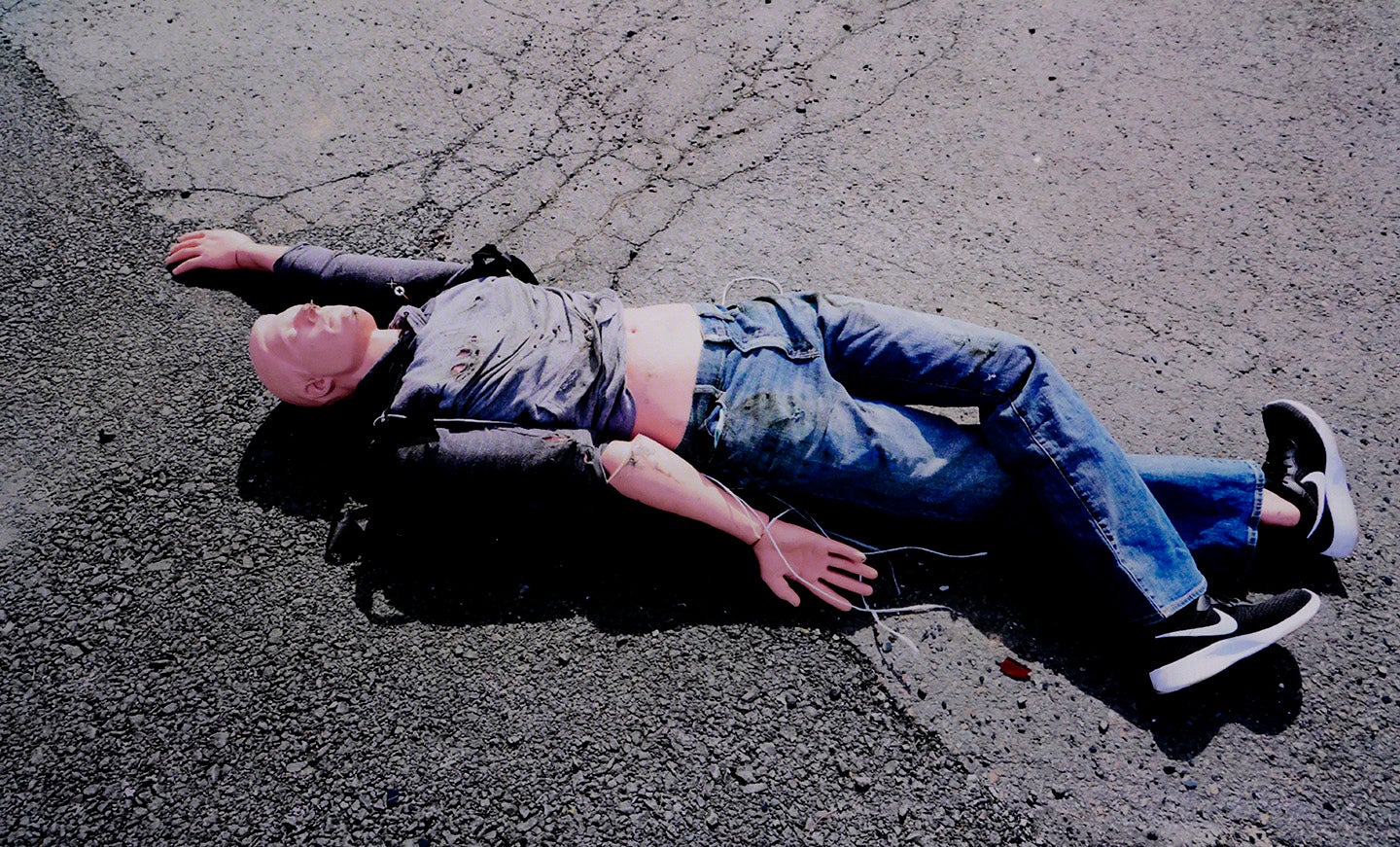
“And finding taillight fragments on the clothes after a collision, that’s not unique, is it?” Brennan asked.
“Unique? No, it’s possible,” Wolfe replied.
Brennan also displayed a photo of the debris from O’Keefe’s clothing, which included minute pieces of red plastic a Massachusetts State Police Crime Lab forensic scientist said were consistent with Read’s taillight. He questioned whether Wolfe considered if O’Keefe had fallen or landed on his back, and Wolfe answered “no.” Wolfe also acknowledged he did not know about or consider holes in the back of O’Keefe’s sweatshirt when he formulated his opinions.
Brennan further confirmed Wolfe conducted no studies about the damage to the sweatshirt “if [O’Keefe] fell or landed on the cold, hard ground and had broken taillight shards in his clothing.”
Back with more questions, Jackson asked Wolfe whether any of his tests showed a taillight fragment tearing a hole in the exemplar sweatshirt’s sleeve.
“No,” Wolfe answered. “There was no holes, punctures, fraying. Nothing to the material.” In fact, he explained, the only ARCCA test that resulted in holes to the shirt was the direct, or “full-on,” impact that saw the dummy sliding across the ground.

Before jurors were brought into the courtroom Monday, the lawyers clashed over upcoming testimony from a defense forensic pathologist and rebuttal testimony from several more prosecution experts.
Karen Read’s lawyers asked Judge Beverly Cannone to bar prosecutors from calling University of California, Davis forensic scientist Teri Kun, canine aggression expert James Crosby, and Massachusetts State Police Crime Lab forensic scientist Maureen Hartnett.
Prosecutors said they intend to call Kun, Crosby, and Hartnett to rebut testimony from defense dog bite expert Dr. Marie Russell, who told jurors last week she believes John O’Keefe’s arm injuries came from a dog attack. Defense attorney Elizabeth Little argued prosecutors were well aware Read’s lawyers intended to argue their dog attack theory and therefore do not have the right to offer a rebuttal at this late stage of the trial.
Special prosecutor Hank Brennan fired back, asserting evidence can’t be rebutted until it’s introduced. Just because the defense has a number of potential theories doesn’t put the onus on prosecutors to anticipate and deflect those attacks, “especially if they’re meritless,” he argued.
Brennan said prosecutors won’t call Crosby as a rebuttal witness if defense pathologist Dr. Elizabeth Laposata doesn’t testify about purported dog bites when she takes the stand. He also acknowledged another rebuttal witness, prosecution accident reconstructionist Judson Welcher, is limited in scope for his additional testimony.
Cannone allowed prosecutors’ motion for rebuttal witnesses and ordered voir dire questioning for Laposata after hearing arguments over several facets of the forensic pathologist’s anticipated testimony.
The voir dire hearing will occur when the jury takes its morning recess, the judge said.
Livestream via NBC10 Boston.
Star defense expert Daniel Wolfe, an accident reconstructionist from ARCCA Inc., returns to the stand Monday in Karen Read’s murder retrial.
Wolfe testified Friday that the damage to Read’s taillight was inconsistent with striking an arm at 24 mph, the speed at which prosecutors allege Read backed her SUV into Boston Police Officer John O’Keefe.
Prosecutors allege Read, 45, rammed O’Keefe — her boyfriend of two years — in a drunken rage while dropping him off at an afterparty in Canton following a night of bar-hopping. The defense, meanwhile, contends O’Keefe was actually attacked inside the home at 34 Fairview Road. They claim Read was framed in a massive coverup intended to protect the homeowner’s family and friends.
Wolfe’s company, ARCCA, was initially hired by the Department of Justice and FBI as part of a federal probe into the state’s handling of Read’s case. Wolfe testified at length Friday about the tests ARCCA conducted at various speeds using exemplar taillights and dummy arms. He told jurors those tests indicated the damage to Read’s taillight was inconsistent with striking an arm at 17 mph, 15 mph, 24 mph, or 29 mph.
Defense attorney Alan Jackson asked Wolfe whether the damage to O’Keefe’s sweatshirt — most notably, a series of small holes running up the right sleeve — was consistent with an impact with Read’s taillight.
“It was inconsistent,” Wolfe opined.
“In any of the testing that you did, did you ever see taillight pieces cut, puncture, or fray the sleeve of that [exemplar] hoodie?” Jackson pressed.
“No,” Wolfe answered.
As he stepped up for cross-examination, special prosecutor Hank Brennan hammered Wolfe’s communications with the defense team and ARCCA’s use of an anthropomorphic test device, or crash test dummy, in its simulated collisions.
Wolfe defended the use of the dummy as generally accepted in the field of accident reconstruction. He said the dummy arm ARCCA used, which clocked in at 9.38 pounds, weighed “close enough” to what O’Keefe’s arm would have weighed.
“Close enough? Wouldn’t you want to get an arm most closely related to his actual weight?” Brennan pushed, suggesting O’Keefe’s arm would have weighed around 11.8 pounds, given his build.
“My question is, are you telling us that having a lighter arm does not impact the damage in these tests, as opposed to using the heavier arm?” he demanded.
“Certainly not in the field tests, no,” Wolfe shot back.
Later in his questioning, Brennan highlight damage to the sweatshirt the dummy was wearing in one of ARCCA’s simulations. Answering a subsequent question from Jackson, however, Wolfe denied the damage to the exemplar sweatshirt was consistent with the damage he saw on the right sleeve of O’Keefe’s sweatshirt.
“This is distinctly road rash,” Wolfe said of the exemplar sweatshirt. “There’s a clear distinction between the two.”
As she dismissed jurors for the day Friday afternoon, Judge Beverly Cannone said the trial appears to be nearing its end. The ongoing trial is Read’s second, after a hung jury in her first trial resulted in a mistrial last summer.


Sign up for our Extra newsletter to get updates from the retrial and other breaking news alerts delivered to your inbox.




To comment, please create a screen name in your profile
To comment, please verify your email address
Conversation
This discussion has ended. Please join elsewhere on Boston.com