

The latest on the Karen Read murder case
Sign up for our Extra newsletter to get updates from the retrial and other breaking news alerts delivered to your inbox.
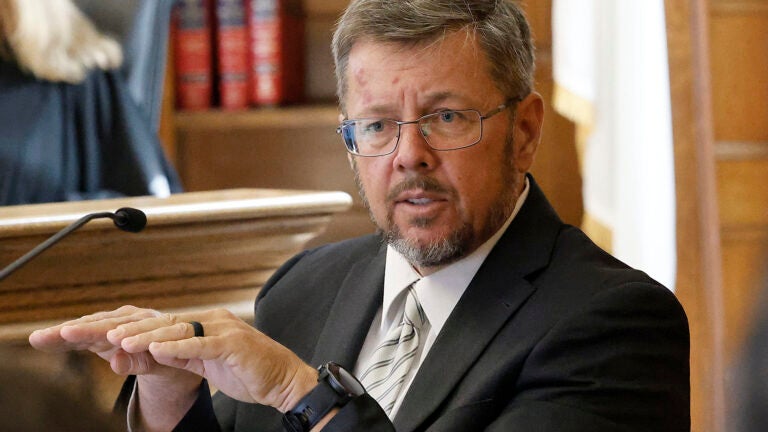
On the stand Wednesday:
Defense attorney Robert Alessi and accident reconstructionist Judson Welcher locked horns Wednesday in a tedious afternoon of questioning that appeared to leave both sides frustrated at various points.
Following the lunch recess, Alessi launched into a line of questioning about force analysis and the force required to break the bones of the arm or hand. He confirmed Welcher did not present a force calculation for John O’Keefe’s right arm, and Welcher explained there were too many unknown variables.
Welcher also confirmed there was no eyewitness who could say for certain how O’Keefe’s arm was positioned when his girlfriend, Karen Read, allegedly backed her SUV into him. O’Keefe’s right arm had a series of cuts when he died, though the bones were not broken.
Alessi questioned whether Welcher made an assumption that because Read’s taillight was shattered, it must have been damaged in an impact with O’Keefe’s arm. “That’s your conclusion, correct?” he asked.
“My conclusion is there are taillight fragments, a broken glass, lacerations to his arm, and his DNA on the back of the vehicle in the area of the taillight,” Welcher replied.
Alessi moved to strike Welcher’s testimony about the DNA, but Judge Beverly Cannone declined to do so. A DNA expert testified last week that testing showed “very strong support” for including O’Keefe in a mixture of DNA found on Read’s taillight.
“So you’re making assumptions, you’re taking what you view to be certain data, and you’re coming to a conclusion,” Alessi continued. “But that is based upon circumstantial information, correct? Is that fair?”
“Are you calling, like, pieces of taillight at the scene around his body circumstantial information?” Welcher asked, his tone slightly incredulous.
Rather than double down, Alessi pivoted and returned to his questions about force. He asked if there are any parts of the back of a Lexus SUV like Read’s that could break the bones in the hand with only 300 to 400 pounds of force.
“Probably,” assuming the entirety of the vehicle’s rear, Welcher answered. But “from a taillight or a broad, flat surface? No.”
He explained that hitting the end of the car’s exhaust pipe — a smaller surface — with that much force would be more likely to cause a fracture. Responding to a follow-up question from Alessi, Welcher agreed the corner of the taillight could potentially cause a fracture, depending on the positioning of the hand.
While a medical examiner didn’t note any fractures in O’Keefe’s right arm or hand, Welcher pointed out that it didn’t appear X-rays had been taken of the limb.

Later in his questioning, Alessi asked about Welcher’s “paint exercise,” a test that saw Welcher dressed as O’Keefe and utilizing grease paint to cover the taillight of a comparable Lexus SUV so he could determine where his arm would make contact with the vehicle.
Welcher acknowledged his paint testing was done at speeds far lower than the rate at which Read drove during the alleged collision. He said he doesn’t know the exact speed the SUV was traveling when it purportedly struck O’Keefe, nor does he know O’Keefe’s position on the road.
Alessi turned his attention to Welcher’s prior testimony that Read’s SUV pulled forward 34 feet and then reversed a total of 87 feet during the alleged collision, per vehicle data. Welcher had also pointed to signs that the wheels slipped on the ground during the backup maneuver outside 34 Fairview Road, and he told jurors Wednesday heavy acceleration could cause the wheels to spin.
Alessi changed gears, questioning Welcher about the number of people inside 34 Fairview Road on Jan. 29, 2022. Welcher said he learned as many as 16 people could have been present, depending on the time, and Cannone called the lawyers to sidebar.
When they returned, Alessi asked Welcher if he assumed there were cars parked in front of the home between midnight and 1 a.m. on the 29th. Welcher said there was, at one point, a pickup truck behind Read’s SUV. Fielding questions from Alessi, he confirmed he saw testimony suggesting a Jeep had also been parked out front, though he said the majority of the testimony he reviewed indicated there were no other vehicles present at the time.
Citing Read’s comments in interviews and statements from witnesses, Welcher said the other vehicle left before Read’s SUV made its backing maneuver. He also testified that as part of his testing, he drove the same model of Lexus SUV backward at 24 mph, roughly the speed at which Read’s vehicle was allegedly traveling during the trigger event.
Pressed by Alessi, he agreed it’s possible — although not necessarily reasonable — that Read’s SUV might have veered off the road and onto a lawn under prosecutors’ version of events.
Alessi also displayed a photo of O’Keefe’s injured arm, asking whether the arm would show vertical lacerations if it were flexed, as it was in Welcher’s testing. No, Welcher replied, rising from his seat and holding out his arm to mime the movement of the car pushing the limb.
“Given the contact that you’ve described, what would you expect to be the orientation of the wounds to the upper part of the arm and to the lower part of the arm?” Alessi asked.
“Just like it’s shown in this photograph,” Welcher answered, pointing to the screen.
Alessi asked Welcher if it’s his theory that the taillight would have to break and O’Keefe’s arm would have to maintain contact with the vehicle as it moved.
“So that is what happens in pedestrian contacts,” Welcher explained, adding that the arm would have been in contact with the vehicle’s rear “for some time.” However, he said there is not enough available information to determine how long O’Keefe’s arm would have had to maintain contact with the broken taillight to produce his injuries.
Later in his questioning, Alessi asked Welcher about confirmation bias, questioning whether the expert approached his paint test with the notion that O’Keefe’s arm was outstretched during the purported collision. Welcher explained he was able to reject alternate hypotheses regarding the position of O’Keefe’s arm through his testing.
“I didn’t come in here to tell these people what didn’t happen,” he added. “I came in here to tell them what I believe happened.”
Cannone sent jurors home for the day around 3:50 p.m., allowing Alessi to question Welcher during a brief voir dire hearing without the jury present. Alessi asked Welcher a series of clarifying questions about where he sourced some of the information in his presentation, particularly a drone image Welcher said came from Massachusetts State Police.
Following the voir dire, Alessi estimated he’s about halfway through his cross-examination of Welcher. The Aperture LLC expert is expected back on the stand Thursday for what is scheduled to be a half day in court.
Defense attorney Robert Alessi took a somewhat philosophical approach as he began cross-examining prosecutors’ accident reconstructionist, Judson Welcher.
He grilled Welcher about objectivity and the scientific method, pointing to the expert’s prior testimony that he “doesn’t have a dog in the fight” in Karen Read’s retrial and simply follows the data.
Several jurors had their heads down and notebooks open as Alessi questioned Welcher about his familiarity with the crash analysis done by Massachusetts State Police troopers, particularly Trooper Joseph Paul, who testified for the prosecution during Read’s first trial.
Alessi noted prosecutors retained Welcher’s company, Aperture LLC, in September 2024, more than two years after the death of Read’s boyfriend, John O’Keefe. According to Alessi, the Norfolk County District Attorney’s Office paid Aperture more than $44,000 last November for its work on the case and inked an April 2025 contract amendment authorizing prosecutors to pay the company $325,000.
Welcher, an executive vice president at Aperture, said he has no involvement in the company’s day-to-day invoicing and billing. He repeatedly maintained he has no personal knowledge of how much prosecutors have paid Aperture to date.
Asked about the “exemplar” Lexus SUV Aperture purchased for testing in Read’s case, he said the company plans to keep the vehicle until the trial ends, sell it, and ask the state to reimburse the difference.
Later in his cross-examination, Welcher confirmed he added a slide to his presentation on May 13 and removed it prior to his testimony in Read’s retrial. The original PowerPoint was submitted in January, though Welcher said he’s modified it as recently as Wednesday in response to rulings from Judge Beverly Cannone.
Welcher told jurors one of the changes he made May 13 came as the result of concerns raised by the defense. He said he did not believe an amendment he made to one slide regarding the possible paths Read’s SUV could have taken was significant.
“Well then, why did you make it in the middle of trial, if it wasn’t significant?” Alessi fired back. “Why didn’t you just leave it off and then discuss it in terms of testimony?”
Welcher said his goal is “to be as accurate as possible” and include as much information as he could. He noted the addition was ultimately left off of the presentation, anyway.
Later, he confirmed he was aware his Aperture colleague, Shanon Burgess, submitted a supplemental report in Read’s case on May 8, after Read’s retrial had begun. Alessi asked Welcher whether Aperture had ever previously submitted an amended report during an ongoing trial.
“I have no idea,” Welcher replied, noting Aperture has hundreds of employees and he can only speak for himself. That said, he testified he has previously submitted new or amended analysis during a trial.
After the morning recess, Alessi asked Welcher whether he was aware Read’s defense team received his amended presentation the afternoon of Memorial Day, less than a day before he began testifying. Welcher said he was not.
Switching gears, Alessi turned his attention to the “Techstream” trigger event data recorded by some Toyota-manufactured vehicles, such as Read’s Lexus. He paid particular attention to the process of assigning timestamps to trigger events, a key point in the testimony offered by Welcher and Burgess.
Welcher stressed the importance of looking at the “totality” of the data.
Alessi repeatedly attempted to ask Welcher whether prosecutors have proposed more than one timestamp for the impact alleged to have occurred outside 34 Fairview Road, though Cannone sustained an objection from prosecutors and called the lawyers to sidebar.

Following the sidebar, Alessi changed tack and asked Welcher about his role as a biomechanical engineer, particularly as it relates to his work on Read’s case.
Welcher testified under direct examination Tuesday that head injuries are the most common injuries in pedestrian impacts. Pressed by Alessi, however, he confirmed the article he cited was published in 1979 and states that of all head injuries sustained in motor vehicle collisions, only 12.7% are fatal.
Alessi suggested advancements in science and medicine have since made injuries to the lower extremities the most common injuries in pedestrian collisions.
“I’d have to see the study,” Welcher said, adding, “It wouldn’t surprise me.”
He explained newer vehicles’ pedestrian safety systems have resulted in autonomous braking that produces fewer higher severity crashes. Welcher also noted common injuries would depend on where a pedestrian makes contact with a vehicle, as in a frontal or rear collision.
Asked about the scene outside 34 Fairview Road, Welcher said he believed O’Keefe’s body was found seven feet into the property and near a flagpole. He estimated the berm, or asphalt curb, on Fairview Road was four inches tall, and Alessi alleged Welcher didn’t factor those inches in when conducting his analysis of O’Keefe’s death.
Welcher previously testified about dressing in clothing identical to what O’Keefe wore when he was injured to test crash scenarios, telling jurors the height of the rear “wing,” or spoiler, on Read’s SUV was about the same height as a small laceration on O’Keefe’s right eyelid.
Alessi pointed out Welcher’s testing showed him standing on flat ground, rather than something four inches higher, and Welcher explained investigators don’t know the exact point of impact or O’Keefe’s posture during the purported crash.
At Alessi’s prompting, Welcher confirmed O’Keefe’s eye laceration could have come from something other than the spoiler on Read’s SUV, including contact with the ground.
Judge Beverly Cannone called a lunch recess shortly before 1 p.m. Welcher will return to the stand for more cross-examination after the break.
The damage to Karen Read’s SUV was consistent with a collision with John O’Keefe around 12:32 a.m. on Jan. 29, 2022, accident reconstructionist and biomechanical engineer Judson Welcher testified Wednesday.
If an impact is “basically more than approximately 8 mph, it will likely break the taillight lens,” he said, referring to the theory that Read’s taillight shattered after making contact with O’Keefe’s right arm.
In Read’s case, Welcher added, “it is consistent with a collision, as long as it’s greater than approximately 8 mph.” He also opined that O’Keefe’s injuries were consistent with being struck by a Lexus identical to Read’s car “and ultimately contacting a hard surface, such as frozen ground.”
In another line of questioning, special prosecutor Hank Brennan had Welcher explain the differences between a head-on pedestrian impact and sideswipe or “clipping” collisions with glancing contact.
Welcher described the mechanics of a pedestrian “vaulting” off the corner of a car in the type of collision alleged to have occurred between Read’s SUV and O’Keefe. After that type of impact, he explained, pedestrians will often take a step and try to regain their balance, altering where they come to rest.
He said direct impacts tend to produce more severe injuries due to greater momentum transfer and applied force. Brennan asked whether it’s uncommon to see a pedestrian sustain no broken bones in their lower body during a sideswipe collision.
“No, it is not uncommon,” Welcher replied. He offered jurors an example of a fatal pedestrian collision in Los Angeles with a sideswipe impact at a speed between 25 to 35 mph.
Welcher pointed to a photo of a “massive” laceration on the Los Angeles pedestrian’s right forearm, noting the man had no broken bones in his arm. Likewise, Welcher pointed out the man had no leg fractures despite “red marks” on his leg and buttocks.
According to Welcher’s presentation, the man did sustain a severe brain injury, rib fractures, a liver laceration, hemothorax/pneumothorax — blood in the space between the lung and the chest wall, and a collapsed lung.
Brennan asked Welcher for his opinion on whether O’Keefe’s lack of lower body fractures was consistent with Read’s SUV striking him in a sideswipe or clipping.
“Yes,” Welcher replied. “You could definitely have this type of impact and not have anything beyond, say, red marks to the lower extremities.”
After Brennan finished his questioning, defense attorney Robert Alessi stepped up for cross-examination.
Judge Beverly Cannone opened Wednesday’s court proceedings with a ruling on the opinions and conclusions prosecution accident reconstructionist Judson Welcher is able to provide.
Welcher testified Tuesday that prosecutors’ theory that Karen Read struck her boyfriend, John O’Keefe, with her SUV at 12:32 a.m. on Jan. 29, 2022, “is what happened.” Read’s lawyers objected, arguing Welcher’s testimony wasn’t appropriate. After a lengthy sidebar and brief oral arguments Tuesday afternoon, Cannone made her decision.
She said Welcher could testify that the data he downloaded and analyzed — and the damage to Read’s SUV — is consistent with the Lexus being in a collision at 12:32 a.m. on Jan. 29, 2022. Cannone also allowed Welcher to testify that O’Keefe’s injuries were consistent with him having been struck by a Lexus physically identical to Read’s car.
However, she said Welcher may not testify that Read’s Lexus collided with O’Keefe, “because that conclusion is not based on the application of reliable scientific methodology.”
“The problem here,” Cannone explained, “is that Dr. Welcher, the expert, is drawing an inference based upon more than scientific method. His opinions set the stage for argument and a permissible inference to be drawn by jurors through the application of their sound judgment to the opinions that they find credible. But the jurors are as well positioned to draw, or reject, the inference as is the expert.”
Defense attorneys Alan Jackson and Robert Alessi shared a satisfied nod following the ruling, and Cannone called for the jury to be brought in.
Livestream via NBC10 Boston.
Karen Read‘s retrial continues in Norfolk Superior Court Wednesday with additional testimony from prosecutors’ accident reconstructionist.
Aperture LLC’s Judson Welcher previously told jurors Read’s SUV accelerated in reverse at 74% throttle around the time she’s alleged to have struck and mortally wounded her boyfriend, Boston Police Officer John O’Keefe. Prosecutors say Read backed into O’Keefe in a drunken rage while dropping him off at an afterparty in Canton after midnight on Jan. 29, 2022.
“Based on the totality of the evidence, DNA, everything I’ve talked about, that is consistent with that happening,” Welcher opined Tuesday, reflecting on the state’s theory. “And with a reasonable degree of scientific certainty, that is what happened.”
Read’s lawyers have floated an alternate theory: That O’Keefe entered the party at 34 Fairview Road and was beaten, attacked by the homeowner’s dog, and ultimately dumped outside in the snow. They allege Read was framed in a widespread law enforcement conspiracy intended to protect the homeowner’s family and friends.
The defense has also sought to undermine the cornerstone of the prosecution’s case, Read’s shattered right taillight. They contend Read damaged the taillight not by backing into O’Keefe, as prosecutors claim, but by reversing into his SUV while leaving his home to search for him the morning of the 29th.
The moment was captured on Ring home surveillance footage from O’Keefe’s driveway, and Welcher walked jurors through the video frame by frame.
“There actually is contact between the vehicles,” Welcher agreed, though he said he ultimately ruled out the possibility that Read’s taillight was broken or cracked in the impact, telling jurors he saw “nothing in the snow” after the Lexus pulled out of the driveway.
He also testified about dressing in clothing identical to what O’Keefe wore when he was injured to test crash scenarios on someone of a similar height and build. Using a comparable Lexus SUV, he said he covered the car’s right taillight in grease paint to determine where his outstretched arm would make contact with the back of the vehicle. According to Welcher, the approximate location lined up with lacerations on O’Keefe’s right arm.
Speaking to reporters outside the courthouse Tuesday, Read appeared skeptical of Welcher’s approach.
“So he tried to dress identically to John, but didn’t do anything else to mimic what the commonwealth is accusing me of,” she said.
Read added: “I think it’s important to demonstrate, what is the commonwealth accusing me of? The speed? The positioning? Recreate that for us. … That’s what I would want to see if I were you.”
Wednesday’s court proceedings are expected to begin at 10 a.m., with Welcher still under direct examination. The ongoing trial is Read’s second, after her first trial last summer resulted in a hung jury.


Sign up for our Extra newsletter to get updates from the retrial and other breaking news alerts delivered to your inbox.



To comment, please create a screen name in your profile
To comment, please verify your email address
Conversation
This discussion has ended. Please join elsewhere on Boston.com