
Sign up for the Today newsletter
Get everything you need to know to start your day, delivered right to your inbox every morning.
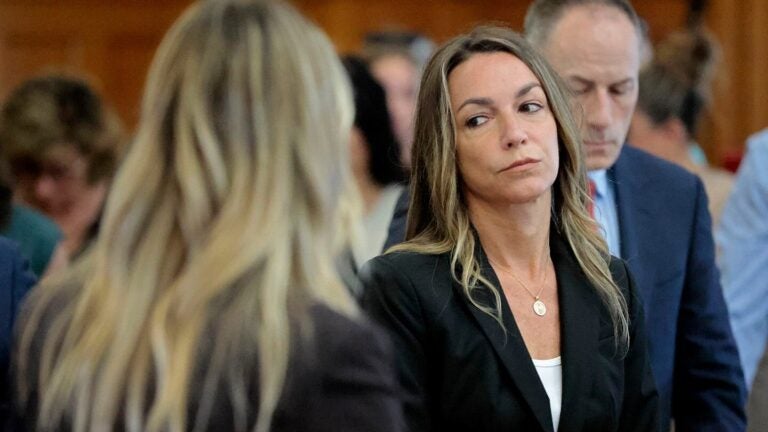
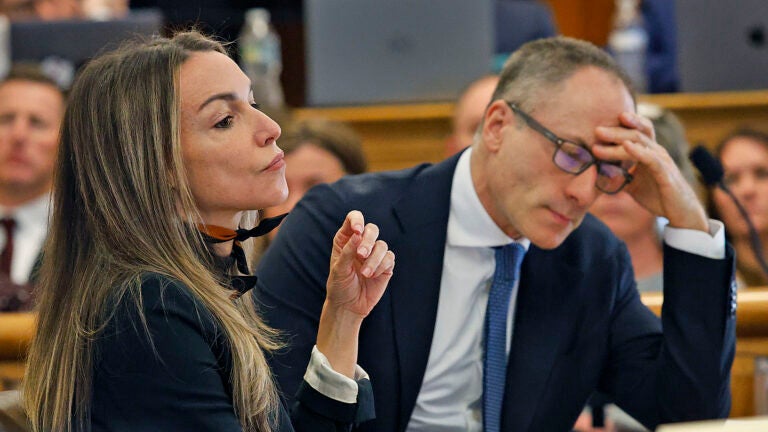
Karen Read’s lawyers argued their motion to dismiss the case against her Wednesday, alleging authorities withheld key evidence and tampered with the jury during her first murder trial.
“Our motion illustrates that dismissal in this case is required, because of the cumulative impact of clear-cut discovery violations, clear-cut, inexcusable Brady violations,” defense attorney Alan Jackson argued. “And from a legal standpoint, the conduct in this case is so egregious, it’s so pervasive, and it’s so deliberate that prejudice must be presumed.”
Both sides were in U.S. District Court in Boston earlier Wednesday as Read’s lawyers asked a federal judge to drop two of the charges against her in the 2022 death of her boyfriend, Boston Police Officer John O’Keefe. The federal hearing came after the state’s Supreme Judicial Court was unswayed by Read’s argument that jurors in her first trial unofficially agreed to acquit her of second-degree murder and leaving the scene of a fatal accident.
Read, 45, is accused of drunkenly and deliberately backing her SUV into O’Keefe while dropping him off at another Boston officer’s home in Canton after a night of bar-hopping in January 2022. Her lawyers maintain she was framed in a law enforcement coverup, floating an alternate theory that O’Keefe entered the home for an afterparty and was beaten, attacked by the homeowner’s dog, and dumped outside in the snow.
Read’s first trial ended with a hung jury last July, and she’s due to stand trial again in April.
With weeks to go before the retrial, the defense team has accused prosecutors of withholding some of the surveillance video of Read’s SUV at the Canton Police Department and misleading jurors by showing an inverted video clip at her first trial. They’ve also alleged jury tampering by Massachusetts State Police Lt. John Fanning, who worked on the investigation into O’Keefe’s death and was part of the team coordinating security at Norfolk Superior Court during the trial.
Specifically, the defense claimed Fanning was involved in reporting an incident that led to a juror being dismissed at a late point in the proceedings. According to Jackson, there were allegations someone overheard the juror speaking improperly about the case.
“Over the defense’s objection, this very potentially defense-friendly juror was then excused,” he said.
Jackson’s arguments prompted a testy exchange with Judge Beverly Cannone, who pointed out court officers are in charge of juries and Fanning did not have access to the jurors in Read’s case. Special prosecutor Hank Brennan likewise noted Fanning worked from a remote location and did not interact with the jury.
“Lt. Fanning is one of the most conscientious, dedicated, admired State Police officers in Massachusetts,” Brennan contended.

Fanning was one of several State Police troopers who came under increased scrutiny following their work on Read’s case. However, State Police determined last year there was insufficient evidence to prove allegations he violated agency rules by failing to uphold the responsibilities of a supervisor.
Much of Jackson’s motion to dismiss focused on the prosecution’s production of surveillance video clips from the Canton Police Department, which Jackson said arrived in “dribs and drabs” and were of poor quality or otherwise defective. He noted the defense received some of the clips years after State Police Trooper Michael Proctor, the lead investigator on the case, obtained them from Canton police.
“The repeated and flagrant discovery violations were not an accident,” Jackson alleged. “There were too many people looking at them, strategizing about them, to then say, ‘I didn’t realize their import.’ … The fact that we weren’t provided the evidence was designed specifically to obtain a strategic advantage over the defense and to get a conviction at all costs, rather than to pursue the truth.”
Brennan acknowledged Proctor should have provided the clips to prosecutors sooner so they could be turned over to the defense, though he maintained the prosecution provided the video soon after learning of its existence. He asserted the defense never filed a motion specifically for the production of video from the Canton Police Department.
Brennan further denied the video had been withheld intentionally, or that it had been altered or tampered with in any way.
“It should have been managed better, no doubt,” he said of the delayed production. “But there was nothing about it that was prejudicial.”

Speaking in federal court Wednesday, defense attorney Martin Weinberg asserted the record from the first trial reflects “no consideration of Ms. Read’s double jeopardy interests.”
He noted the defense has heard from five jurors — four directly, one indirectly — who said the jury internally agreed to acquit Read on the charges of second-degree murder and leaving the scene. And while there was no verdict read in open court before Cannone declared a mistrial, Weinberg argued “the acquittal is not the announcement, not the formality of the verdict,” but the decision itself.
Weinberg further noted none of the remaining jurors have come forward to dispute reports of an unofficial verdict. Cannone previously rejected the defense team’s request to bring the jury back for a post-trial inquiry to confirm those claims.
As he did when he argued Read’s appeal before the SJC, Weinberg cited Boston Marathon bomber Dzhokhar Tsarnaev’s case, where jurors were called back nine years after the trial to look into claims of bias. But Chief Judge F. Dennis Saylor IV noted the Tsarnaev matter involved a federal court examining its own jury, whereas Read’s request calls for a federal court to examine a state jury. He asked about the legal precedent, noting the unusual nature of Read’s petition.
“We’re here in a bit of a legal wilderness,” Weinberg acknowledged, while noting voir dire questioning of jurors is not unusual.
He later added: “This case cries out for some decision-making, your honor, in an area that hasn’t had a great deal of decisions.”
Weinberg also argued Cannone didn’t consider alternatives before declaring a mistrial, such as polling jurors or asking them whether they wanted to continue deliberations or if they had reached a unanimous decision on any of the three counts.
“They were all alternatives,” he argued. “None appeared to have been considered by Judge Cannone.”
Yet Assistant District Attorney Caleb Schillinger noted the SJC found Cannone pursued alternatives by encouraging continued deliberations and issuing a Tuey-Rodriguez instruction the first two times jurors reported a deadlock. He said Cannone only declared a mistrial after jurors wrote a final note saying further deliberations would be futile and might compromise their “deeply held beliefs.”
Schillinger noted that in Massachusetts, verdicts must be unanimous and returned in open court. Until then, jurors still have the ability to change their minds, and Schillinger argued Read’s team couldn’t rule out that possibility.
He also pointed out that some of the jurors who came forward with acquittal claims had different recollections of the jury’s tally on the charge of manslaughter while operating a motor vehicle under the influence.
Saylor took the matter under advisement, telling lawyers the case was “well-briefed and well-argued on both sides.” He said he’s “quite conscious” of the April start date for Read’s retrial and will aim to file his opinion as soon as possible, leaving enough time for potential appeals.
Reflecting on the jurisprudence and legal questions at stake, Saylor added: “Mr. Weinberg said it’s a wilderness. It’s a thick forest, anyway.”
Speaking to reporters outside the courthouse, Weinberg said Read’s team is hopeful Saylor will decide in their favor, and they believe the issues at hand are of “profound constitutional significance, which is whether or not the Norfolk DA can reprosecute Ms. Read when there’s such strong and compelling evidence that the prior jury acquitted her.”
Livestream via NBC10 Boston.

Get everything you need to know to start your day, delivered right to your inbox every morning.



To comment, please create a screen name in your profile
To comment, please verify your email address
Conversation
This discussion has ended. Please join elsewhere on Boston.com