
Battle of the barley: 15 massive barleywines ranked
-

In a field awash with malty musculatures, swelling ABVs, and a deluge of pungent hops, American-style barleywines are typically the burliest clod on the block. A close relative to old ales and winter warmers, these liquored-up after-dinner sippers have alcohol levels that regularly hover in the double digits, making them perfect for austere winter days. After reaching its peak of popularity in 18th- and 19th-century Britain, presumably alongside a snifter of brandy and a crackling fireplace, barleywines fell out of favor.
Now, in the age of barrel-aging, brettanomyces, and anything sinewy or eccentric, brew masters are amping up production on these once forgotten ales. I invited several friends and colleagues to help blind sample 15 modern American examples. We wanted to compare popular local offerings with award-winning, nationally recognized brands like Anchor’s influential forebear, Old Foghorn. Frederic Yarm , Russell House Tavern bartender and author of “Drink & Tell: A Boston Cocktail Book,’’ took part, as did my Boston.com colleague Jon Palmer, and my beer savvy friend, Jeff Soyk.
Almost all of the brews had some laudable detail or nuance, while others were comfortably pardoned to the dump bucket. Here are the results of our blind barleywine tasting from worst to first.
-
14. Rock Art Ridge Runner

Without Matt Nadeau there might never have been a Shaun Hill (Hill Farmstead) or John Kimmich (Alchemist Brewery). Vermont now has more breweries per capita than any other state in the country (about 1 for every 25,030 people), and a lot of that interest can be traced back to Nadeau’s pioneering spirit. Unfortunately, a lot of those earlier efforts — yes, the late ’90s are eons ago in the context of craft beer — don’t have the resonance they once used to. Think of those oceans of forgotton amber ales (hello, New Belgium Fat Tire) and modest pales (when’s the last time you even saw Coopers Original?) that barely register on today’s hop-wrecked palate. Rock Art’s Ridge Runner, one of their signature beers, is another perfect example of this astigmatic phenomenon. Their website qualifies it as a “mild barley wine (by today’s bigger beers),’’ but I’m afraid Nadeau didn’t go far enough. Ridge Runner was so frail and lifeless, one taster wondered if it was a nonalcoholic beer. Another accused me of raiding the “bargain bin.’’ The nose presented little beyond microwave popcorn, spent grain, and funky barnyard aromas. The real travesty though was in its anemic mouthfeel, which could have given Bud Light a lesson in insipdness. How is this the same brewer that makes Belvidere Big IPA (an imperial IPA) or Vermonster (something resembling an actual barleywine)? It’s a conundrum that could baffle the best minds on the planet.
Average Score: 4.9
-
13. Weyerbacher Blithering Idiot

Every blind tasting, I incorporate Easton, Pa.’s finest, futilely assuming that Weyerbacher’s much-ballyhooed line of ales will bequeath at least one noteworthy selection. Its Imperial Pumpkin Ale fell firmly in the middle of our fall pumpkin beer tasting and their Old Heathen just barely circumvented the dubious honor of most disappointing winter stout. Weyerbacher’s year-round barleywine, followed in that same lackluster trend, with a fleeting, ephemeral memory of hops and a nose more akin to a German Dunkel or Belgian Trappist Dubbel. This led to speculation regarding possible errant strands of wild yeast. Sure, there were some intriguing prune and dried dark cherry notes, but they were practically suffocated by a pervasive mustiness that fell somewhere between mildewed cardboard and fossilized potpourri. It was like poking around the crawlspace of Grandma’s attic, searching for a lost crate of Christmas ornaments. I’m beginnning to see a pattern in Weyerbacher’s beer and it’s not a flattering one.
Average Score: 6.2
-
12. Great Divide Old Ruffian

Great Divide out of Denver is consistently one of my favorite microbreweries. Winners of 18 Great American Beer Festival medals, five World Beer Cup awards, and ranked 12th in Ratebeer.com’s “Best Brewers in the World,’’ Brian Dunn and his staff have helped push American beermaking onto the world stage. But, their Old Ruffian proved a divisive selection. I saw nothing but potential in the beer and was enchanted by the floral citrus hops and the bold notes of burnt caramel, pineapple, and sour tangerine. Fans of Dogfish Head’s decadent 120 Minute IPA, with its lanoline texture and cordial-like levels of sugar and alcohol (18 percent ABV), will undoubtedly fawn over Old Ruffian’s exaggerated architecture. This year’s batch does seem to be a bit boozier though (it’s listed as 10.2 percent ABV), and I found the other tasters wincing like teetotalers taking their first pull of Southern Comfort. American-style barleywines tend to mature with age. The alcohol burn mellows and, like a stew sitting in the fridge overnight, the contrasting flavors meld. Even with just a little time, the better aromatics come to the forefront. Unfortunately, we were blind tasting the freshest possible beer, and collectively, nobody could get beyond the one-note burn of ethanol.
Average Score: 6.3
-
11. Smuttynose Barleywine

One of their first four original “Big Beers,’’ Smuttynose has been brewing this hop-forward Barleywine since 1998, almost a full decade before extreme beers became de rigueur. This New Hampshire stalwart uses six types of malts and three varieties of hops (Bravo, Centennial, and Apollo) in their brew, but it’s the addition of amber Belgian candi syrup that commands the most attention. Like a belligerent child in the throes of a tantrum, this supplemental pop of sweetness was a nagging distraction. The Apollo hops, a favorite among IPA enthusiasts, provided a nice, clean, citrusy hop aroma, but the bittering Bravo hops left the finish dry and acrid. Overall, Smuttynose’s Barleywine seemed to suffer from a bit of an identity crisis, shooting for a more progressive style of American barleywine, but coming across as a disjointed, ’roided-up brown ale.
Average Score: 6.95
-
10. Victory Old Horizontal

Formed by childhood friends Bill Covaleski and Ron Barcheton at the site of an old Pepperidge Farm bakery in Downingtown, Pa., Victory brews an impressive array of beers, now widely recognized as some of the best in the country. Erik Asimov of The New York Times routinely cites their Prima Pils, with it’s “wonderfully refreshing bitterness’’ as his favorite American pilsner, and Beeradvocate.com has named Storm King as its fourth best imperial stout in the world. Too bad Victory’s Old Horizontal suffered from the same imbalanced approach as Great Divide’s Old Ruffian. The body had nice butterscotch, sweet tea, and panettone flavors, but they were muddied by the alcohol esters, which permeated every aspect of its composition. Again, I’d be curious to see how this beer drinks with some more time in bottle, but Old Horizontal’s final impression was as astringent as chewed asprin.
Average Score: 7
-
9. Anchor Old Foghorn

Founded on the cusp of the 20th century, Anchor Brewing in San Francisco is a venerable institution. The creators of America’s first original beer style, the California common or steam beer, this prestigious brewery remains a leader in chic consumption. One of the first microbreweries to produce a porter or IPA and a vanguard of the current mixology scene with their early advocacy of small batch gins and ryes, Anchor is like the freewheeling silver fox in a room full of pups. Think Roger Sterling coolly ambling past the secretary pool on “Mad Men.’’
Brewed since 1975, Old Foghorn is considered the first modern American barleywine, combining traditional English brewing methods with flowery, West Coast Cascade hops. Collectors tend to stockpile vintages like good Burgundy and Bordeaux because it can come across as muted or bottle-shocked upon release. Everyone at our tasting was impressed by its ruby hue, the malt-to-hop balance, and the cheeky aromas of strawberry Red Vines. But there was also something medicinal , like cheap jug wine, that will hopefully dissipate over time.
Average Score: 7.3
-
8. Pretty Things Our Finest Regards

Pretty Things’ Dann Paquette is very much the product of Old World influences. A former protege of Daleside Brewery in Harrogate, Yorkshire, England, Paquette often indulges his penchant for more historically grounded brews with collaborative projects like his Once Upon A Time series with Dutch beer historian Ron Pattinson and Pretty Things’ recent partnership with Roosters Brewery in Yorkshire. Paquette tends to steer away from craft beer’s affinity for experimental, piquant new hop varieties. This is never more obvious than in his Our Finest Regards, a barleywine that eschews anything but minimal hopping, in deference to some of England’s most revered barley from Thomas Fawcett & Sons. This was one of the richest examples of the evening (29 Plato!) with a deep walnut complexion and a nose of caramel, coffee, and banana Laffy Taffy. The whopping 12.1 percent ABV was well-integrated and the finish had a pleasantly warm, cognac-like affect.
Average Score: 7.35
-
7. Jack’s Abby Baby Maker

Jack’s Abby brews nothing but lagers at its Framingham operation, but that doesn’t hold it back from the type of adventurous concoctions typically practiced at better ale houses. Just last fall, the three Hendler brothers released their first ever “lager wine,’’ a bottom-fermented barleywine, barrel-aged for nine months in Willett bourbon barrels. “We had to pull out every trick in the brewer’s book to pull out as much sugar for the yeast to work on,’’ says co-owner Jack Hendler. To achieve a whopping 14 percent ABV, Hendler had to triple-mash the brew in three small batches as well as adding a 15 percent sugar solution. The result is like walking into a French pastry shop with the smell of yeast, dough, and confectioners sugar wafting in the air. In our group, Baby Maker was likened to all manner of guilty indulgences — coconut macaroons, cheese danishes, and Royal Dansk butter cookies. The oak staves, with their natural vanilla seasoning, saturated every facet of this singular, intoxicating beer. But like ice wine or any other ambrosial delicacy, Baby Maker is best savored in small doses.
Average Score: 8.1
-
6. North Coast Class of ’88

What the 1984 draft was to the NBA (Michael Jordan, Hakeem Olajuwon, Charles Barkley), the class of 1988 was to craft brewing. That was the year that three of the West Coast’s most influential breweries all opened their doors: Rogue and Deschutes in Oregon and North Coast Brewery in Fort Bragg, Calif. To commemorate that pivotal year, the three brewing teams collaborated on three interpretations of a barleywine, based on the description outlined in Fred Eckhardt’s “The Essentials of Beer Style,’’ an indispensable book conveniently published — you guessed it! — in 1988. “The three beers were all different, but terrific,’’ says North Coast cofounder Tom Allen. The North Coast version we sampled was like a sticky grapefruit gelato, with earthy hop notes, toffee aromas, and an underlying grassiness. Because of market demand on their year-round line of beers, this was North Coast’s first opportunity to collaborate with another of its craft brewing brethren. That’s disappointing because their limited-production, 25th anniversary offering is immensly complex and has, as Allen says, “a lot of staying power.’’
Average Score: 8.15
-
5. (tied) Left Hand Widdershins

For years, the South African wine industry has been lost in translation. Somehow, its red wine (specifically Pinotage) has had an unfortunate association with burnt rubber and Band-Aids. Corrective measures are in place to eliminate possible contagions that emerge in transit, including: brettanomyces, reductive winemaking, and old fourdes used in fermentation. I bring that up because that unmistakeable bouquet is present in Left Hand’s Widdershins. Some tasters were drawn to it, like the woodsy, outdoor-types who don’t mind the stink of a good campfire ingrained in the deepest fibers of their clothes and scalps. Others (myself included) thought there was far too much going on. Widdershins was easily the most ambitious beer of the evening, brewed as it is with wheat, peated barley (think Islay single malt Scotch), four types of hops (Mount Hood, Golding, Willamette, and CTZ), and turbinado sugar. The smokey peat and earthy hops mingle to form a meaty, savory libation hearty enough to sustain a tribe of tundra-dwelling Inuits.
Average Score: 8.175
-
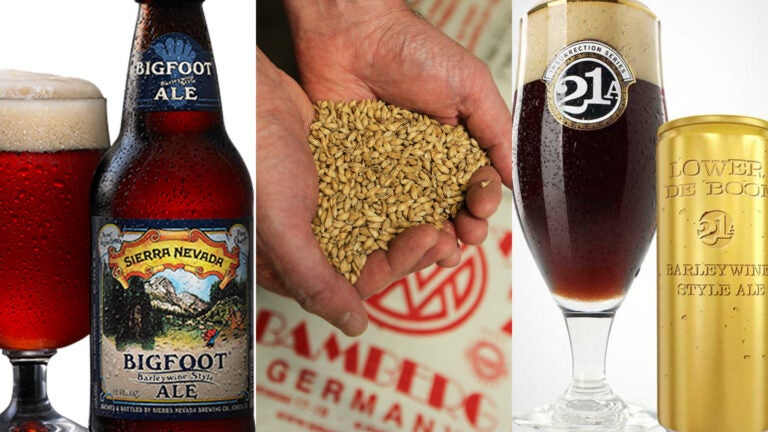
5. (tied) 21st Amendment Lower De Boom

Named in honor of the amendment that repealed the insanity of Prohibition, 21st Amendment Brewery was built, in part, to honor the plentiful early 20th watering holes that served as communal gathering spots in San Francisco. The Bay Area is still trying to rejuvenate that lost era of friendly neighborhood brewpubs, but 21st Amendment owners Nico Freccia and Shaun O’Sullivan — along with historic Anchor Brewing and newcomers like Triple Voodoo– are doing a commendable job of bringing back the culture of quality, hand-crafted brewing. 21st Amendment stormed onto the scene in 2000 with their unique, all-aluminum line, which has grown to include their phenomenal Marooned on Hog Island oyster stout and Lower De Boom barleywine. Brewed with Amarillo, Cascade, and Warrior hops, this mahogany elixir offers notes of cranberry, currant, and peanut butter toast. The finish might be a little too tame, but its complex sweetness, not unlike the crackly top of a creme brulee, makes every drop of Lower De Boom’s 8.4-ounce “nip can’’ a memorable indulgence.
Average Score: 8.175
-
4. Sierra Nevada Bigfoot

The beer that not only started the American barleywine craze, but the idea of “cellarability.’’ First introduced in the winter of 1983, at the height of Strohs, Schlitz, and Bartles & Jaymes wine coolers, Sierra Nevada introduced a high-octane, vintage-dated behemoth that almost doubled conventional ABV percentages. The first in what would eventually become Sierra Nevada’s High Altitude series, this seasonal favorite is practically dripping in the pine resin and cannabis skunkiness of Centennial, Cascade and Chinook hops. Purists will argue that the heaping amount of malt should never take a backseat in a barleywine’s anatomy, but the hoppy components lend it an unparalled freshness that only serves to complement the dark caramel core.
Average Score: 8.2
-
3. Berkshire Brewing Holidale

Definitely the most pleasant surprise of the evening, Berkshire Brewing’s Holidale wowed with notes of sweet pipe tobacco, cinnamon, toasted hazelnuts, and milk chocolate. Chris Lalli and Gary Bogoff ‘s solid South Deerfield brewery is an oftentimes overlooked gem in the loaded New England beer scene, but Holidale came within fractions of a point to stealing the whole tasting. The recipe on this cult holiday beer changes annually, with 2013’s manifestation introducing cocoa and an aytpically robust amount of malted barley. Visually, Holidale isn’t the most appealing beer, with a muddy, opaque consistency that had one taster begging for a coffee filter, but one whiff alayed all but the most superficial concerns.
Average Score: 8.5
-
2. Uinta Anniversary

That other West Coast brewery — the one not from California or the Pacific Northwest — Uinta, out of Salt Lake City, Utah is beginning to rival leviathans like Lagunitas, Deschutes, and Sierra Nevada. Humbly launched on the site of a former auto mechanic’s garage, Uinta now operates out of a sprawling 26,000-square foot facility that churns out nine impressive year-round ales, six organic beers, a canned line, three seasonals, and the Crooked Line big beer series, packaged in 750ml bottles. The recipient of ten North American Beer awards, Anniversary Barley Wine is extremely well balanced, with traces of brown sugar, orange marmalade, and toasted Hawaiin sweet bread. This was the second beer sampled and each subsequent competitor suffered because of it. As the cliche goes, “you never really get over your first love.’’ That certainly held true with this consensus stunner.
Average Score: 9.2
-
1. Avery Hog Heaven

Ratebeer.com just unveiled their much-anticipated regional rankings, and Adam Avery’s eponymous brewery recieved top honors in Colorado. In the beer world, that’s the equivalent of being named best bubbles in Champagne or top Pinot Noir in Burgundy. Colorado is arguably the single greatest state producing quality microbrews with Odell, Left Hand, and Oskar Blues, just to name a few. Hog Heaven was the innaugural extreme beer in Avery’s “Holy Trinity of Ales’’ series and the first real breakout success for the Boulder stalwart. Loaded with aromas of candied grapefruit, peach, prailines, and Darjeeling tea leaves, this hop bomb is dangerously drinkable. The brewery’s website suggests aging for up to three years, but I advocate opening and enjoying Hog Heaven as often as you can. Seriously, go find some today!
Average Score: 9.3



To comment, please create a screen name in your profile
To comment, please verify your email address
Conversation
This discussion has ended. Please join elsewhere on Boston.com