
Can Clotheslines and Mattresses Make Schools Care About Rape?
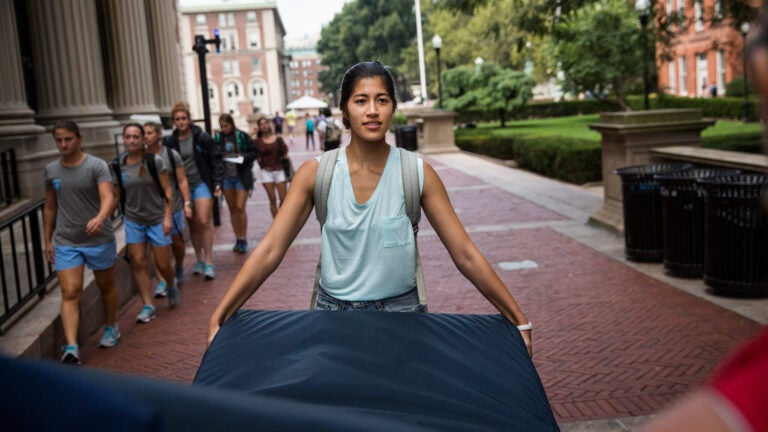
By now, you’ve probably heard about Emma Sulkowicz.
The Columbia University senior vowed to carry a mattress around with her on campus until the school agrees to expel the student who allegedly raped her at the beginning of September. Her protest has sparked international headlines at a time when universities’ responses to campus rape and violence are being reevaluated by lawmakers, as well as the public, with renewed scrutiny.
What started as Sulkowicz’s personal traumatic event has garnered support far beyond New York City. A group called Carrying that Weight Together has organized mattress-based demonstrations at other universities, from Arizona State to Princeton. Students at Cornell organized a National Day of Protest Against Rape Culture earlier this week, asking students to carry their own mattress or pillow on campus to show solidarity with Sulkowicz. UPenn, Ball State, Texas Tech, Centenary College, and others have documented their own on-campus mattress demonstrations. Locally, activists at Brandeis strapped a mattress onto the statue of the school’s founder with a letter of solidarity.
[fragment number=0]
Sulkowicz’s statement is not just a protest—it’s also art. The 21-year-old is a visual art major, and “Mattress Performance’’ is her senior thesis. While this has prompted some to debate her intent — that doesn’t make it any less poignant or powerful, and it certainly doesn’t make it not a protest.
Sulkowicz is hardly the first to turn her own experience of sexual assault into performance. ArtNet cites the works of Suzanne Lacy and Leslie Liebowitz’s Three Weeks in May and Ana Mendieta’s Untitled (Rape Scene) as precursors for Sulkowicz’s work.
And in fact, her art project protest has a local student antecedent. In October 2012, Alison Safran, a Mt. Holyoke student at the time, decided to speak out and raise awareness of the trauma caused by her own sexual assault. She posted a handwritten sign in a Newton park, the same spot where she had been attacked three years prior. The note detailed her assault and the frequency of sexual violence.
“Three years ago on this date, I was sexually assaulted here. Coming back to this spot still evokes serious nausea, but I return here to make a point.
Sexual violence is preventable.
1 in 6 women will be sexually assaulted in her lifetime
These women are your friends, sisters, neighbors, peers.
We can stop this violence from occurring. I won’t be silent about this issue, and neither should you.
Get active.’’

Safran’s poster
“It was a call to action,’’ Safran told Boston.com. “I thought about how many people I had told my story to, not just on that day—in general having gone through the legal system for no real justice.’’
From there, Safran’s protest turned into a group effort. Safran asked sexual-assault support groups at Boston University, Tufts, UMass Amherst, and Mt. Holyoke, where she was a student at the time, to submit signs detailing their own experiences using numbers. Safran photographed the submissions and posted them on Tumblr, naming the project, Surviving in Numbers. She said Mt. Holyoke was “very supportive’’ of her project, even hosting an on-campus exhibit of prints from “Surviving in Numbers’’ last year.

A submission to Surviving in Numbers
Today, Safran travels to campuses in Massachusetts and across the country to spread awareness and help survivors tell their own stories through art. She continues to accept submissions and said she receives hundreds since the project’s conception. “I also get a lot online from students who want to share their stories, but can’t make an event or don’t feel comfortable sharing in person,’’ she said.
Safran, now 22 and a volunteer at the Boston Area Rape Crisis Center, continues her work by hosting educational workshops at high schools that focus not only on assault and rape prevention, but peer support strategies after an attack. She notes, “A lot of what I see in submissions to Surviving in Numbers talk about how peers or parents can be unsupportive.’’

A display by the Clothesline Project at Converse College in Spartanburg, S.C, on Feb. 20, 2014.
With similar goals in mind, the Clothesline Project was established by Cape Cod artist Rachel Carey-Harper in 1990 to bring awareness to violence against women. The concept was inspired by the AIDS Memorial Quilt project, and asked participants to tell their story on a T-shirt to be strung on a clothing line as a visual representation of cases of violence against women. Each color represents for a different type of violence; red, pink, and orange shirts are for rape and sexual assault, while purple signifies violence based on sexual orientation. According to the project, “Originally there was a color code that gave us a visual ‘statistic’ regarding the types of violence to which women were exposed.’’ The Somerville Commission for Women was the first in Greater Boston joined in Carey-Harper’s effort in 1991, picking up support from independent demonstrators, universities, and awareness support groups.
Simmons College first partnered with the Clothesline Project in 1993, and still hosts the event annually. The project came to Boston University last April, Wentworth in the November the year prior, and will arrive at Boston College on Monday, October 6th through the 10th.
Projects like Clothesline and Surviving in Numbers aren’t the typical protests of picket signs and rallies, but their impact endures, as all great art does.
In an essay by Sulkowicz in May about her experience dealing with Columbia University’s administration, she wrote: “They’re more concerned about their public image than keeping people safe.’’
The question remains, will the school have the ability to ignore and neglect performance art -based protests that focus on a topic that they may rather keep in shadows.



To comment, please create a screen name in your profile
To comment, please verify your email address
Conversation
This discussion has ended. Please join elsewhere on Boston.com