

Sign up for the Today newsletter
Get everything you need to know to start your day, delivered right to your inbox every morning.
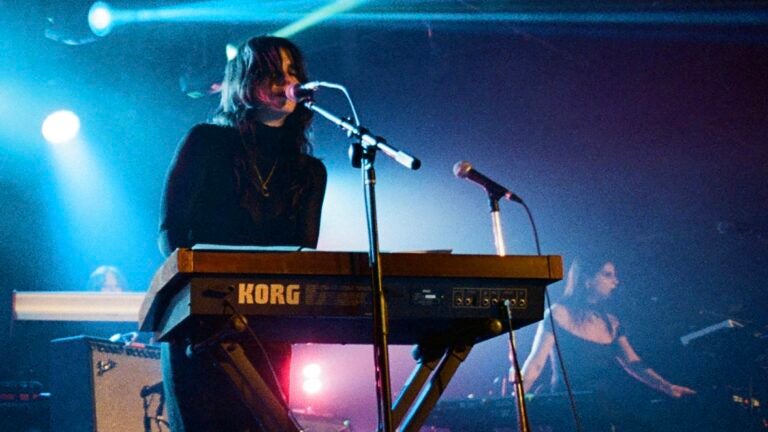
Sharon Van Etten & The Attachment Theory, with Love Spells, at Roadrunner, Thursday, May 1
Before anyone set foot on stage, it started: a synth-bass throb and pulsing purple lights filling the air. It kept up as Sharon Van Etten & The Attachment Theory took their places and the singer repeated the line “Who wants to live forever?” as keyboard bleeps bumped behind her.
It was a striking opening to Thursday’s Roadrunner performance, and Van Etten maintained her composure right up until the moment she threw her hand to the side as if snatching something, at which point the drums snapped into the song and the sheer weight began to grow overwhelming.
If there’d been any doubt, that ought to have quelled it: This wasn’t a Sharon Van Etten concert, it was a Sharon Van Etten & The Attachment Theory concert. The singer has built her name on a strain of indie rock that veers between confessional intimacy and sweeping, sad majesty, and she set it aside for an hour and a half in favor of a postpunk-fueled, goth-inspired charge.
But to hear her tell it, the translation of her self-described “folky” earlier songs to the new format wasn’t as difficult as it might have seemed. “The roots were there,” she told the crowd.
But Van Etten & The Attachment Theory didn’t worry about that for quite some time. Seven of the first eight songs came from the group’s terrific self-titled album, where Van Etten wrote songs collaboratively for the first time, and as befits songs built from the ground up by playing together in the same room, they worked splendidly on the stage.
The motorik beat of “Idiot Box” gave it a heady momentum, and with its echoed, sequencer-like keyboard slashes cutting the beat in half, “Somethin’ Ain’t Right” was a high-speed late-night cruise down a neon-streaked city street. “I Can’t Imagine (Why You Feel This Way),” meanwhile, played like a herky-jerky New Wave dance song.
All the while, Van Etten herself served as a commanding focus amid a backdrop that was new to her, vibing off of the music in ways that avoided self-indulgence but instead made her a fulcrum, embodying the energy being fed her way and then sending it right back out into the audience. Her voice, once used for deeply-felt openheartedness, was a marvel, whether skimming softly across the top of high keyboard pings on “Afterlife” or helping the hard churn of “Hands” blossom into something more anguished and vicious during the chorus.
And she dipped into her earlier days with the molasses slow and sweet “Tarifa,” with its heavy reverbed vocals and soft, plinging gutar, and the flutey high-lonesome singing on a solo electric “I Wish I Knew.”
Whether old or new, the songs were played in keyboards-forward arrangements, with Shanna Polley’s guitar serving (quite effectively) as the texture that Teeny Lieberson’s keyboards might have provided in a slightly different version of the Attachment Theory. That gave the slow burn of “I Want You Here” a buzzing swell as the sound of the instruments seemed to fan out behind Van Etten, underlining her own growing need.
And while “Comeback Kid” was short, tight and whirring, many of Van Etten’s older works lacked a bit of the sharpness and balance of the new songs. With Jorge Balbi’s shuddering drums and the three-guitar attack of Van Etten, Lieberson and Polley, “Anything” hewed closer to churning indie rock, and the keyboard touches didn’t prevent “Every Time The Sun Comes Up” from coming off as a heart-tugging guitar strum. And with its galvanized chug and bittersweet teenage nostalgia, you could hear the Springsteen coming out of Jersey girl Van Etten in “Seventeen.”
Even so, the fact that the older songs seemed to come up just a hair short only served to underline how great Van Etten is with the Attachment Theory already. (The tightness was cemented by the singer announcing full credits for her entire crew, from the band and sound techs to her drivers and merch-booth staffer.) They closed with “Fading Beauty,” all soft keyboard boops and slow, stretched vocals, practically a tone poem of pure sound. “Let us be defiant with our joy tonight,” Van Etten had said early on, and her new band made it easy to do.
Opener Love Spells applied his high, whispery vocals against a wash provided by light drums and a guitarist who switched between swirling acoustic strums and an electric guitar drowning in reverb. The effect was one of ethereal swooning, with a hint of swagger poking its head out on rare occasions.
ENCORE:
Marc Hirsh can be reached at [email protected] or on Bluesky @spacecitymarc.bsky.social.
Get everything you need to know to start your day, delivered right to your inbox every morning.




To comment, please create a screen name in your profile
To comment, please verify your email address
Conversation
This discussion has ended. Please join elsewhere on Boston.com