
Tell us: Should teacher strikes be legalized?
Some lawmakers in Massachusetts have proposed legislation that would allow legal strikes for certain public sector workers, such as teachers.
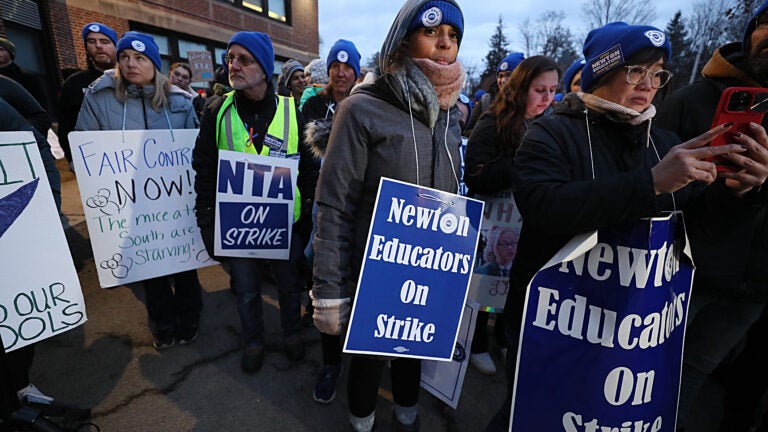
Newton Public School teachers, students, and staff returned to their classrooms on Monday after an illegal — and unprecedented — strike by the teacher’s union came to an end.
The union reached a tentative agreement with the school district on Friday, and voted on Sunday to ratify a new contract.
The strike, which began on Jan. 19, was the longest in the state since 2022. Schools were closed for 11 days and teacher’s spent 15 days on the picket line. The Newton Teachers Association (NTA) said it sought living wages for all employees and decided to strike after talks with the Newton School Committee, which negotiated on behalf of the district, went on for more than a year.

In a Facebook post, the NTA said the new four-year union contract included a pay increase of at least 12% for all union members, increasing paid parental leave from 10 to 20 days and family sick days from 11 to 14 days, as well as upgrades to minimum wages.
The contract will also strengthen mental health support for students by increasing the number of social workers, school counselors, and psychologists in schools.
Despite the gains made in the contract, the union faces a hefty fine of more than $600,000 for illegally striking.
Under Section 9A(a) of Massachusetts’ General Laws, it is illegal for public workers, including teachers, in Massachusetts to go on strike. Massachusetts is among 37 other states and Washington D.C. that prohibit teacher strikes. Penalties for breaking the law include fines, termination, license suspensions, and even jail time, according to EducationWeek.
The law, however, has not prevented teachers in the Bay State from going on the picket line. Since 2022, six teacher unions have gone on strike in Brookline, Malden, Haverhill, Woburn, Andover, and Newton.
Some lawmakers in Massachusetts have proposed legislation that would allow legal strikes for certain public sector workers, such as teachers.
Rep. Erika Uyterhoeven of Somerville is a co-sponsor of a bill, alongside Rep. Mike Connolly of Cambridge, to give public sector workers (with the exception of public safety employees) the ability to go on strike after six months of negotiations.
“At the end of the day, I believe that there needs to be a level playing field between labor and management,” she told Boston.com reporter Ross Cristantiello. “To me, this fundamental right not existing in the public sector results in these really challenging circumstances that we’re finding ourselves in today.”
Gov. Maura Healey, however, is critical of legalizing strikes for public sector employees and said keeping kids in classrooms should be the priority.
“Every day when I see kids out of school because of a strike, my heart just breaks because kids have been through enough in terms of learning loss and the like,” Healey told WBZ political analyst Jon Keller.
But Uyterhoeven told Boston.com this is a misconception; In her opinion, these bills would reduce the number of strikes by encouraging both sides to be productive in negotiations during the six-month period and refrain from using delay tactics.
We want to hear your take: Should strikes be legalized for teachers?
Tell us by filling out the form or e-mailing us at [email protected], and your response may appear in a future Boston.com article.
Sorry. This form is no longer available.



Be civil. Be kind.
Read our full community guidelines.To comment, please create a screen name in your profile
To comment, please verify your email address