
Newsletter Signup
Stay up to date on all the latest news from Boston.com
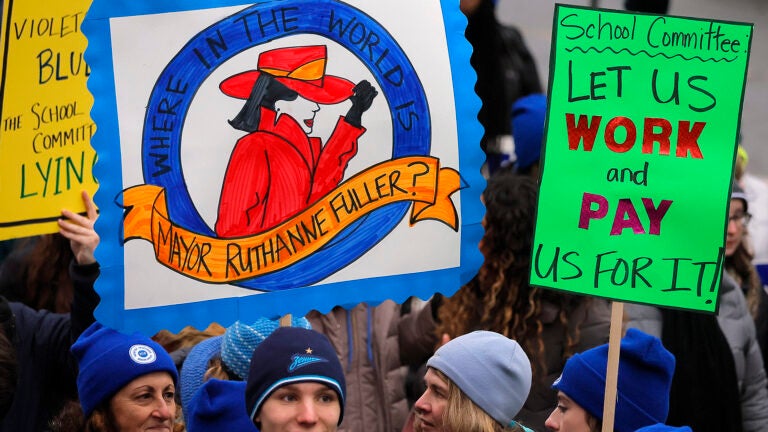
The Newton Teachers Association became the latest group of educators to go on strike in Massachusetts last week when 98% of its members authorized a work stoppage. As classes were canceled again on Thursday and the NTA racked up hundreds of thousands of dollars in fines, some lawmakers are continuing a push to make future strikes like this legal under state law.
In Massachusetts, public employees including teachers are prohibited from going on strike. That has not stopped teachers unions in communities like Brookline, Andover, Haverhill, and Malden from taking to the picket line in recent years.
After more than a year of tense contract negotiations with district officials, the NTA ultimately decided to follow in their footsteps. Demonstrations continued Thursday even as negotiators returned to the table and both sides expressed some optimism about coming to an agreement.
Lawmakers like Rep. Erika Uyterhoeven of Somerville are hoping that the strike in Newton helps gin up support for bills that would allow some public employees to strike legally in Massachusetts.
Uyterhoeven is a co-sponsor of such a bill, alongside Rep. Mike Connolly of Cambridge. It would give public sector workers, with the exception of public safety employees, the ability to go on strike after six months of negotiations.
“At the end of the day, I believe that there needs to be a level playing field between labor and management,” she said. “To me, this fundamental right not existing in the public sector results in these really challenging circumstances that we’re finding ourselves in today.”
Multiple versions of the bill have been filed, including one sponsored by Sen. Becca Rausch of Needham. Uyterhoeven said that the House bill is also currently being reviewed, and that she hopes there will be progress made this spring.
“[A strike] is a last-resort measure,” she said. “A good faith bargaining process involves both parties bargaining and not stalling the process. What we’ve seen over and over again in other districts is these stalling practices. A lot of times lawyers or mediators are brought in, but the union representatives can’t negotiate directly with the school committee or the mayor. So these processes get pushed, and pushed, and pushed.”
In the face of stiff opposition, advocates who agree with Uyterhoeven have been pushing to change the law for years. The Massachusetts Teachers Association threw its weight behind the legislation, with its leaders testifying before the Joint Committee on Workforce and Labor Development at the State House last fall.
Ultimately, educators around the state are finding that teachers strikes are “worth it,” MTA President Max Page told State House News Service last year.
Gov. Maura Healey, who was endorsed by the MTA on the campaign trail, voiced opposition to the idea in an interview with WBZ about a year ago. Healey said that students had experienced enough learning loss during the pandemic and, although she supports teachers getting fairly compensated, keeping kids in classrooms should be the priority.
This is one of the most common arguments made against changing the law, Uyterhoeven said: There is a misconception that legalizing strikes for public workers would lead to more strikes, but this would not be the case, she said.
Organizing a strike vote in the first place is challenging, she said, and building consensus within a union is even harder.
“People never just go on strike because they feel like it. In Newton, 98% of that membership voted in favor of a strike. As a legislator, it’s so hard to get 98% of people to agree on anything, and yet that’s how bad things have gotten there,” Uyterhoeven said.
In her opinion, these bills would actually reduce the number of strikes by incentivizing both sides to be productive in negotiations during the six-month period and refrain from using delay tactics.
Uyterhoeven said that she saw this as an important issue even before she became a legislator, but there was not as much attention being paid to it. Now, momentum is growing among teachers and she hopes that will translate to the State House.
“Educators are burnt out, they are not compensated the way they should be for their level of skill and education,” she said. “They’re trying to ensure that we fully fund our public schools and that our students are fully supported. That’s what’s at the table right now.”
Stay up to date on all the latest news from Boston.com




To comment, please create a screen name in your profile
To comment, please verify your email address
Conversation
This discussion has ended. Please join elsewhere on Boston.com