
After Newton teacher strike, readers are split on legalization efforts
Recent bills to make teacher strikes legal in Mass. have faced steep criticism by state leadership and Boston.com readers alike.
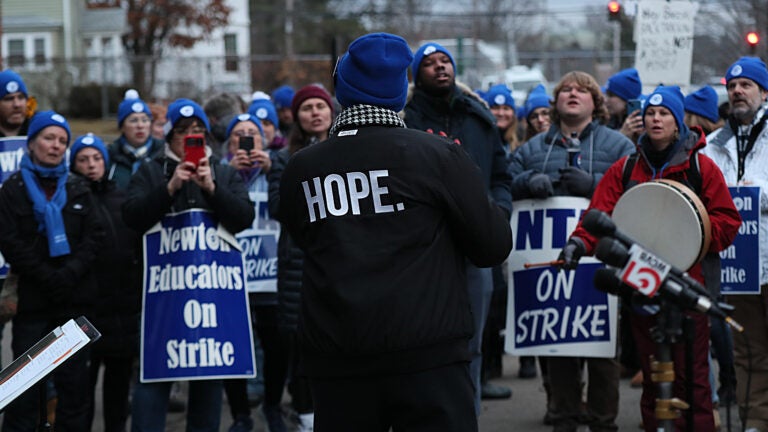
The Newton Teachers Association walked away with a new contract on Feb. 4 (albeit, with a hefty fine of more than $600,000) after a historic strike. The ordeal has prompted Boston.com readers to question if public sector workers should be given the legal right to strike.
The strike, which began on Jan. 19, was the longest in the state since 2022. Schools were closed for 11 days and teachers spent 15 days on the picket line. The Newton Teachers Association (NTA) said it sought living wages for all employees and decided to strike after talks with the Newton School Committee, which negotiated on behalf of the district, went on for more than a year.

While strikes are illegal in Massachusetts under Section 9A(a) of the state’s General Laws, teachers unions in Andover, Malden, Brookline, Woburn and Haverhill have organized similar strikes in recent years. The recurrence of illegal strikes has prompted lawmakers like Representative Mike Connolly of Cambridge to propose legislation that would give certain public sector workers the right to strike.
“The current reality is that these strikes are happening — it’s not as if the current prohibition [on public sector workers striking] has been a deterrent,” Connolly said in an interview with Boston.com. “With this legislation, we’re really saying, can we further empower workers, and in so doing, might we be able to avoid a strike altogether?”
The bills (H.1845 and S.1217), which are co-sponsored by Connolly and Rep. Erika Uyterhoeven of Somerville, would give public sector workers, with the exception of public safety employees, the ability to go on strike after six months of negotiations. Connolly said giving public sector workers the right to strike could reduce the number of strikes by incentivizing both sides to be productive in negotiations, and turn to striking as a last resort.
“The intent behind the bill is to actually avoid these continued teacher strikes,” Connolly said. “Having the right to strike can actually inspire the parties to a typical teacher’s contract negotiation to reach an agreement sooner.”
After reviewing the legislation, the Joint Committee on Labor and Workforce Development decided to send the bills to study, which “effectively means that it doesn’t look like it will move forward this session,” Connolly told Boston.com. He said he has not heard a specific reason from the Committee for the decision. But still, he is hopeful.
“I think it’s an important concept that I think could play a very constructive role if we’re able to move it forward in the future,” he said.
The legislation has faced steep opposition from state leadership (namely, Governor Maura Healey) and by some Boston.com readers. When we asked our readers if teacher strikes should be legalized, nearly 400 respondents responded to our poll. Readers were nearly split, with a slight majority (55%) against legalizing teacher strikes, with 43% for it.
Below, find a sampling of readers sharing their thoughts on legalization efforts for teachers.
Some entries have been edited for length or clarity.
Should teacher strikes be legalized?
No
“Absolutely not. Kids are the ones who suffer the most . There are supposed to be other options to settle disputes, strike should remain illegal and enforce by state on day one instead of waiting for two weeks (like in Newton case)” – “Newton Parent”
“Teachers’ strikes put students in the middle of disputes between teachers and municipal governments. As with other professions, if you are not satisfied with how you are being compensated, you are always free to seek employment elsewhere. The Newton strike, by some of the highest-paid teachers in the state (and country), hurt the most vulnerable students the most (those with special needs/disabilities). If the working conditions in Newton were so horrible, feel free to take your talents elsewhere, but do not harm students by holding them hostage to your greed. Newton has very high teacher retention – how horrible could it be?” – Bruce, Newton
“Public employees have a responsibility to the public they serve. Arbitration should be used but to be effective it must be used in a timely fashion. Both parties should be ready to argue their positions quickly after filing for arbitration and no delays on the parties or the arbitrators should be tolerated.” – Ralph, Brockton
“I do not support teacher strikes. Kids need to be in school- learning. While I feel for teachers who believe they must fight for what they view as a fair contract, perhaps they should consider some funding alternatives going forward. Cities/towns should not be treated like an ATM and taxes raised or overrides passed when negotiations break down. At what point does managing a budget matter? I believe that teachers’ unions are doing a huge disservice to the profession/people they exist to support. If the unions are willing to receive $600,000 in fines, perhaps they should look to supplement teachers’ needs by tapping their own coffers.” – Kara, Belmont
“These individuals chose public service, period end of story. They knew the terms of the job before they signed on the dotted line. There already paid way beyond the average private sector job, as well as exceptional benefits. When you choose a public job, you have a duty to fulfill that obligation.” – Craig, Plainville
“Absolutely not. Teacher strikes hold our kids’ education hostage.” – C.J., Weston
“The law has it absolutely right. It should be more strongly enforced. Teachers are essential workers as the importance of their work rivals police and fire. We have seen the damage the isolation of the pandemic caused our children. Any interruption in their education is unacceptable.” – Frank D., Winthrop
“Why would any lawmaker think that these employees should have the special privilege such as the legal right to strike? What makes them more special than any other unionized worker? My opinion is that they have a civic duty to provide the best education possible for our children and they should do so without any strings attached to their employment. If they do not like the conditions, then choose some other line of work. Unfortunately, our children have been short changed over the past four or five years in regard to a good education due largely to COVID.” – John K., Norfolk
“If you serve and are paid by the public you have an obligation to serve the public. If teachers go on strike parents can’t just start sending their kids to another school until the strike is over. It is different in the private sector where if for example the workers at one supermarket chain go on strike, shoppers can go to another supermarket chain.” – Bill, Boston
Yes
“I live in Newton and have a child in the Newton school system. I saw firsthand how the school committee and the mayor were not bargaining in good faith with the union.” – Megan F., Newton
“Every single teachers’ strike that has taken place since 2022 has been due to stalled negotiations with municipal elected officials who either fail to show up to negotiations, or fail for follow mutually established ground rules at the outset of bargaining. Legalizing strikes for these employees who serve society by imparting the most fundamental of skills and values, would force cities and towns to bargain and negotiate swiftly, openly and in good faith. No teacher wants to strike. If bargaining occurred swiftly and openly, taxpayers would learn just how reasonable the demands of these bargaining units are, and how much they improve student learning and outcomes. Legalizing teacher strikes is the only way to keep elected officials in charge of financing our children’s education honestly!” – Liz D., Woburn
“I’m a retired teacher but part time community college professor. Our contracts are always years overdue and we’re underpaid even compared to public K-12. Meanwhile the administration constantly expands with assistants to assistants.” – Peter F., Newburyport
“Cities and towns in Mass. do not negotiate with teachers until after the contract expires. All municipalities should be required by law to begin negotiations one year prior to contract expiration. Springfield does this with every contract (police & fire too) and it is inexcusable.” – Jay M., Springfield
“Teachers are labor. Strikes are the strongest tools of labor.” – Kristin, Wilmington
“Without the ability to create significant pressure, unions have not the bargaining power a collective group of employees holds over individual employees. I’ve seen this play out a few times now. After months of stalling negotiations and non-offers from school committees (and general invisibility of mayors), union members often find themselves working on an expired contract for months if not years with no new contract in sight. The law currently prohibits strikes and thus assigns the moral high ground and legal support to only one side of the bargaining table while depriving the other side of the most common tool of organized labor: the right and ability to withhold that labor as a last resort.” – Matthias K., Brighton
“The purpose of unions is to give membership leverage against an employer. Making strikes illegal makes the cost of taking a stand on policies or work conditions too high.” – Shawn, Norwell
“A strike is the best leverage a union has. Unions don’t want to strike (pay goes down or goes away, for one thing), but sometimes management forces their hands. Making strikes illegal is like making the union illegal.” – Jim C., Wayland
Boston.com occasionally interacts with readers by conducting informal polls and surveys. These results should be read as an unscientific gauge of readers’ opinion.



Be civil. Be kind.
Read our full community guidelines.To comment, please create a screen name in your profile
To comment, please verify your email address