
Hyundai’s 2015 Sonata Flaunts its New Design
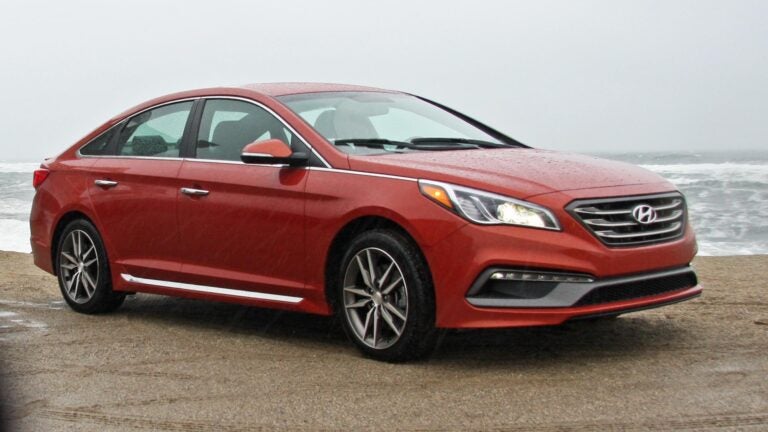
So I was lazy. I put off photographing today’s test car, the 2015 Hyundai Sonata Sport 2.0T, until Tuesday (the day it was being returned) and was then forced to try to get a decent shot during the Nor’easter. I was fortunate to salvage one decent photograph before the wind-driven rain covered the camera lens.
The photo shows some of the nice styling points designers put into the Sports 2.0T, the performance trim level of the ’15 Sonata.
In front, there are the LED running lights, a blacked-out lower insert in the fascia, Hyundai’s traditional hexagonal grille, and Xenon headlights.
The side features one trim line running from the headlights down the side just below the windows, a character line just above the door handles, and a well-defined rocker panel with a chrome accent stripe.
Door handles have a built-in welcoming light and the side mirrors show both directional signals and are part of an outstanding blind-spot alert/lane-change alert system. The Sonata, redesigned for 2015, retains its coupe-like roofline.
“We crafted the shape the same way an award-winning chef refines his recipe over the years,’’ says chief designer Chris Chapman.
The advances have been amazing—and reflected in sales as the Sonata became a major player in the midsize sedan segment starting with its 2011 redesign.
“We like to say the 2011 took the sedan from a meal to a gourmet dinner,’’ says Chapman. “The evolution in Fluidic Sculpture 2.0 reflects the improvements in refinement and driving dynamics for 2015.’’
The Sonata Sport 2.0T is the performance-oriented model with a 2.0-liter turbocharged engine that has been optimized for lower-RPM response and produces 245 horsepower and 260 lb.-ft. of torque. A six-speed automatic transmission sends the power to the front wheels. Quad exhaust diffusers differentiate the 2.0T from the other Sonata models: SE, Limited, and Sport.
A power mode selection button allows the driver to choose among Econ, Normal, and Sport settings. Econ basically turns the Sonata into a slug, normal (the default setting) is OK, and Sport is too aggressively set for normal driving. Something between Normal and Sport would have better suited my driving style as would a more aggressive exhaust tone.
That said, the twin-scroll turbo responds quickly when you hit the accelerator hard enough in any setting. It also returns 23 miles per gallon in city driving, 32 on the highway, and 26 combined. In a full week of commuting between Newburyport and Brighton, I managed 29.4 mpg on one tank and 28.9 on another.
Our Sport 2.0T came well equipped at with an MSRP of $29,385. The only option was a nice set of carpeted mats ($125) which brought the bottom line to $29,510.
Hyundai still offers its groundbreaking 10-year, 100,000-mile powertrain warranty. Among the standard features were a rearview camera and blind spot detection system with rear cross-traffic alert. Their chime alerts were a great assist in maneuvering through Boston traffic. The rear camera shows the location of the back bumper, making it a wonderful assist in backing into parking spots.
If we stepped up one level to the $4,950 Ultimate Package we “coulda-woulda-shoulda’’ had all the technology of a near-luxury vehicle. Among other features, it would have added a sunroof, smart cruise control with start/stop capability, lane-departure and forward-collision warnings, automatic high beams, rear parking assistance, memory seats, an eight-inch navigation system, vented front seats and heated rear seats, premium audio system, and 4.2-inch color LCD display and electroluminescent gauges.
As it was, the Sport 2.0T gets a premium look-and-feel interior with leather seats with side bolsters and contrasting stitching.
A D-Cut steering wheel (it has a flat bottom) offers a full array of controls, including voice commands. The redundant controls—voice, buttons, touch screen—are intuitive. Our model didn’t have navigation so the audio display touch screen was only five inches.
The controls and center stack are laid out logically with one surprising lack of continuity. Most instrument lighting was blue except for the two main gauges and driver display, which are black and white.
Rear legroom is ample and the Sonata’s interior has so much space it carries a large car designation. That’s a carryover from the 2011 redesign when Hyundai engineers set out to design a four-cylinder-only vehicle, using the space savings from not having an optional V-6 to make a larger passenger cabin.
On the road, the 2.0T is quieter than its Sonata predecessors but there’s still some engine buzz and road noise. The 18-inch wheels and P235/45R/18 tires have a low profile, which, combined with the sport-tuned suspension, give the car a stiffer ride with likely more road noise than the models that have 16- and 17-inch wheels and tires with more sidewall.
If you’re getting the impression that we’re witnessed the maturing of the Sonata brand, you’re getting the picture.
2015 Hyundai Sonata Sport 2.0T
THE BASICS
Price, base/as tested (with destination): $29,385/$29,510. Fuel economy, EPA estimated: 23 city/32 highway/26 combined. Fuel economy, Globe observed: 28.9 and 29.4 on two tanks. Drivetrain: 2.0-liter turbocharged 4-cylinder, 6-speed automatic transmission, front-wheel-drive. Body: 5-passenger sedan.
THE SPECIFICS
Horsepower: 245. Torque: 260 lb.-ft. Overall length: 191.1 in. Wheelbase: 110.4 in. Height: 58.1 in. Width: 73.4 in. Curb weight: 3,505 lbs.
THE GOOD
Punchy motor, spacious cabin, sporty handling, precise steering, usable technology.
THE BAD
Still get some road noise inside, normal driving calibration needs adjusting.
THE BOTTOM LINE
Hyundai long ago caught up, now it’s pushing the bar.
ALSO CONSIDER
Chevrolet Malibu, Chrysler 200, Ford Fusion, Honda Accord, Kia Optima, Nissan Altima, Toyota Camry, Volkswagen Passat.




To comment, please create a screen name in your profile
To comment, please verify your email address
Conversation
This discussion has ended. Please join elsewhere on Boston.com