
2015 Kia Soul an EV with Best-in-Class Range
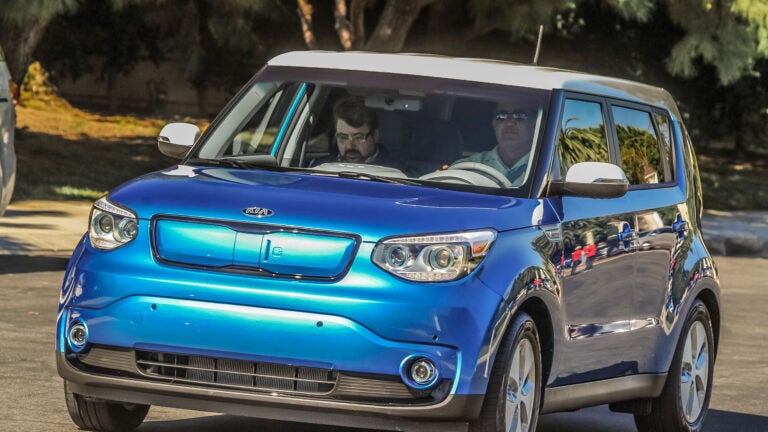
It wasn’t that long ago that the thought of purchasing any Kia—let alone one as complex as the 2015 Kia Soul EV—would have been unthinkable. Now that the Korean automaker is ranked sixth overall in the J.D. Power Initial Quality Study, all bets are off. It has come a long way and we’re ready to plug in.
Working immediately in the Soul EV’s favor is the placement of the batteries beneath the passenger compartment floor. It means minimal disruption to the cargo capacity (but a loss of about three inches of rear legroom). This is a car that legitimately could be used as a small delivery vehicle in an urban setting.
The Soul EV is going to be the centerpiece of Kia’s clean mobility program. It has been tagged with an EPA estimated range rating of 93 miles with an miles-per-gallon estimate of 92 miles highway and 120 miles city for a combined mileage of 105 miles. Super low-rolling resistance tires improve fuel efficiency by 10 percent over basic low-rolling tires.
Those economy numbers put the Soul at the bottom of the electric vehicle lineup when compared to the Nissan Leaf, rated 126city/101highway; the Volkswagen eGolf, rated 126city/105highway; and the Chevy Spark EV, rated the best of this quartet at 128city/109highway.
But, and this is the important distinction, the Soul has the most range at 93 miles because of its battery capacity. The Leaf is rated at 84 miles, the e-Golf at 83, and the Spark at 82. That eases range anxiety by almost 10 miles.
The front-wheel-drive Soul EV is powered by a 109 horsepower electric motor, producing a generous 210 lb.-ft. of instantaneous torque. You’ll have to learn how to feather the accelerator to avoid jackrabbit starts (unless you like them). And remember, in the Soul EV it’s not a gas pedal.
Acceleration is brisk but that kind of driving does drain the battery more quickly. For what it’s worth, Kia says the Soul EV can hit 60 mph in less than 12 seconds, but my seat-of-the-pants estimate felt a lot faster. Published reports put the gas-powered Soul at 8.4 seconds for a 0-60 time and I didn’t sense much of a difference.
Handling is strong. The battery’s location beneath the floor results in a lower center of gravity, which helps ride and handling and ensures that the EV remains true to the Soul’s fun-to-drive reputation. Additional cross bracing beneath the low-mounted battery contributes to a 5.9 percent improvement in torsional rigidity over the gasoline-powered Soul and offers protection to the battery.
The Soul EV features two standard charging ports, a SAE J1772 port for Level 1 and Level 2 AC charging, and a CHAdeMo DC fast-charging port (480v). It can be charged to 80 percent in 33 minutes with a 50 Kw–output fast charger (five hours using a 240v outlet).
The Soul EV uses Kia’s third-generation regenerative braking system to capture up to 12 percent of the car’s kinetic energy, which is fed back into the battery while the Soul EV is coasting and braking. It’s a system that takes getting used to—figure at least 15 minutes on a test drive on city streets.
One feature I like—and it’s designed to improve energy drain—is driver-only ventilation with heat pump and air induction control. Press a button on the center stack and all other ventilation is shut off. (It’s a great way to annoy your co-pilot.) Kia says it reduces HVAC energy consumption by 27 percent.
The Soul EV has the usual stable of safety features plus one specific to electric vehicles. To help people with vision problems, it is equipped with a Pedestrian Warning System that emits an auditory alert at speeds below 12 mph and whenever the car is in reverse. That’s important for the Soul EV because it lacks the electric-motor whine associated with other electric vehicles.
Consumers have two options: leasing the Soul EV for $249 a month with $1,500 down or pay $33,700 for the base model. The Soul EV Plus costs $35,700. Both prices are before federal tax credits
The Soul EV Plus adds EV-unique leather trimmed seats, which are tri-level heated and ventilated for front passengers, while the rear outboard seats are heated for added comfort. The Plus also includes projection-style fog lamps and power-folding outside mirrors, rounding out the thoughtfully packaged, value-conscious electric vehicle offering.
Electric vehicles are becoming more prominent. Track your commute. See if you can comfortably do two roundtrips without recharging. That makes the Soul EV and its electric counterparts a viable choice, especially if you’re in a two-car family.
2015 Kia Soul EV
THE BASICS
Price, base (with $800 destination): $34,500. Fuel economy: 120 city/92 highway. Drivetrain: AC synchronous permanent magnet electric motor with 27kWh, air-cooled, 200 watt-hour/kg lithium-ion polymer battery. Body: 4-door crossover.
THE SPECIFICS
Horsepower: 109 hp. Torque: 210 lb.-ft.Overall length: 163 in.Wheelbase: 101.2 in.Height: 63.0 in.Width: 70.9 in.Curb weight: 3,289 lbs.
THE GOOD
An electric vehicle with good cargo and passenger space, fun to drive, best-in-class range.
THE BAD
Price premium for electric, overall design, initial limited availability.
THE BOTTOM LINE
The Kia Soul EV is an evolutionary step in electric vehicles with good performance, little compromise on cargo space, and an uptick in range. The latter will make people a little less anxious about going electric.




To comment, please create a screen name in your profile
To comment, please verify your email address
Conversation
This discussion has ended. Please join elsewhere on Boston.com