
Brutal Winter Taking Its Toll on Massachusetts Farmers
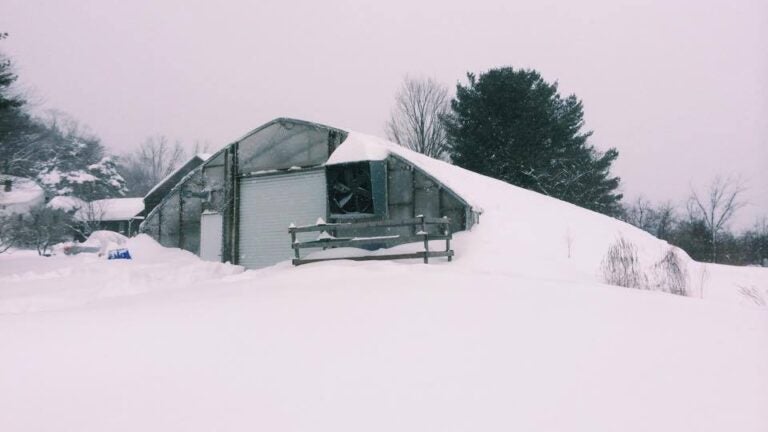
The snow this year has knocked everyone off track. Commuters, school children, public transportation, and business owners all struggled as week after week delivered snow and unrelenting cold temperatures to the region. Farmers, whose livelihoods depend on the whims of Mother Nature, have struggled along with everyone else.
Clearing the Snow
“A lot, a lot, lot.’’ That’s what Ken Lane, owner of Seaview Farm in Rockport said of this year’s snowfall. He estimated that they have received somewhere between 78 and 80 inches so far. Lane has dealt with blizzards in the past, but he said the back-to-back storms from late January into February created a huge snow removal challenge for him on his farm where he raises beef cattle and chickens, boards horses, and grows produce for Community Supported Agriculture, or CSA.
“It’s just a whole lot worse because it was so much, so fast,’’ he said.
As storms arrived each week, Lane began to run out of space to put the snow. And with the way his horse barn is situated, each storm left a 6 to 12-foot drift blocking the door used to get the horses in and out. He said the constant snow clearing has cost him an enormous amount of time and fuel.

Horses navigate a field through shoveled paths on Seaview Farm
But Lane has another problem: Manure. Usually the manure is placed on a cement pad close to the barn, and it’s hauled about once a week to another field. But with snow piled at the end of his lane and along the edges of fields, moving the manure has been delayed.
“We’ve got about a month’s worth of manure there now,’’ he said. “And I have no idea what I’m going to do with it for a while.’’
The depth of the snow has also prevented the horses from getting out as much as they usually do, and Lane had to shovel out pathways in the field for them to navigate. When the snow started covering the electric fence for his cattle enclosure, Lane had to shovel the snow around the fence, creating snow piles that gave the animals “something to look at.’’
“If they thought about it for a few minutes, they could just step right over,’’ he said.
Jack Kittredge, co-owner of Many Hands Organic Farm in Barre, said this winter has been just as hard on farmers as on everyone else, but that having animals dependant on you adds another layer of intensity for staying on top of snow management.
“The problems are basically just getting them feed and water and shelter,’’ he said of taking care of the chickens and beef cows on his farm. “They can keep warm if they’re in shelter, but if they’re outdoors and in the wind, they will suffer a lot.’’

Snow and a manure piles at Seaview Farm
Some farms have systems to keep water from freezing, he said, but others have to haul water to their animals every day, which freezes quickly with the cold temperatures we’ve had.
“This is certainly a bad winter as everybody knows,’’ he said. “In terms of snow, I’d say it’s probably the worst we’ve had.’’
The depth of the snow has been a problem for farmers with orchards. Brian Cramer, manager of Hutchins Farm in Concord, said they were only able to do some pruning of their apple trees before the snow made the task too difficult.
“Everything is complicated and made more difficult just by the presence of so much snow, not to mention the cold,’’ he said.
Immediate Impacts
For those farmers who grow produce in greenhouses or hoop houses during the winter months, this season’s cold temperatures and volume of snow have caused a great deal of anxiety. The danger of collapse was made apparent in two recent incidents. A barn collapse in Westford left two horses dead. Another in Andover trapped seven horses, but they all escaped without injury.
“It definitely makes you on edge as you watch the snow piling up on the roofs of structures, so we’ve been cleaning the roofs far more than we otherwise would,’’ said Cramer.
[fragment number=0]
“We lost a greenhouse,’’ said Phil Jones, owner of Jones Farm in Chelmsford, which grows winter greens in four, unheated greenhouses.
One of Jones’s greenhouses collapsed even after he cleared snow off the structure. In January, two others became infested with voles that were tempted by the greens inside.
“We had 750 heads of lettuce quite close to being ready to harvest, we had tatsoi, spinach arugula, and within four days everything in the greenhouse was gone,’’ he said.
The remaining greenhouse was planted in November for a December harvest, so the loss hits Jones hard. The farm was starting to rely on the income flow from winter growing.
“For us if we can make three, four, five hundred dollars a week in the wintertime, that’s a lot of money to us when we’ve never had it before,’’ he said.
Between the snow, voles, and the cold, Jones estimated he’s seen a minimum loss of about $5,000 dollars this winter.
Even for those farmers with heated greenhouses, the freezing temperatures have caused much nail-biting, and there is an expectation that heating costs for the greenhouses will be high.
“Any night that drops below 20, we get a little nervous,’’ said Danielle Andrews, of The Food Project in Boston. If the heater dies, she said, everything in the greenhouse dies.
Limbo With an Unknown Spring
Instead of doing the preparations necessary for spring, farmers have been worrying about the snow weighing on greenhouses, maintaining access to food and shelter for livestock, and trying to prevent the freezing temperatures from claiming the viability of vegetation in greenhouses.
“We’re kind of in limbo because now would be a nice time to start cutting bush for fence lines and stuff, which we often do this time of year,’’ said Lane.
“We should have thousands of seedlings started, but I only have a couple things started,’’ said Jones. “And then I’m not taking care of them very well.’’

The snow at Hutchins Farm
How and when the snow melts is another unknown factor for operations.
Kittredge said there’s always a mud season, but it is hard to tell how long, or how intense the upcoming season could be.
A slow spring could have a long-term drag on the season and impact farms financially.
“It will impact things like plant sales, our ability to keep up our scheduled plantings in the fields just because it stays cold,’’ said Cramer.
Chris Kurth, owner of Siena Farms in Sudbury, said he has a contingency plan for if the spring turns out to be slow.
“If we’re in late March, and there’s still four feet of snow on the field, we may attempt actually doing some snow removal from our earliest fields, so that we can let the sunlight in, and start plowing,’’ he said. “That would be a time-consuming activity, and we hope we don’t have to do that. But we’re prepared to do that.’’
More damage also may be revealed once the snow melts. For those with orchards, like Hutchins Farm, voles could be a problem that they don’t know about yet. For voles — the same pests that ate up the greenhouses at Jones Farm — the deep snow provides insulation and protection from predators. Voles eat the cambium — the layer under the outer bark, which can kill trees. But Cramer said there is no way to tell if this has happened until the snow melts.

Snow in the orchard at Hutchins Farm
On the other hand, the freeze from this winter could have helped by killing off other pests that normally impact crops in the spring and summer.
Wait and See
Facing all the unknowns — whether the spring will be slow, whether there’s damage from voles, whether more hay will have to be ordered because of the slow spring and muddy fields — there is a wait-and-see attitude among the farmers interviewed for this story. For this, in many ways, is life with a farm. Chris Kurth said what made this winter unique is it affected the whole region the way that a farmer is always impacted by the weather.
“On the farm, we’re impacted by the weather almost 365 days a year in terms of legitimate impacts to our business,’’ he said. “So I’m comforted a little bit by the experience of seeing everybody around me impacted by the weather. It’s sort of a reminder that we do live at the mercy of things that we can’t control, and the weather’s the biggest thing we can’t control on the farm year-round.’’



To comment, please create a screen name in your profile
To comment, please verify your email address
Conversation
This discussion has ended. Please join elsewhere on Boston.com