
Sign up for the Today newsletter
Get everything you need to know to start your day, delivered right to your inbox every morning.
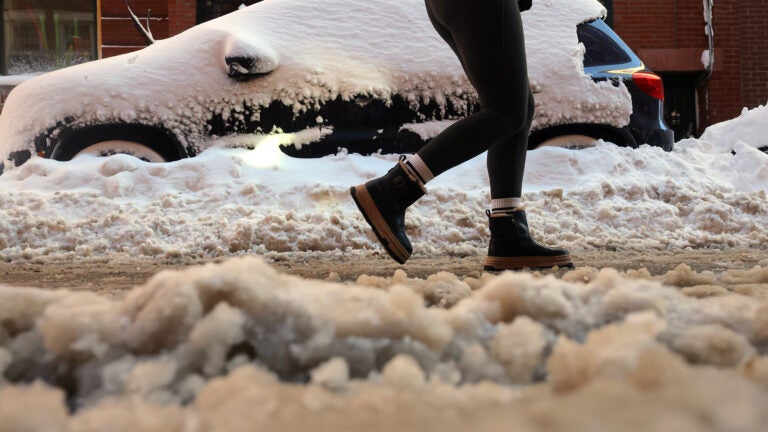
Let me say at the outset that predicting when you’re going to see your lawn is even more difficult than predicting how much snow you’re going to get on that lawn.
There are some assumptions we can make, however, and history gives us a lot of guidance.
Most of us have 1 to 3 feet of snow on the ground, with, of course, those snow banks exponentially higher. Looking ahead at the week’s high temperatures, we’re above freezing through the week and might even hit the 40s over the weekend, so that should give us a little start anyway at some snow melting.
I would venture to say that snowfall depth across Eastern Massachusetts, Rhode Island, and Connecticut is at some of the highest levels on record this time of year. Providence, for example, had 7 inches of snow on the ground before Monday’s storm and now has over 40 inches. So, it doesn’t take a scientist to know that several feet of snow is going to take a bit to melt.
Although you may want to see your lawn and the crocuses next week, we also don’t want this to be melting too quickly or else we would have a lot of flooding. A gentle return to bare ground will be a little more frustrating than a quick melt, but in the end, it will pay off.
Aside from above-freezing temperatures, snow can also sublimate, going directly from a solid to a gas. This is why even when the temperature is below freezing, snow can still dwindle. It’s similar to when you leave an ice cube tray in your freezer for a few months, the ice cubes eventually shrink.
This time of the year, even if it’s not above freezing, the sun is becoming so much stronger that it will allow for melting to occur in those areas that face south.
Snow will also settle. All those little air pockets between the individual flakes will get squeezed out over the next couple of weeks. In some ways, this prolongs the snowmelt because it becomes denser and needs more energy to break apart to liquify.
Looking at the Blue Hill snow depth data, if we go out to April 1, there are very few years where the snow has been consistently on the ground the entire winter. The 2014-15 winter season still had snow on the ground through early April. But this isn’t surprising because the more than 100 inches of snow the region got that season was going to take a while to melt.
So far, the Boston area has about 60 inches of snow. About 70 inches in the Providence area.
Another great dataset is Jamaica Plain. We have snowfall data all the way back to the 1960s, and once again, the winter of 2014-15 stands out with snowfall on the ground in early April.
One thing you will notice is that over the past few years, there’s been very little snow on the ground in March, and I think we’ve become accustomed to that. There was a similar pattern with not much snow on the ground in March after the winter of 1978 up until the late ’80s.
March snow cover is actually not that unusual, and I think that mentally you want to prepare for at least the first couple of weeks of the month still not being able to get into the garden, so to speak.
Depending on how much cold continues to move across the northern tier of the U.S. and whether or not we see more snow is, of course, also going to impact exactly when the snow is gone. This year, however, I would plan on astronomical spring (March 20) as a mental marker for when things will look less wintry.
The good news is that with the strong sun, any south-facing slopes will clear out much faster. I suspect weeks ahead of areas that are in the shade. This is an old-fashioned New England winter, and it’s not going anywhere for a bit!
Get everything you need to know to start your day, delivered right to your inbox every morning.



To comment, please create a screen name in your profile
To comment, please verify your email address
Conversation
This discussion has ended. Please join elsewhere on Boston.com