
With clouds aloft, the only way to see transit of Venus may be via live feed
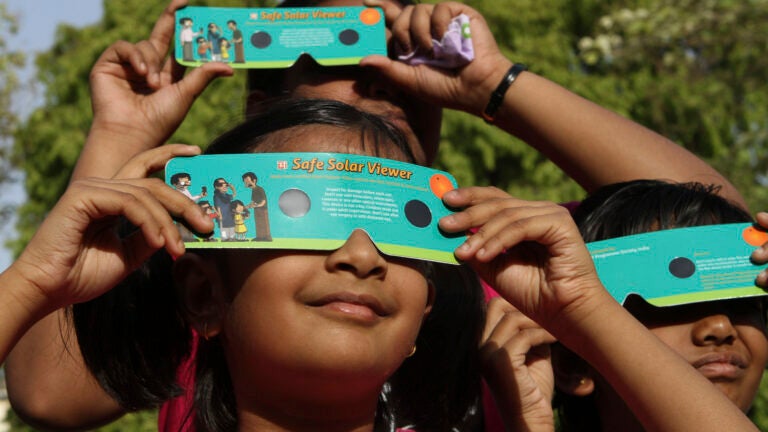
With a dull dome of gray clouds capping Massachusetts today, people who were hoping to have the rare experience of observing a transit of Venus will likely be thwarted. But some still may be able to see it, if they just go indoors — and watch the live feed.
“We have a weather system stalled and locked down on the whole New England coast, so we won’t be able to see it visibly,’’ said David Aguilar, director of science information at the Harvard-Smithsonian Center for Astrophysics in Cambridge. “Instead, we’re going to be webcasting it from Hawaii in real-time so people will be able to see it on the giant screen here in Phillips Auditorium.’’
If the clouds were to open, the rare astronomical passage would become visible just after 6 p.m. today. As Venus passes between Earth and the sun, its silhouette could be seen as a small dot slowly crossing the face of the sun. The last transit took place in 2004, but the next won’t happen for another 105 years – in 2117.
At Boston University, one official said they were still ready, if the sun decides to peek out of the clouds, with a plan to have astronomers assist people in viewing the phenomenon.
“We’re moving forward, rain or shine,’’ said John Clarke, director of BU’s center for space physics. “We have stations along Commonwealth Ave. so if it looks like we might get some sunshine, we will have people out there.’’
Clarke said the center will also offer a live feed of the transit from Hawaii in room 522 of the College of Arts and Sciences building at 685 Commonwealth Ave. The astronomy department will give four presentations on the history and importance of Venus transits. An “ask an astronomer’’ table will be set up there to field questions from guests, Clarke said.
Aguilar said researchers will be studying this transit closely because it could provide answers to other astronomical questions.
“There are a lot of researchers looking very closely at this event, especially to see if they can detect specific chemicals in the atmosphere of Venus as it crosses,’’ he said. “We’re all looking at the phenomenon to see how easily we can detect chemicals in the atmospheres of alien planets. If they have oxygen in abundance that means it was created by plant life.’’
Despite the overcast skies, Aguilar said the spectacle of the transit won’t be diminished.
“It is a shame we don’t get to see it here in New England,’’ he said. “But, we have access to the Internet so we can still share in it even though we may not be able to pierce the clouds in Boston.’’




To comment, please create a screen name in your profile
To comment, please verify your email address
Conversation
This discussion has ended. Please join elsewhere on Boston.com