
Less than year to election, presidential, Senate races moving from chaos to clarity
By this time next year, both the presidential and Massachusetts US Senate elections will be decided.
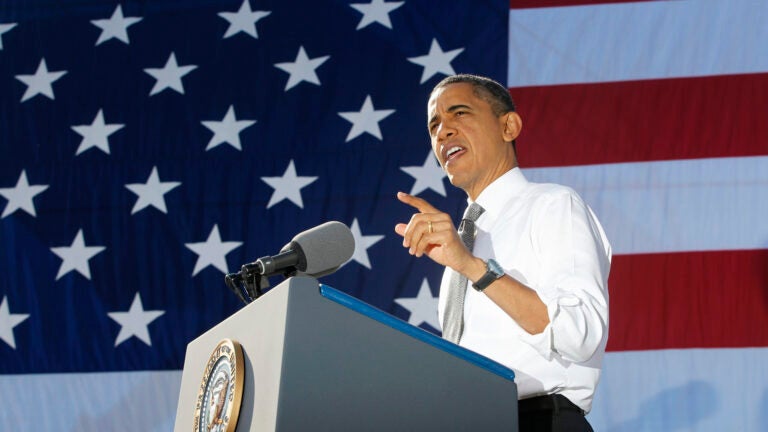
We will know if Barack Obama has won a second term or been the first president since George H. W. Bush to be bounced after just four years in office.
Voters will have decided if Scott Brown deserved a full six-year term in the Senate, or if the Democrats rebounded to reclaim the seat Brown and his Republican Party stunned them by winning in the 2010 special election to replace the late Senator Edward M. Kennedy.
In short, while Election Day won’t be until Nov. 6, 2012, the Iowa caucuses are in only 57 days, the New Hampshire primary in just 63.
It’s getting close to the time when even the most casual observer has to engage in political discourse.
While those holdouts have been focused elsewhere, both campaigns have effectively gone through a significant whittling process even before any voting, be it primaries or caucuses, whether at the state or federal levels.
The race for the Republican presidential nomination has been shaped by an unprecedented string of widely watched television debates. The Massachusetts Senate race has been streamlined by the emergence of Democratic challenger Elizabeth Warren.
Both have instilled clarity from some early campaign chaos.
In the presidential contest, there have been seven debates so far featuring virtually all the candidates, including five in a six-week span from Labor Day through mid-October.
The next is on Wednesday from Michigan, which will be televised by CNBC. And counting that one, there are at least seven debates scheduled between now and the first voting, the Iowa caucuses on Jan. 3.
Mitt Romney has emerged as the most consistent performer, generally being seen as the winner if not always the most spectacular performer in each debate.
Those same debates have proven extremely harmful to the candidacy of Texas Governor Rick Perry, who entered the race in early August as a potential conservative alternative to Romney but then showed the peril of a last-minute candidacy by stumbling in his earliest appearances.
Other candidates have had one or two noteworthy debates, with Michele Bachmann winning acclaim early and Herman Cain doing so more recently. But Bachmann’s candidacy has been eclipsed by Perry’s, while sexual harassment charges against Cain have shifted attention from the policy that propelled him to prominence: his “9-9-9’’ tax plan.
The next few debates should answer whether Perry can rebound and slug it out with Romney through the primary season, or if Romney will run away with the nomination.
Casual observers may not have noticed that the primary and caucus calendar has also firmed up in recent weeks. It will be far less compressed than in 2008.
The Iowa vote will be the first Tuesday after New Year’s, on Jan. 3, 2012, meaning the candidates will spend much of the holiday season in the Hawkeye State.
New Hampshire Secretary of State William Gardner announced last week that his state’s first-in-the-nation primary will occur a week later, on Jan. 10.
While Nevada officials talked about moving their own caucuses to Jan. 14, they reversed course and that voting will now happen in February.
Instead, the campaign will take the traditional turn south from New Hampshire, with the South Carolina primary set for Jan. 21. The Florida primary is next, on Jan. 31, followed by the Nevada caucuses on Feb. 4.
The so-called Super Tuesday vote won’t occur until March 6, when roughly a dozen states have contests. That is over a month later than the last “Super Tuesday’’ vote on Feb. 5, 2008.
In 2008, that proved to be the end of Romney’s campaign. Political analysts now say the later date could shape the 2012 race by stretching out the process to allow for a potential rival’s rise – or seal Romney’s nomination.
All signs suggest he will be among the very few candidates with the fund-raising or organizational breadth to last the two months between the Iowa caucuses and Super Tuesday contests.
In the Senate race, Warren’s own fund-raising and organizational strength had the effect of scaring long-time candidates out of the Democratic primary campaign.
Setti Warren, Bob Massie, and Alan Khazei all dropped out in quick succession after Warren raised $3 million during her first quarter as a candidate and won the support of an array of party institutions and pro-Democratic groups.
Warren still has four opponents – Tom Conroy, Marisa DeFranco, Herb Robinson, and Jim King – but both she and Brown are already focused purely on each other.
The remaining candidates could be officially eliminated from the race if they don’t win the support of at least 15 percent of the delegates to next spring’s Democratic State Convention.
The Senate primary isn’t until next September, but the race will be engaged well before then. In fact, it already is.
Two outside groups – the League of Women Voters and the League of Conservation Voters – have already begun television ad campaigns aimed at highlighting Brown’s Senate voting record and driving up the popular politician’s negative rating.
Brown hasn’t been lured into tapping his own $10 million campaign kitty to respond before his own Republican allies can target Warren, but the senator’s campaign committee released its own – and inexpensive – web video last week countering the most recent ad.
“Our ad will help set the record straight,’’ said Brown spokesman Colin Reed. “We’re confident Massachusetts voters will once again reject this business-as-usual mentality from the political machine.’’
One year out, the battle is joined, whether or not some voters are ready for it.



To comment, please create a screen name in your profile
To comment, please verify your email address
Conversation
This discussion has ended. Please join elsewhere on Boston.com